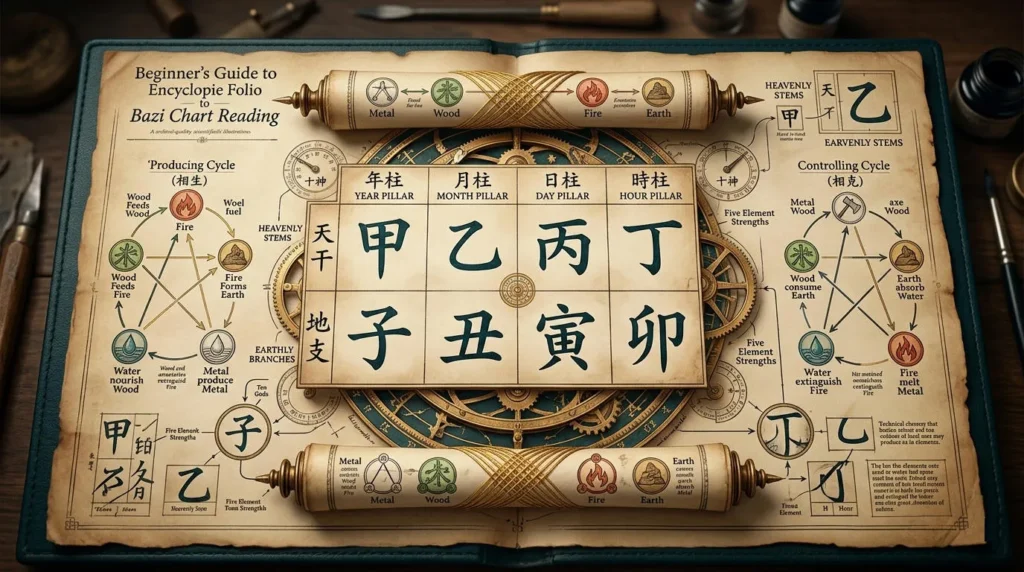
Beginner’s Guide to Bazi Chart Reading 1: Decode Your Day Pillar & Hour Pillar to Unlock Your True Self & Life Destiny
This is the first part of a beginner-friendly Bazi guide, focusing on two core points: decoding the Day Pillar and calculating the Hour Pillar. It breaks down the division of labor between the Day Stem and Day Branch, the logic of Shi Shen, and the skills of calculating the Hour Pillar, combined with cases, quick reference tables and pitfall avoidance guides, suitable for easy learning on mobile devices, helping beginners get started quickly and avoid mistakes in Bazi charting.
I. Introduction: Why Learn the Day Pillar and Hour Pillar First?
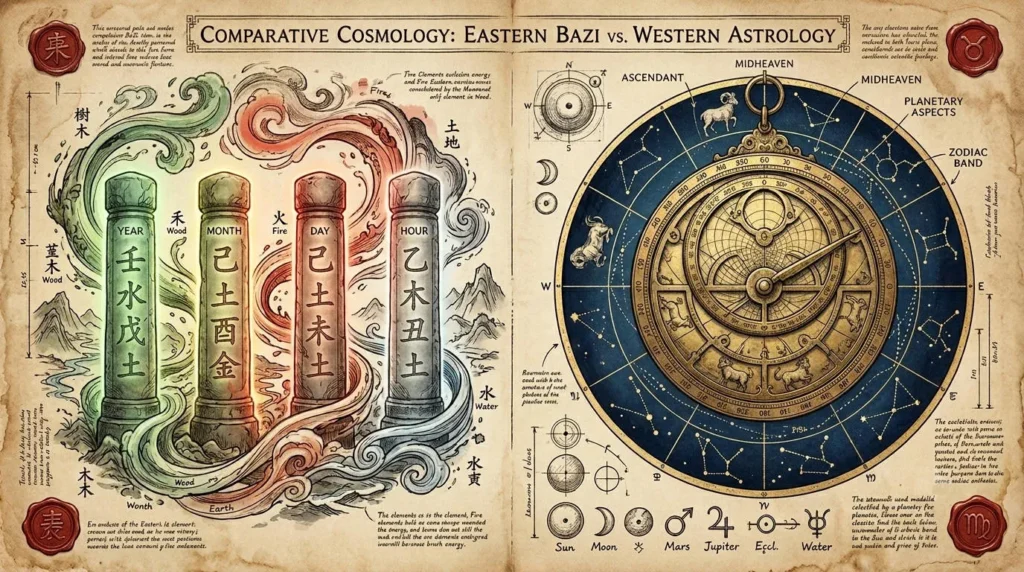
A Bazi chart consists of four groups of Heavenly Stems and Earthly Branches: Year Pillar, Month Pillar, Day Pillar, and Hour Pillar. The Day Pillar is related to your inner self and marital status, while the Hour Pillar indicates your later life and final direction. Both are the keys to getting started with zero foundation—you can directly query the Year Pillar and Month Pillar through a Lunar calendar, but decoding the Day Pillar and calculating the Hour Pillar require mastering core methods. Once the Hour Pillar is miscalculated, the entire Bazi chart will deviate.
Each group of Heavenly Stems and Earthly Branches corresponds to a life dimension, which is clear and easy to understand:
– Year Pillar: Influence of ancestors and original family
– Month Pillar: Youth fortune and personality framework
– Day Pillar: Core self and marital status (One of the cores)
– Hour Pillar: Later life and final direction (One of the cores)
The core value of reading Bazi is to recognize your own personality background and avoid life mistakes, not superstition.
Special Reminder (for overseas users): The core of Bazi charting is accurate time. Differences between overseas time zones and the East 8th Zone will lead to time deviations. We will explain the method of converting to True Solar Time later to help you avoid this pitfall.
II. Core Theory of Decoding the Day Pillar
1. Core Logic of Decoding the Day Pillar
1.1 Division of Labor Between the Day Stem and Day Branch
The Day Pillar is composed of “Day Stem + Day Branch”, with clear division of labor and mutual influence, which is the core of Bazi interpretation:
– Day Stem①: Represents the person themselves, and its Five Elements traits determine the inner personality
– Day Branch②: Represents the spouse, marital status and inner world, which is the key to interpreting feelings
Five Elements traits of the Day Stem (can be directly compared and self-tested with zero foundation):
1. Metal: Calm and rational, rigorous and principled, strong execution but not good at flexibility
2. Wood: Cheerful and aggressive, loyal and resilient, good at learning but occasionally impetuous
3. Water: Smart and sensitive, flexible in thinking, strong adaptability but overthinking
4. Fire: Warm and straightforward, optimistic and motivated, values feelings but is easily impulsive
5. Earth: Honest and pragmatic, steady and responsible, reliable but easily stubborn
1.2 The Relationship Between Day Stem Strength and Personality
Day Stem Strength③ will amplify/weaken the Five Elements traits of the Day Stem, which can be simply judged with zero foundation:
– Strong Day Stem: Distinctive and confident personality, motivated but stubborn, easy to ignore others’ opinions
– Weak Day Stem: Gentle and sensitive, good at compromising, occasionally passive and lacking in initiative
1.3 Combination Rule of the Day Pillar: Shi Shen on the Day Branch
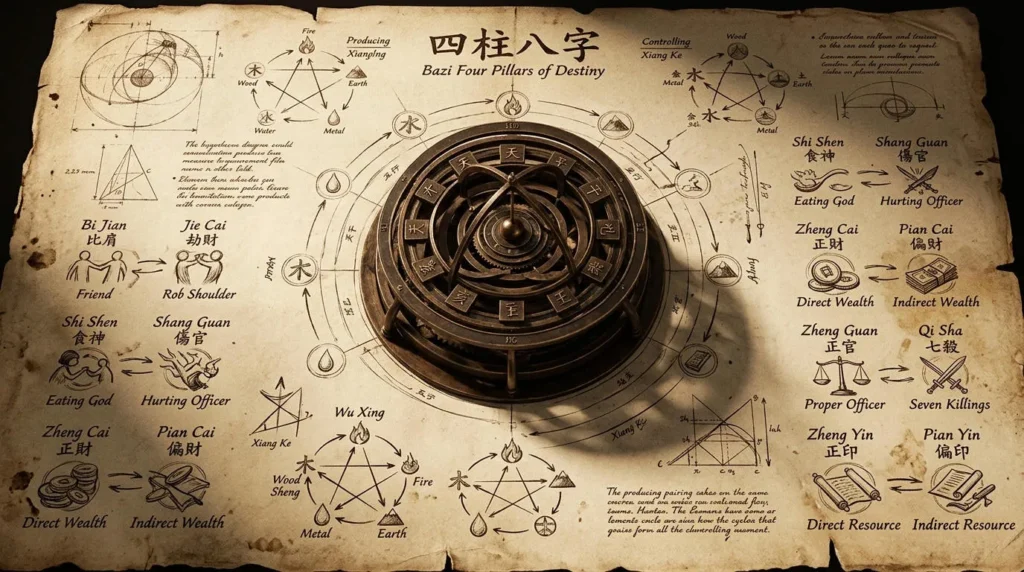
The core of Shi Shen ④ on the Day Branch is the generation and restraint relationship between the Day Stem and the Day Branch, which should focus on the Day Stem rather than just the Day Branch. As the classic Bazi book “Yuan Hai Zi Ping” says: “Shi Shen are the different names of the Five Elements, divided by yin and yang.” The specific rules are as follows:
– Sitting on Resource Star (Day Branch generates Day Stem): Steady and knowledgeable, values spirit, down-to-earth and not impetuous
– Sitting on Wealth Star (Day Stem restrains Day Branch): Pragmatic and values material things, good at financial management, and pays attention to practical dedication in feelings
– Sitting on Official/Killing Star (Day Branch restrains Day Stem): Self-disciplined and responsible, rational, suitable for rule-based work
– Sitting on Food/Injury Star (Day Stem generates Day Branch): Smart and talented, romantic and loves freedom, good at expression
– Sitting on Peer Star (Day Stem and Day Branch have the same Five Elements): Values loyalty, has many friends, and is prone to disputes in feelings
Supplementary Reminder: The same Day Branch can be different Shi Shen ④ due to different Day Stems (for example, Wu Fire: it is an Injury Star on Jia Wood Day, and an Official Star on Geng Metal Day), which beginners need to pay special attention to.
2. Interpretation of Day Pillar Cases
2.1 Xin Hai Day Pillar
Core: Day Stem Xin Metal, Day Branch Hai Water, sitting on Injury Star ⑤ + Wealth Star ⑥
Advantages: Smart and quick-witted, good at speaking, strong learning ability, suitable for the learning rhythm of beginners with zero foundation.
Disadvantages: Perfectionist, critical and harsh, easy to overthink.
Interpretation of Marriage Palace: High requirements for the spouse, prone to conflicts over details, it is recommended to learn to be tolerant.
2.2 Ji Wei Day Pillar
Core: Day Stem Ji Earth, Day Branch Wei Earth, sitting on Peer Star ⑦ + Indirect Resource ⑧ + Seven Killing Treasury ⑨
Advantages: Honest and pragmatic, hardworking, loyal and responsible, which is a down-to-earth trait that beginners can easily refer to.
Disadvantages: Stubborn in heart, likes to get into dead ends, introverted and lonely, not good at expressing emotions.
Interpretation of Marriage Palace: The spouse is pragmatic, prone to disputes due to different opinions, it is recommended to think more from the other’s perspective and learn to compromise.
III. How to Calculate the Hour Pillar—Unlock Your “Destiny” and “Later Life”
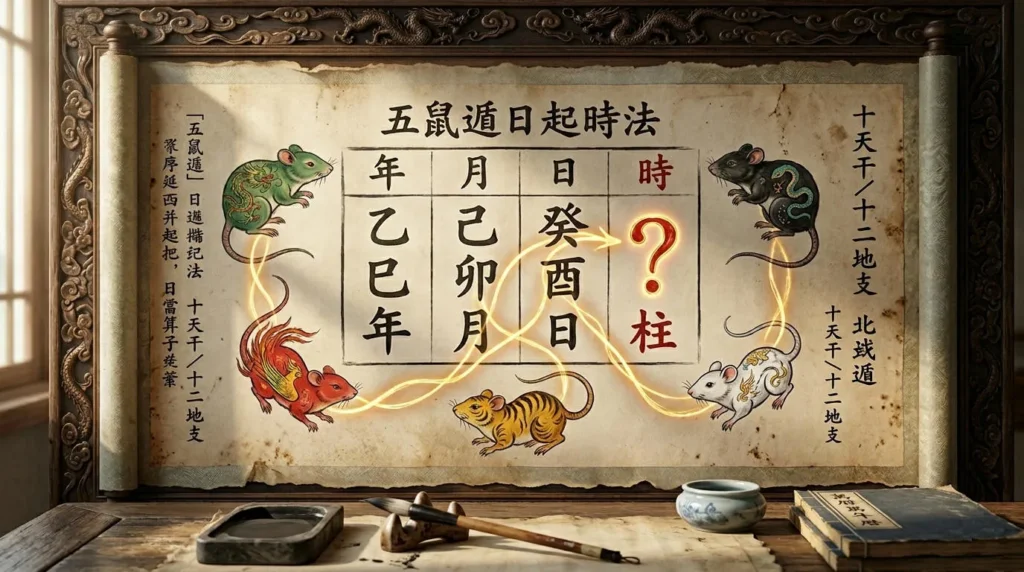
Core Pain Point: You can directly query the Year Pillar, Month Pillar and Day Pillar through a Lunar calendar, but there is no fixed way to query the Heavenly Stem of the Hour Pillar, which needs to be calculated through the “Five Rat Escape” rhyme. Once wrong, the entire Bazi chart will deviate.
1. Tool and Rhyme: Five Rat Escape – Method of Calculating Hour from Day Stem
Five Rat Escape is the core tool for calculating the Hour Pillar. It is essentially a rhyme for “calculating the Hour Stem based on the Day Stem”. There is no need to memorize all hour combinations by heart. Beginners can directly recite the rhyme and use it with the quick reference table.
1.1 Five Rat Escape Rhyme and Popular Interpretation
Complete Five Rat Escape rhyme:
Jia Jia dds Jia again, Yi Geng starts with Bing. Bing Xin begins with Wu, Ding Renstarts with GengZi. Wu Gui where to start? Ren Zi is the way!
(甲己还加甲,乙庚丙作初。丙辛从戊起,丁壬庚子居。戊癸何方发,壬子是真途。)
Core logic of the rhyme: Start calculating from Zi Shi (11 PM–1 AM) (Zi corresponds to the zodiac Rat, hence the name “Five Rat Escape”). Beginners can directly refer to the interpretation:
– If the Day Stem is Jia or Ji, the Hour Stem of Zi Shi is Jia, and the Hour Pillar corresponding to Zi Shi is “Jia Zi”;
– If the Day Stem is Yi or Geng, the Hour Stem of Zi Shi is Bing, and the Hour Pillar corresponding to Zi Shi is “Bing Zi”;
– If the Day Stem is Bing or Xin, the Hour Stem of Zi Shi is Wu, and the Hour Pillar corresponding to Zi Shi is “Wu Zi”;
– If the Day Stem is Ding or Ren, the Hour Stem of Zi Shi is Geng, and the Hour Pillar corresponding to Zi Shi is “Geng Zi”;
– If the Day Stem is Wu or Gui, the Hour Stem of Zi Shi is Ren, and the Hour Pillar corresponding to Zi Shi is “Ren Zi”.
1.2 Five Rat Escape Quick Reference Table and Usage Instructions
To facilitate quick query for beginners with zero foundation, we have sorted out the Five Rat Escape quick reference table (printable for later use). By comparing the Day Stem and hour, you can quickly find the corresponding Hour Pillar, suitable for mobile viewing:
|
Day Stem |
Zi Shi (23:00-01:00) |
Chou Shi (01:00-03:00) |
Yin Shi (03:00-05:00) |
Mao Shi (05:00-07:00) |
Chen Shi (07:00-09:00) |
Si Shi (09:00-11:00) |
Wu Shi (11:00-13:00) |
Wei Shi (13:00-15:00) |
Shen Shi (15:00-17:00) |
You Shi (17:00-19:00) |
Xu Shi (19:00-21:00) |
Hai Shi (21:00-23:00) |
|
Jia/Ji |
Jia Zi |
Yi Chou |
Bing Yin |
Ding Mao |
Wu Chen |
Ji Si |
Geng Wu |
Xin Wei |
Ren Shen |
Gui You |
Jia Xu |
Yi Hai |
|
Yi/Geng |
Bing Zi |
Ding Chou |
Wu Yin |
Ji Mao |
Geng Chen |
Xin Si |
Ren Wu |
Gui Wei |
Jia Shen |
Yi You |
Bing Xu |
Ding Hai |
|
Bing/Xin |
Wu Zi |
Ji Chou |
Geng Yin |
Xin Mao |
Ren Chen |
Gui Si |
Jia Wu |
Yi Wei |
Bing Shen |
Ding You |
Wu Xu |
Ji Hai |
|
Ding/Ren |
Geng Zi |
Xin Chou |
Ren Yin |
Gui Mao |
Jia Chen |
Yi Si |
Bing Wu |
Ding Wei |
Wu Shen |
Ji You |
Geng Xu |
Xin Hai |
|
Wu/Gui |
Ren Zi |
Gui Chou |
Jia Yin |
Yi Mao |
Bing Chen |
Ding Si |
Wu Wu |
Ji Wei |
Geng Shen |
Xin You |
Ren Xu |
Gui Hai |
Note: When browsing on mobile devices, the table can be slid horizontally to view the complete content, which is suitable for mobile phone screens.
Usage Instructions: ① Determine your own Day Stem; ② Find the row corresponding to your Day Stem in the table; ③ Find the column corresponding to the hour horizontally, and the intersection is the Hour Pillar of that hour; ④ For the remaining hours (Wu Shi-Hai Shi), deduce according to the rule of “Heavenly Stems pushed forward in order, Earthly Branches fixed”. For example, after Si Shi comes Wu Shi, the Heavenly Stem is pushed forward one step according to the Heavenly Stem of Si Shi, and the Earthly Branch is fixed as Wu.
1.3 Practical Demo (Take Day Stem “Xin” as an Example)
Assuming the known Day Stem is “Xin” and you want to calculate the Hour Pillar of “Chen Shi” (07:00-09:00), the steps are as follows:
Step 1: Find the starting point of Zi Shi – the Day Stem is Xin, corresponding to the rhyme “Bing Xin begins with Wu”, so the Hour Stem of Zi Shi is Wu, and the Hour Pillar corresponding to Zi Shi is “Wu Zi”;
Step 2: Push forward to Chen Shi – Zi Shi (Wu Zi) → Chou Shi (Ji Chou) → Yin Shi (Geng Yin) → Mao Shi (Xin Mao) → Chen Shi (Ren Chen);
Final Result: Day Stem Xin, Chen Shi, the Hour Pillar is “Ren Chen”. (You can directly refer to the table above, the row corresponding to Day Stem Xin and the column corresponding to Chen Shi intersect at “Ren Chen”, which can quickly verify the result)
2. Pitfall Avoidance Guide
The core of calculating the Hour Pillar is “accuracy”. The following two pitfalls are the most common mistakes for beginners, so be sure to keep them in mind:
2.1 The Difference Between Early Zi Shi and Late Zi Shi (23:00-00:00 vs. 00:00-01:00)
Zi Shi is divided into “Late Zi Shi” (23:00-00:00) and “Early Zi Shi” (00:00-01:00), and their Heavenly Stems and Earthly Branches are very different:
– Late Zi Shi (23:00-00:00): Belongs to the previous day, the Day Pillar is calculated according to the previous day, and the Hour Pillar is calculated according to the Day Stem of the previous day;
– Early Zi Shi (00:00-01:00): Belongs to the next day, the Day Pillar is calculated according to the next day, and the Hour Pillar is calculated according to the Day Stem of the next day.
Example: Born at 23:30 (Late Zi Shi), the Day Pillar is calculated according to the same day; born at 00:30 (Early Zi Shi), the Day Pillar is calculated according to the next day, and the calculation results of their Hour Pillars are completely different.
2.2 Exclusive for Overseas Users: Conversion Logic Between True Solar Time and Beijing Time (East 8th Zone)
Bazi charting uses “True Solar Time” (local time calculated based on the actual position of the sun), not local time zone time or Beijing Time:
– Core Logic: Beijing Time is the standard time of the East 8th Zone. For different overseas time zones, you need to first convert to Beijing Time, then adjust to True Solar Time according to the local longitude (every 15° difference in longitude, the time difference is 1 hour, add time for east, subtract time for west);
– Simplified Method: No manual calculation is needed. Enter your birth area and birth time in the “Bazi Charting” on this site, which can automatically convert to True Solar Time to avoid time deviations.
Glossary
① Lord of Destiny: That is the Day Stem, representing the person themselves, the core of Bazi interpretation, determining the inner personality and essential traits.
② Marriage Palace: That is the Day Branch, representing the spouse, marital status and inner world. Its generation and restraint relationship with the Day Stem affects the emotional model.
③ Day Stem Strength: Refers to the energy intensity of the Day Stem, which directly affects the distinctness of the personality and is an important prerequisite for interpreting the Day Pillar.
④ Shi Shen: Ten symbols divided based on the generation and restraint relationship of the Five Elements, used to interpret the interaction between the Heavenly Stems and Earthly Branches of Bazi, reflecting the characteristics of various life dimensions.
⑤ Injury Star: One of the Shi Shen, representing wisdom, expression ability and criticality. Moderate means outstanding talent, while excessive means easy overthinking.
⑥ Wealth Star: One of the Shi Shen, representing material things, financial management ability and practical dedication in feelings, focusing on pragmatism and reality.
⑦ Peer Star: One of the Shi Shen, having the same Five Elements as the Day Stem, representing friends and competition, focusing on loyalty and being prone to disputes.
⑧ Indirect Resource: One of the Shi Shen, representing introversion, wisdom and loneliness, focusing on careful thinking but poor ability to express emotions.
⑨ Seven Killing: One of the Shi Shen, representing pressure, restraint and a sense of responsibility, focusing on self-discipline and rationality but prone to psychological pressure.
⑩ Hour Pillar: One of the four Bazi pillars, composed of the Hour Stem and Hour Branch, representing later life and final direction. The core of its calculation is the Five Rat Escape rhyme.
⑪ Five Rat Escape: Also known as “Method of Calculating Hour from Day Stem”, it is the core tool for calculating the Hour Pillar. It infers the Hour Stem through the Day Stem, and beginners can quickly master it with the help of rhymes and quick reference tables.
⑫ True Solar Time: The standard time for Bazi charting, calculated based on the actual position of the sun, different from Beijing Time (East 8th Zone Standard Time), which needs to be converted for overseas users before use.
⑬ Early Zi Shi/Late Zi Shi: The subdivision of Zi Shi in traditional numerology. Late Zi Shi (23:00-00:00) belongs to the previous day, and Early Zi Shi (00:00-01:00) belongs to the next day, which directly affects the calculation of the Day Pillar and Hour Pillar.
Can the Day Pillar really determine the marital status?
The Day Pillar is the core of marriage interpretation (the Day Branch is the Marriage Palace), but it is not the only basis. It needs to be comprehensively judged in combination with the Month Pillar, Hour Pillar and Shi Shen combination to avoid deviations in single interpretation.
How can beginners quickly judge their own Day Stem Strength?
Beginners can simply refer to this: if the Five Elements of the Day Stem have more generation relationships with the Five Elements of the Earthly Branches of the Year, Month and Hour Pillars, it is relatively strong; if there are more restraint relationships, it is relatively weak. A more accurate judgment method will be explained later.
Do people with the same Day Pillar necessarily have the same personality and marriage?
No. The Day Pillar is the core, but the combination of the Year Pillar, Month Pillar, Hour Pillar and the difference in Day Stem Strength will lead to obvious differences in personality and marriage, which need to be interpreted in combination with the complete Bazi chart.
Do overseas users have to convert to True Solar Time when making a Bazi chart?
Yes. Bazi charting is based on True Solar Time. Overseas users need to first convert their local time to Beijing Time, then adjust to True Solar Time, or use a Bazi charting APP for automatic conversion.
What if I can’t remember the Five Rat Escape rhyme?
There is no need to memorize it by heart. You can refer to the Five Rat Escape Quick Reference Table in this article to directly query the corresponding Hour Pillar according to the Day Stem and hour, and it is more convenient to print it for later use; practice more with practical cases, and you can naturally remember the rhyme logic when you are proficient.
How to quickly distinguish between Late Zi Shi and Early Zi Shi in actual operation?
The core is to look at the birth time: 23:00-00:00 is Late Zi Shi, and the Day Pillar is calculated according to the same day; 00:00-01:00 is Early Zi Shi, and the Day Pillar is calculated according to the next day. Determine the Day Pillar first before calculating the Hour Pillar.