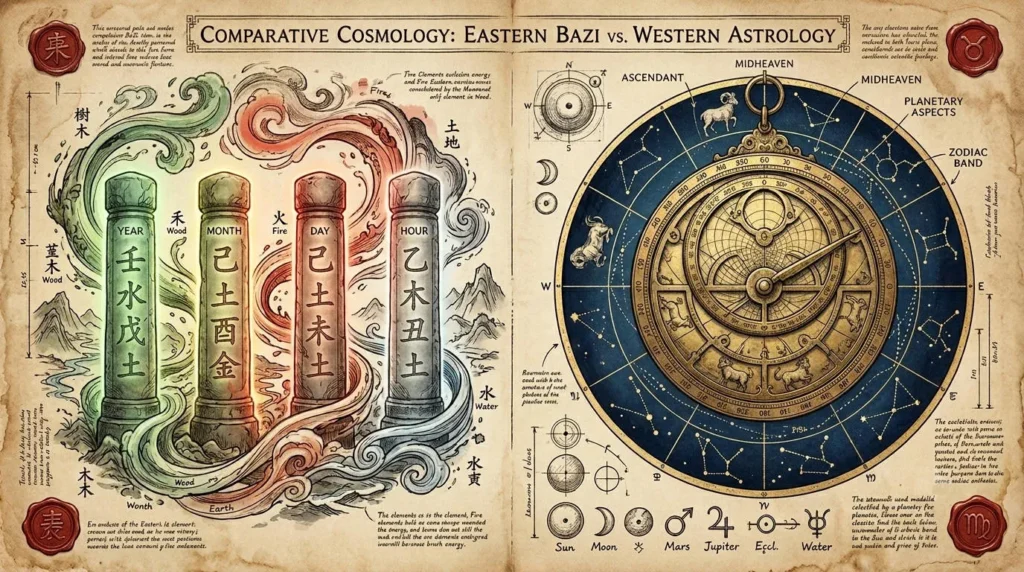
1. BaZi vs Western Astrology
BaZi and Western Astrology are two mainstream ancient systems for analyzing personality and life fortune trajectories. However, their core theories, application logics and practical values are fundamentally different!
Western Astrology has become a lightweight social entertainment tool popular among global young people. In contrast, BaZi (Four Pillars of Destiny), the traditional Eastern fortune-telling system rooted in ancient Chinese cosmology, is often unfairly misunderstood and labeled as superstitious.
The two systems derive from completely different Eastern and Western civilizations and philosophical systems, with no overlapping core operational logic. This article elaborates on their differences from six core dimensions, helping users clarify cognitive misunderstandings and grasp the unique application value of BaZi and Western Astrology.
2. Public Perception Gap: Opposite Social Reputations
Western Astrology enjoys extremely high public acceptance and recognition worldwide. Discussing zodiac personality traits, strengths and weaknesses has become a casual and trendy daily social ritual, with almost no public doubt.
On the contrary, traditional BaZi is often stereotyped as obscure, mysterious and unscientific. Most people hold biased views and fail to evaluate this traditional metaphysical system objectively.
In essence, both BaZi and Western Astrology originate from ancient human cognitive wisdom. Their original core purposes are consistent: self-discovery and life trend prediction.
The huge reputation gap between the two has nothing to do with theoretical accuracy. It stems from their distinct worldviews, operational logics and real-life application scenarios.
3. Core Structure: Static Zodiac Personality vs Dynamic BaZi Destiny
3.1 Western Astrology: Static Star-Based Personality Classification
Western Astrology originated from ancient Babylonian astronomical observations. It divides the zodiac orbital plane into 12 equal areas, forming the 12 zodiac signs widely used in modern society.
Daily public zodiac discussions only focus on Sun Sign, which corresponds to the sun’s ecliptic position at the time of birth. It is the simplest but shallowest standard for personality judgment.
Professional Western Astrology includes systematic dimensions such as Moon Sign, Rising Sign, planetary placement, astrological houses and aspect relationships. However, ordinary users only rely on Sun Sign analysis. In short, mainstream public astrology is a static personality label fixed at birth, without dynamic change rules.
3.2 BaZi: Precise Time-Encoded Destiny System
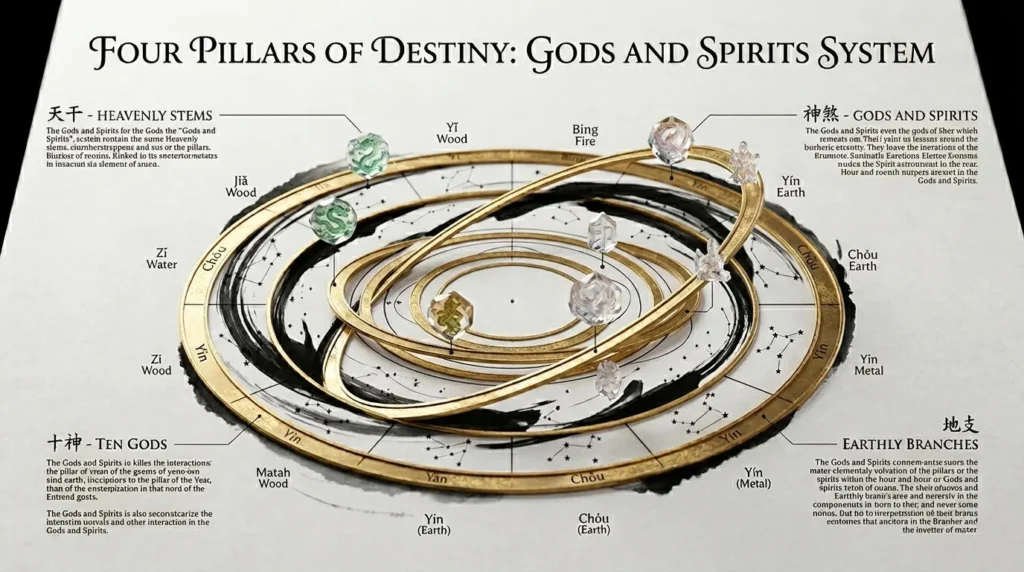
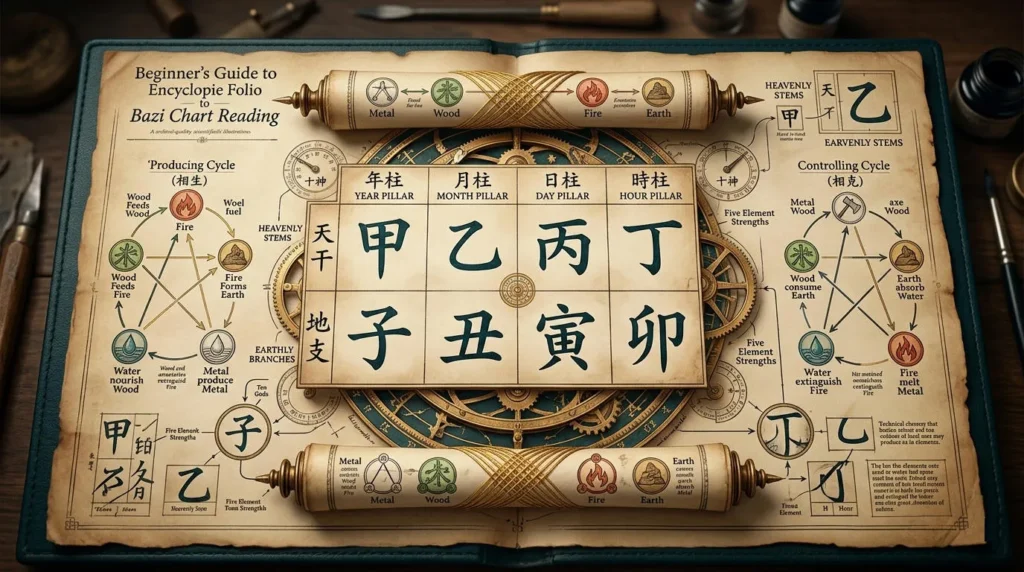
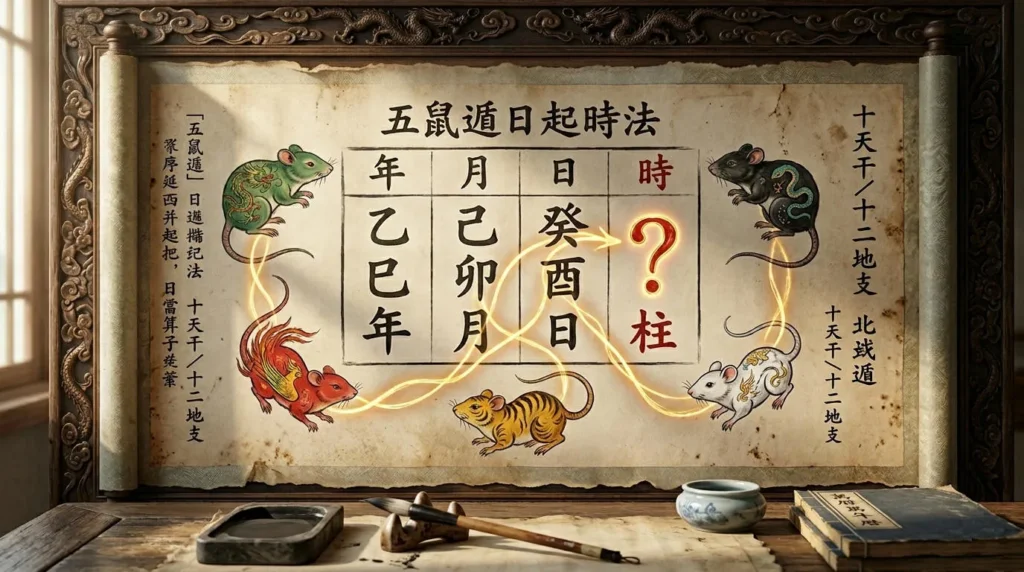
BaZi (Four Pillars of Destiny) is the core carrier of traditional Chinese metaphysics. It converts the exact year, month, day and hour of birth into four groups of Heavenly Stems and Earthly Branches, totaling eight characters — hence the name “BaZi”.
Based on the ancient 60 Jiazi cyclic calendar system, BaZi records the operation laws of cosmic natural energy. It is equipped with unique Great Fortune (Da Yun) andAnnual Fortune (Liu Nian) dynamic deduction mechanisms, which can accurately track life fortune fluctuations at different stages.
The balance state of cosmic energy at the moment of birth forms a person’s innate destiny blueprint, determining inherent talents, personality tendencies and life development foundations.
There is a huge accuracy gap between the two systems! The Sun Sign system divides all humans in the world into only 12 personality templates, which is overly generalized and lacks individual pertinence.
In contrast, BaZi has more than one million unique chart combinations, which can accurately distinguish individual personality characteristics, inherent strengths and weaknesses, and life development trajectories. It is worth noting that the conventional zodiac traits summarized by Western Astrology only correspond to a single branch dimension in the complete BaZi system.
4. Philosophical Roots: Western Idealism vs Eastern Qi Monism
4.1 Western Astrology: Spiritual Idealism System
The theoretical foundation of Western Astrology is Platonic idealism, which holds that the spiritual world dominates and guides the material world.
The 12 zodiac signs are not merely abstract star symbols; they represent 12 complete and mature spiritual personality prototypes.
A personal natal chart is an exclusive spiritual energy map. Different planets carry different spiritual energy frequencies, and form energy superposition and restriction relationships through astrological aspects and house placements.
The birth chart completely records an individual’s subconscious desires, hidden talents and inner spiritual pursuits. Therefore, Western Astrology always focuses on spiritual needs and inner ideals, answering core questions about the soul and inner cognition.
4.2 Eastern BaZi: Realistic Energy Balance System
BaZi is based on the traditional Eastern cosmological view of Qi Monism. It believes that Qi is the origin of all things in the universe, and all life ups and downs, blessings and misfortunes come from the movement and transformation of cosmic Qi energy.
The Five Elements (Metal, Wood, Water, Fire, Earth) in BaZi represent five basic operating forms of cosmic energy, corresponding to the whole cycle of object growth, prosperity, stability, convergence and dormancy.
A BaZi chart is a personal exclusive energy balance system. It judges life development status by analyzing the strength of the Five Elements, energy circulation and pattern checks and balances. It focuses on individual real-life bearing capacity and objective endowments, rather than spiritual ideals, accurately defining the upper limit of real-life development.
There is a classic and vivid metaphor in metaphysics: your Western Astrology natal chart is your ideal life script, while your BaZi chart is your real-life development carrier and tangible foundation.
Many people have outstanding talents and ambitious career ideals displayed in their astrological charts. However, if their BaZi chart has unbalanced Five Elements and weak energy, they will easily fall into the dilemma of “ambition without fulfillment”, accompanied by missed opportunities, internal friction and difficulty in landing plans.
To sum up simply: Western Astrology sees your spiritual potential and ideal upper limit, while BaZi sees your real-life endowment and practical bearing capacity. Only by combining the two can we form a complete and objective self-cognition.
5. Interpretation Logic: Professional Deduction vs Standardized Reading
5.1 BaZi: Multi-Dimensional Logical Deduction
BaZi interpretation is a rigorous multi-dimensional logical deduction process, which is completely different from the simple template comparison of Western Astrology.
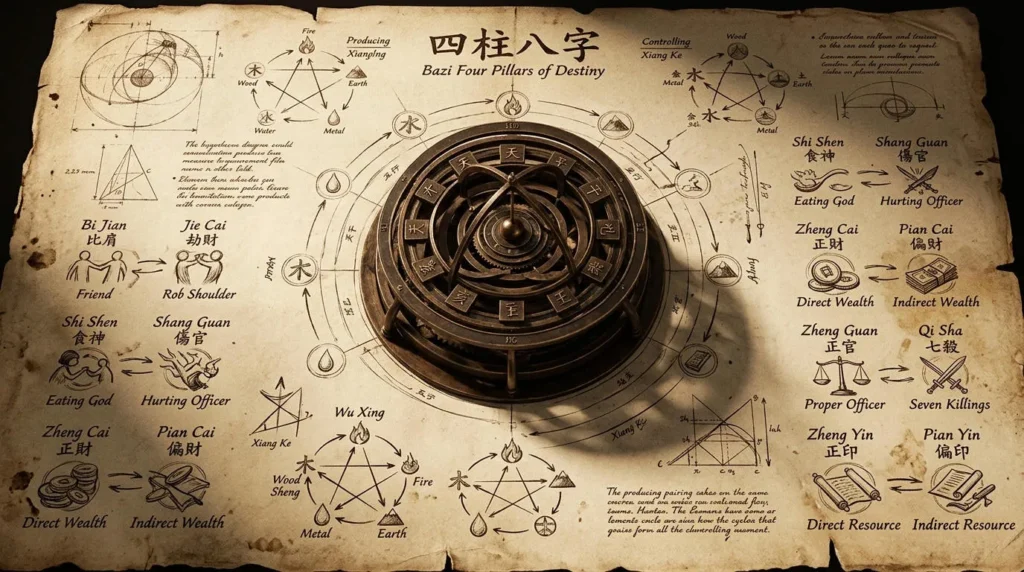
Based on eight core characters, BaZi analysis needs to integrate dozens of professional rules, including Five Elements generation and restraint, Branch Interactions (Xing Chong He Hai), Ten Gods (Shi Shen) configuration, Great Fortune and Annual Fortune changes, to form comprehensive and accurate judgment results.
BaZi has the characteristic of “easy to learn but hard to master”. Slight deviations in analysis will lead to completely wrong conclusions. It requires years of practical case accumulation, so ordinary users cannot complete accurate BaZi interpretation by themselves.
5.2 Western Astrology: Standardized Chart Translation
Western Astrology has a highly standardized theoretical system with low entry barriers. Users can generate a complete personal natal chart only with accurate birth time and location.
Modern Western Astrology has unified and mature interpretation standards for planetary placement, aspect combinations and house definitions, with extremely low subjective deviation. Even beginners can obtain effective personality reference information.
In short, Western Astrology is suitable for rapid self-cognition and emotional healing through personality trait analysis; BaZi focuses on tracing the root of problems, judging high-risk cycles and providing practical life solutions. Astrology serves inner exploration, while BaZi serves accurate real-life decision-making.
6. Practical Application: Life Value & Functional Differences
6.1 Value Orientation: Worldly Achievement vs Inner Healing
BaZi is a purely practical worldly decision-making tool, focusing on core life dimensions such as career development, wealth fortune, marriage, children and physical health. It judges real-life success or failure and accurately defines the level of personal life development.
However, BaZi does not focus on individual emotional experience and spiritual happiness. It only targets objective life results and answers the core practical question: What real-life achievements can a person ultimately attain?
Modern Western Astrology has evolved into a professional inner healing and self-exploration tool. It deeply explores individual subconsciousness, personality flaws, inner obsessions and true spiritual demands, without judging worldly success or failure.
It excels at alleviating anxiety, improving inner defects and helping people accept themselves. It solves spiritual confusion and answers the core soul question: Who am I, and what do I truly pursue?
6.2 Time Logic & Social Function: Dynamic Fortune vs Casual Social Label
The core difference between BaZi and Western Astrology lies in time operation logic. Popular zodiac Sun Signs are static personality labels that remain unchanged throughout life, with no stage-based fortune prediction function.
BaZi has a unique dual structure of “innate destiny + acquired fortune”. The fixed natal chart represents innate endowments, while the ten-year Great Fortune and yearly Annual Fortune dynamically track life changes, accurately predicting opportunities, risks and development trends in different life stages.
Relying on the core judgment standard of Favored & Avoided Elements (Xi Ji), BaZi provides targeted and practical guidance for career planning, entrepreneurial transformation and risk avoidance, which is far more valuable than ordinary zodiac interpretation.
In terms of social functions, Western Astrology is a lightweight entertainment tool, widely used for daily chatting and social ice-breaking among young people.
BaZi is a high-threshold professional life decision-making tool, never used for casual entertainment. It only provides professional reference for major life choices including marriage, entrepreneurship, career switching and investment. The public stereotype that “zodiac is entertainment while BaZi is superstitious” is a typical cognitive bias.
7. Conclusion: Complementary Value of BaZi vs Western Astrology
After comparing the six core dimensions, it is clear that BaZi and Western Astrology have no absolute advantages or disadvantages. As two unique self-cognition systems derived from Eastern and Western civilizations, they have their own independent application scenarios and core values.
Western Astrology is rooted in Western star philosophy, focusing on individual inner spiritual growth, self-awareness and emotional healing.
Eastern BaZi is based on the natural time and energy operation laws of the universe, focusing on real-life development trends and rational major life decision-making.
The most comprehensive self-exploration and life planning is to combine the two systems. Use Western Astrology to understand inner talents and spiritual pursuits; use BaZi to clarify real-life development boundaries, grasp future opportunities and avoid potential risks. The complementary application of the two can help people realize thorough self-cognition and scientific life layout.
8. Glossary
Four Pillars of Destiny (BaZi): The core system of traditional Eastern metaphysics. It takes personal birth year, month, day and hour as four energy pillars, matched with traditional Heavenly Stems and Earthly Branches, to analyze innate life patterns and long-term fortune trends.
Heavenly Stems & Earthly Branches: Ancient Chinese chronological and symbolic recording system. The combination of 10 Heavenly Stems and 12 Earthly Branches forms the 60 Jiazi cycle, which records periodic changes of cosmic energy and natural time.
Great Fortune (Da Yun): Ten-year cyclic energy trend in BaZi theory. Each cycle governs the overall life state, long-term development opportunities and potential challenges of an individual.
Annual Fortune (Liu Nian): Yearly cosmic energy fluctuations, used to judge specific opportunities, risks, gains and losses in each calendar year.
Five Elements: Five basic energy forms (Metal, Wood, Water, Fire, Earth) that constitute all cosmic substances and changes, serving as the core judgment basis for BaZi chart balance and fortune quality.
Branch Interactions (Xing Chong He Hai): Four core interactive relationships between Earthly Branches, an important basis for judging specific life events, interpersonal relationships and fortune fluctuations in BaZi analysis.
Ten Gods (Shi Shen): Ten professional metaphysical symbols derived from the Five Elements restrictive and generative relationships between the day master and other chart pillars, used to interpret personality, career, wealth, marriage and other detailed life information.
Favored & Avoided Elements (Xi Ji): The core judgment criterion of BaZi pattern analysis. Favored Elements bring positive energy and good luck, while Avoided Elements cause obstacles and setbacks, guiding scientific life adjustment and trend prediction.
Which is more accurate, BaZi or Western astrology?
There is no absolute accuracy ranking for the two systems. They have completely different functional positioning. Western Astrology excels at analyzing personality traits, inner desires and subconscious flaws, suitable for self-awareness and emotional healing. BaZi focuses on predicting real-life trends in career, wealth, marriage and health, providing reliable professional reference for major life decisions.
Why do people with the same zodiac sign have totally different lives?
Daily zodiac readings only adopt Sun Sign analysis, a rough statistical classification that only reflects superficial personality tendencies. Personal life achievements are jointly shaped by innate destiny, acquired environment and personal choices. A single zodiac label cannot define a complete life.
Does BaZi represent fixed fate?
Absolutely not! BaZi only predicts innate talents, personality weaknesses and potential fortune trends, not unchangeable fixed fate. Similar to weather forecasting, it predicts trend changes rather than controlling human choices. Personal efforts, mindset and behaviors can always adjust and change life trajectories.
Can I use BaZi and astrology together for self-exploration?
Yes, the combined use achieves the best self-exploration effect. Use Western Astrology to explore personal talents, preferences and inner confusions to clarify spiritual pursuits. Use BaZi to confirm real-life capabilities, fortune cycles and optimal action timing. The dual-system complement helps users understand themselves comprehensively and plan life rationally.
Why is BaZi more reliable for major life decisions?
Ordinary zodiac signs are static personality labels without time-based dynamic fortune guidance, only suitable for casual daily self-understanding. BaZi adopts a unique “fixed destiny + dynamic fortune” system, which accurately predicts staged life opportunities and risks. It provides targeted professional guidance for entrepreneurship, marriage, career transition and investment, with far higher practical value for critical life choices.