Most people completely misunderstand Shangguan (Hurting Officer) and Qisha (Seven Killings) in BaZi astrology. They do not symbolize bad luck or negative energy. Instead, they are two powerful personality forces that help ordinary people break self-limits and achieve breakthrough personal growth.
This practical guide combines Western psychology, classic movie archetypes, and real cross-cultural workplace cases. It simplifies the two core BaZi patterns with actionable skills and daily life tips. You will clearly understand your unique innate talents, fix hidden personality flaws, and achieve steady progress in both career and personal life.
1. Break Cognitive Bias: Rebellious Personality Traits in Eastern & Western Perspectives
Here is a universal truth. True geniuses and outstanding leaders always carry a rebellious streak. Some change the world by breaking outdated rules. Others win success through bold competition and decisive control.
Famous Western icons perfectly represent these two high-end BaZi personalities. Steve Jobs embodied innovative disruption. Napoleon embodied dominant control. Andy from The Shawshank Redemption embodied systemic breakthrough. All of them showcase the core traits of Shangguan and Qisha energy.
Zodiac signs and MBTI only scratch the surface of human personality. However, Shangguan and Qisha in BaZi astrology reveal your core talents, stress coping mechanisms, and inherent behavioral logic. Shangguan drives innovation and boundary-breaking. Qisha fuels competitiveness and stress resilience. These two underrated energies are the key to personal advancement and self-transformation.
No complex jargon, no fatalistic superstition. This article translates traditional Eastern BaZi logic into accessible Western thinking. Anyone can learn to leverage Shangguan’s creative power and Qisha’s resilience to thrive in modern workplaces and cross-cultural life scenarios.
2. Core Definition: The True Essence of Shangguan & Qisha
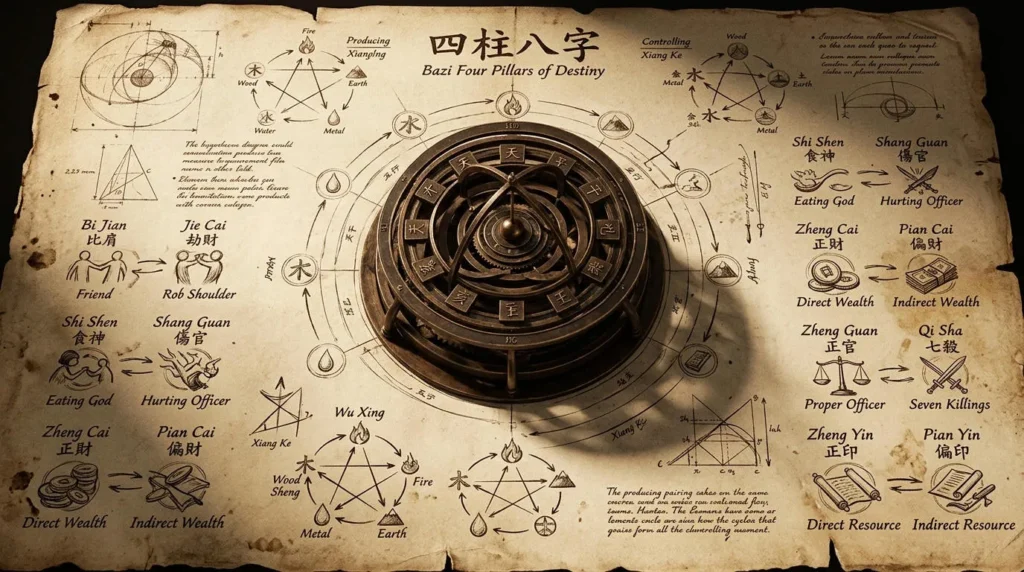
In the BaZi Ten Gods system, Shangguan and Qisha are defined as tension-driven growth energies. They empower people to rise against adversity. Yet they may trigger self-doubt and internal friction if left uncontrolled. Based on the classic ancient Chinese astrology textSan Ming Tong Hui, we simplify their core logic to build a solid foundation for personality cognition and practical application.
2.1 Core Generating & Restraining Rules
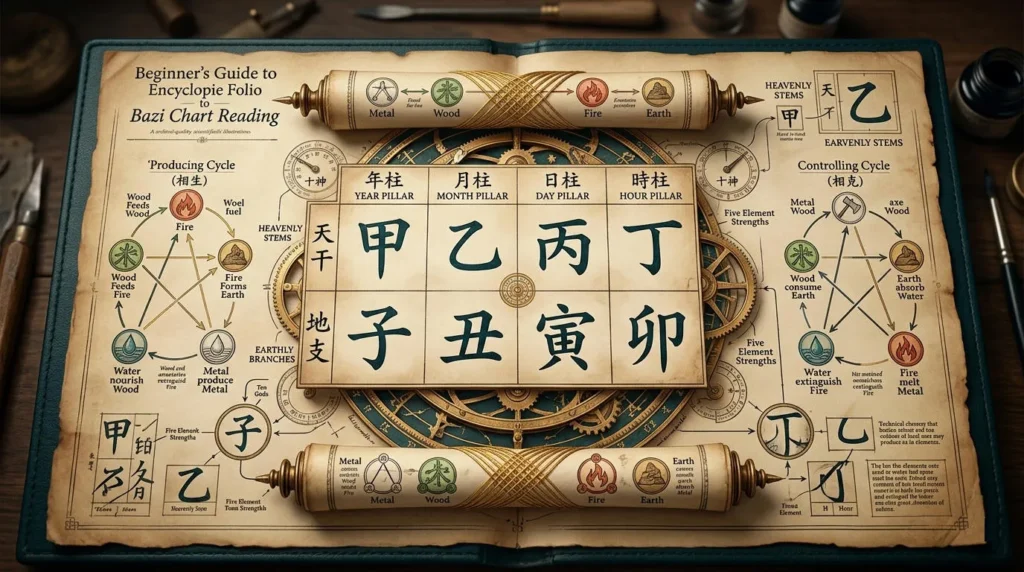
Let’s start with the foundational BaZi concept: Day Master. The Day Master is the core of your BaZi chart. It represents your true self and core personality. All life patterns, fortune shifts, and energy interactions revolve around this core.
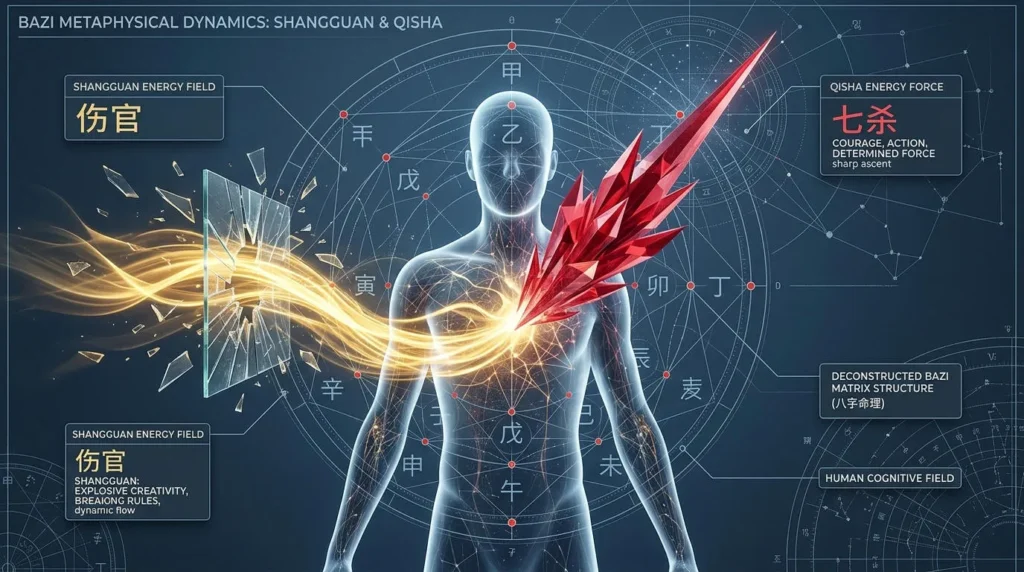
Shangguan (Hurting Officer): An opposite polarity energy generated by your Day Master.
Simply put, Shangguan refers to your innate talents, creative thinking, independent ideas, and personal expression. It is your inner sharp edge. People with strong Shangguan energy refuse blind obedience and rigid rules, making them natural innovators and rule-breakers.
Qisha (Seven Killings): A same polarity energy that restrains your Day Master.
Qisha represents external pressure, market competition, life challenges, and authority constraints. It pushes individuals to grow stronger under pressure. People with prominent Qisha energy are highly competitive, extremely stress-resistant, and blessed with strong execution and leadership potential.
2.2 Dual Traits: Strengths & Flaws of the Two Patterns
Key takeaway: Shangguan and Qisha have no absolute good or evil nature. Balanced energy delivers top-tier personal talents and advantages. Excessive, uncontrolled energy leads to obvious personality shortcomings. Check their dual traits clearly below.
Shangguan Pattern Traits
Strengths: Incisive thinking, outstanding natural talent, strong creativity, critical thinking ability, courage to break old limitations
Weaknesses: Arrogant mindset, sharp-tongued communication, idealistic thinking, prone to overthinking and mental burnout, weak execution ability
Qisha Pattern Traits
Strengths: Strong willpower, decisive judgment, extreme stress resistance, goal-oriented mindset, bold and adventurous, thrives in adversity
Weaknesses: Aggressive temperament, excessive desire for control, irritable mood, tense interpersonal relationships, stubborn and inflexible thinking
2.3 Trait Distinction Between Similar Ten Gods
Many BaZi beginners confuse Shangguan with Shi Shen (Eating God), and Qisha with Zheng Guan (Direct Officer). These four energies are vastly different. Master the distinctions to avoid pattern misjudgment.
Zheng Guan (Direct Officer) vs Qisha (Seven Killings)
Zheng Guan: Gentle, rule-abiding, respectful of social order, a traditional rule protector
Qisha: Dominant, competitive, rule-breaking, a bold innovator of existing order
Shi Shen (Eating God) vs Shangguan (Hurting Officer)
Shi Shen: Mild, low-key, easy-going, steady and gentle self-expression
Shangguan: Sharp, innovative, rebellious, radical and groundbreaking self-expression
3. Personality Mapping: Interpret Shangguan & Qisha With Western Systems
We simplify abstract traditional BaZi concepts for modern readers. By combining MBTI, Enneagram, Greek mythology archetypes, and classic movie characters, we turn intangible Shangguan creativity and Qisha competitiveness into vivid, relatable personality traits. No prior astrology knowledge required.
3.1 Shangguan Personality & Archetype
Core essence of Shangguan: Never blindly worship authority, only trust core logic. Individuals with strong Shangguan deconstruct outdated rules through creativity and critical thinking. They act as born innovators, critics, and game-changers.
Western Personality Match: MBTI ENTP/INTP, Enneagram Type 4 & Type 7. They excel at reverse thinking, problem analysis, and creating unique personal perspectives.
Classic Archetypes & Characters: Prometheus (Greek Mythology), Tony Stark (Iron Man), Andy (The Shawshank Redemption)
3.2 Qisha Personality & Archetype
Core essence of Qisha: Grow stronger under pressure. People with prominent Qisha transform external hostility, difficulties, and fierce competition into self-discipline, execution power, and combat capability. This is the ultimate survivor personality for challenging times.
Western Personality Match: MBTI ENTJ/ESTJ, Enneagram Type 8 (The Challenger). They excel at overall planning, crisis confrontation, problem-solving, and fighting back in adversity.
Classic Archetypes & Characters: Ares & Athena (Greek Mythology), Napoleon, Frank Underwood (House of Cards), Severus Snape (Harry Potter)
3.3 Behavioral Differences Between Shangguan & Qisha
Compare their core behaviors, stress responses, and inherent weaknesses to instantly distinguish these two powerful BaZi personalities.
Rebellion Mode
Shangguan: Soft deconstruction. Questions authority through creativity and unique opinions. Breaks limitations via thinking rather than direct confrontation.
Qisha: Hard confrontation. Fights directly with strength and power. Takes initiative to compete for discourse power and overall control.
Stress Response
Shangguan: Converts pressure into creative inspiration and in-depth thinking. Relieves anxiety through mental output.
Qisha: Converts pressure into execution motivation and control desire. Solves real dilemmas through practical action.
Core Weaknesses
Shangguan: Overthinking tendency, arrogant attitude, unintentionally offensive words, low interpersonal sensitivity, poor execution
Qisha: Chronic mental tension, overly competitive, unwilling to show weakness, prone to isolation due to dominant traits
4. Pattern Identification: Types & Real-World Personality Traits
Based on the classic BaZi masterpiece Yuan Hai Zi Ping, we streamline the complicated qualification standards for Shangguan and Qisha patterns and summarize practical self-check methods for beginners. Combined with years of real-case consulting experience, we classify the two patterns into different types and analyze their actual life and workplace performances.
4.1 Pattern Qualification Standards
Shangguan Pattern: Shangguan appears in the month branch or reveals on the heavenly stem with stable root energy, without severe suppression from Official Stars.
Qisha Pattern: Qisha dominates the month branch or reveals on the heavenly stem with powerful rooted energy, without excessive restraint or energy weakness.
Super simple. You can identify your core BaZi pattern in 5 seconds with the self-check table attached at the end of this article.
4.2 Pattern Types & Real Case Analysis
According to internal energy balance, Shangguan and Qisha patterns are divided into three categories: balanced & advantageous, moderate, and flawed & excessive. Each type leads to completely different career paths and life outcomes. Below are authentic cases with actionable optimization suggestions.
Three Types of Shangguan Pattern & Practical Application
① Talented & Balanced (Shangguan generating wealth, well-restrained energy)
Scenario: Cross-border content creators and independent designers. You possess outstanding creative talent but struggle with unstable traffic and irregular income.
Solution: Focus on a vertical niche field. Output personalized and differentiated content. Convert abstract creativity into marketable products and services.
Result: Build a unique personal brand within 3 months. Eliminate homogeneous industry competition and achieve stable income growth.
Flaw: Over-reliance on sporadic inspiration leads to unstable creation output.
Optimization: Establish a fixed creation rhythm and material library. Adopt standardized workflows to stabilize long-term output.
② Sharp & Unrestrained (Uncontrolled Shangguan with no wealth energy relief)
Scenario: Industry analysts and professional critics. You have precise professional insights but sharp verbal expression, leading to frequent workplace conflicts.
Solution: Retain your professional critical thinking. Focus opinions on events rather than individuals. Reduce emotional and aggressive expression.
Result: Gain continuous professional recognition. Improve workplace reputation and reduce unnecessary interpersonal conflicts.
Flaw: Long-term suppression of personal nature causes mental pressure and internal friction.
Optimization: Maintain rigorous professionalism at work. Release expressive desires through writing and creation in private time.
③ Frustrated Idealistic Type (Excessive Shangguan with weak Day Master)
Scenario: New graduates and freelancers. You have abundant creative ideas but poor execution, trapped in long-term anxiety and self-doubt.
Solution: Avoid blind multi-tasking. Focus on one skilled field. Break down ambitious goals into small actionable steps to accumulate positive feedback.
Result: Gradually overcome idealistic flaws. Build professional competence and reduce mental burnout.
Flaw: Low self-recognition, prone to self-denial, quick to give up when facing setbacks.
Optimization: Lower unrealistic self-expectations. Prioritize completion over perfection. Build confidence through consistent small achievements.
Three Types of Qisha Pattern & Practical Application
① Leader Type (Balanced Qisha with supportive Seal energy)
Scenario: Startup founders and cross-border entrepreneurs. You face fierce market competition and heavy team management pressure.
Solution: Give full play to Qisha’s decisive and courageous traits to seize market opportunities. Leverage senior mentors and industry resources to avoid operational risks.
Result: Quickly break through market bottlenecks. Stabilize team operation and achieve steady business growth in high-competition industries.
Flaw: Overly decisive decisions may ignore details and trigger team doubts.
Optimization: Reserve review time for major decisions. Listen to team feedback to balance overall strategy and detail management.
② High-Pressure Striver Type (Moderate Qisha energy)
Scenario: Financial traders and international lawyers working in long-term high-intensity, competitive environments.
Solution: Utilize Qisha’s extreme stress resistance to build standardized workflows. Convert external pressure into precise execution and professional judgment.
Result: Maintain stable high performance under pressure, outperforming peers in professionalism and resilience.
Flaw: Long-term mental tension causes severe physical and mental exhaustion.
Optimization: Stick to regular exercise and scheduled rest. Release pressure to sustain stable working status.
③ Extreme & Flawed Type (Uncontrolled strong Qisha)
Scenario: Junior workplace managers with dominant, competitive personalities and strong control desires, resulting in frequent conflicts with colleagues and subordinates.
Solution: Restrain aggressive personal temperament. Establish standardized management rules. Replace arbitrary personal control with institutional management for rational workplace governance.
Result: Greatly reduce interpersonal conflicts. Enhance team cohesion and improve overall management efficiency.
Flaw: Forced gentleness may weaken decision-making courage and cause occasional indecision.
Optimization: Remain firm and decisive on core principles. Stay flexible and tolerant in trivial matters to balance leadership courage and empathy.
5. Pattern Combination: Growth Logic of Classic BaZi Combinations
Pure Shangguan or Qisha patterns are extremely rare in real BaZi charts. Most people have mixed energy combinations. Among all compound patterns, Shangguan Jian Guan (Hurting Officer clashes Direct Officer) and Sha Yin Xiang Sheng (Seven Killings generates Seal Star) are the two most influential and classic combinations. We analyze their personality conflicts, growth logic, and breakthrough strategies through Western stories and cross-cultural cases.
5.1 Shangguan Jian Guan Pattern Analysis
Core Principle: When Shangguan and Zheng Guan (Direct Officer) coexist in a BaZi chart, conflicting energy emerges. Shangguan pursues freedom, innovation, and rule-breaking. Zheng Guan represents tradition, discipline, and social norms. This creates an inherent clash between personal nature and secular rules.
Western Story Parallel: It echoes the core spirit of One Flew Over the Cuckoo’s Nest and V for Vendetta. It reflects the breakout of individual independent consciousness against rigid systems and outdated conventions. It is not an inauspicious sign, but a powerful symbol of self-awakening.
Cross-Cultural Practical Tips
Scenario: Overseas Chinese workers, international students, and cross-cultural freelancers. You love innovation and freedom but struggle with rigid East Asian workplace rules, leading to persistent internal friction and cultural adaptation conflicts.
Solution: Avoid rigid, hierarchical jobs that suppress creativity. Prioritize creative industries, academic research, independent content creation, and cross-border roles that embrace individuality and innovation.
Result: Give full play to innovative talents. Avoid systemic conflicts and maximize personal value and career growth.
Flaw: Excessive rejection of rules may cause you to miss platform dividends and industry resources.
Optimization: Respect basic workplace norms while retaining innovative core thinking. Stay flexible externally and persistent internally. Leverage platforms and rules to empower personal growth.
5.2 Sha Yin Xiang Sheng Pattern Analysis
Core Principle: When aggressive Qisha brings continuous pressure and challenges, the Seal Star energy transforms external stress into internal strength. It turns crisis, hostility, and fierce competition into personal experience, professional authority, and self-confidence.
Western Story Parallel: It perfectly fits Paul Atreides’ growth journey in Dune. He transforms from passive suffering in adversity to leveraging wisdom and resources to achieve counterattack. This is the ultimate growth logic for ordinary people to become top-tier strong individuals.
Cross-Cultural Practical Tips
Scenario: Overseas workers facing long-term foreign competition, workplace ceilings, environmental hostility, and circle exclusion.
Solution: Deepen professional capabilities. Connect with senior mentors and high-quality industry resources. Upgrade personal cognition and expertise to resolve external competitive pressure.
Result: Convert suppression and competition into growth motivation. Rapidly accumulate industry experience and break through workplace bottlenecks smoothly.
Flaw: Long-term pressure-driven growth leads to persistent mental tension and gradual physical and mental fatigue.
Optimization: Build a sustainable long-term growth rhythm. Balance work and rest. Accept personal imperfections and reduce unnecessary mental tension and internal friction.
6. Practical Application: Match BaZi Pattern Advantages to Workplace & Life
Based on the above pattern theories, personality traits, combination logic, and real cases, we summarize actionable strategies for career selection, self-improvement, and weakness correction. These tips adapt to modern cross-cultural life and workplace scenarios, forming a complete growth closed loop of “cognition – identification – optimization – practice” to maximize your BaZi pattern advantages.
6.1 Development Path for Shangguan Personalities
Best Career Tracks: Creative design, new media & self-media, academic research, cultural criticism, freelance work, cross-border creative industries. All fields require innovation, critical thinking, and unique personal expression.
Core Growth Strategies
Follow the “Shangguan generates wealth” logic. Convert fragmented inspiration, unique insights, and sharp opinions into implementable, monetizable products and services to realize the commercial value of personal talents.
Overcome arrogant and idealistic weaknesses. Replace empty criticism with solid practical achievements and improve real-world execution capabilities.
6.2 Development Path for Qisha Personalities
Best Career Tracks: Enterprise management, entrepreneurship, financial trading, crisis public relations, legal professions, cross-border business, competitive sports. These are high-pressure, high-competition fields requiring strong execution and control capabilities.
Core Growth Strategies
Actively seek supportive resources including professional mentors, systematic knowledge, and positive values to balance Qisha’s aggressive nature and avoid extreme, stubborn personalities.
Release inner tension through regular exercise and goal decomposition. Learn to stay decisive in work and flexible in life, achieving perfect balance between toughness and gentleness.
6.3 Personality Adaptation Rules for Cross-Cultural Scenarios
Adaptation Tips for Shangguan Personalities
In traditional East Asian workplaces: Properly restrain personal sharpness while retaining innovative core thinking. Respect workplace hierarchy and interpersonal rules to avoid missing development opportunities due to excessive rebellion.
Adaptation Tips for Qisha Personalities
In Western team cultures: Soften dominant and overly decisive traits. Balance competitive ambition and teamwork spirit. Pursue win-win cooperation to break the “aggressive and isolated” personal label.
7. Conclusion: Empower Self-Growth With BaZi Personality Patterns
BaZi astrology is never fatalistic. It is an Eastern personality analysis system highly compatible with modern society. Just like MBTI and zodiac analysis, its core value is to help you understand yourself, identify personality weaknesses, and optimize personal growth.
Shangguan represents your innate creative talent and free soul, symbolizing infinite possibilities for breaking limits and achieving subversive growth.
Qisha represents your hidden stress resistance and competitive courage, standing for the strength to counterattack and grow stronger in adversity.
Shangguan and Qisha have no inherent good or evil. Your life growth ceiling never depends on the pattern itself, but on your ability to control and balance your inner energy wisely.
Recognize your Shangguan and Qisha traits. Embrace your rebellious and powerful sides. Leverage your strengths and fix your flaws. You will convert innate BaZi talents into real-life growth advantages and take full control of your life rhythm.
Appendix: 10-Day Master Quick Self-Check Table
Check your Day Master from your BaZi chart to quickly match your core pattern energy. The stronger and purer the energy, the more prominent your corresponding personality traits will be.
|
Day Master (Stem) |
Shangguan (Creativity & Breakthrough) |
Qisha (Pressure & Competitiveness) |
|
Jia Wood |
Ding Fire |
Geng Metal |
|
Yi Wood |
Bing Fire |
Xin Metal |
|
Bing Fire |
Ji Earth |
Ren Water |
|
Ding Fire |
Wu Earth |
Gui Water |
|
Wu Earth |
Geng Metal |
Jia Wood |
|
Ji Earth |
Xin Metal |
Yi Wood |
|
Geng Metal |
Ren Water |
Bing Fire |
|
Xin Metal |
Gui Water |
Ding Fire |
|
Ren Water |
Jia Wood |
Wu Earth |
|
Gui Water |
Yi Wood |
Ji Earth |
Glossary of Core BaZi Terms
1. Day Master: The core of a BaZi chart, representing the individual’s true self and the fundamental benchmark for all pattern and energy analysis.
2. Shangguan (Hurting Officer): One of the BaZi Ten Gods. Creative energy generated by the Day Master. It represents innovation, talent and self-expression. Excessive energy causes rebellion and mental burnout.
3. Qisha (Seven Killings): One of the BaZi Ten Gods. Restraining energy against the Day Master. It represents pressure, competition and leadership. Balanced energy builds strong resilience, while uncontrolled energy leads to extremeness.
4. Shangguan Jian Guan: A classic conflicting BaZi pattern. The clash between innovative Shangguan and restrictive Official Star reflects the universal conflict between personal creativity and social rules.
5. Sha Yin Xiang Sheng: A top-tier auspicious BaZi pattern. Seal Star energy transforms Qisha’s negative pressure into personal qualifications, authority and sustainable growth motivation.
Are Shangguan and Qisha bad BaZi patterns?
Not at all. They are high-potential growth-oriented patterns with strong personality tension. Balanced energy brings outstanding talents and competitive advantages. Only uncontrolled, excessive energy causes flaws such as extremeness and overthinking, which can be improved through acquired self-cultivation.
How to quickly identify strong Shangguan or Qisha energy?
You can use the attached self-check table. You have dominant Shangguan energy if you love innovation, critical thinking and freedom. You have dominant Qisha energy if you are highly stress-resistant, competitive, decisive and goal-oriented.
Why do people with strong Shangguan often feel unappreciated?
The core reason is excessive Shangguan without supportive balancing energy. You possess brilliant creative thinking but lack practical execution. Meanwhile, your arrogant mindset resists compromising with secular rules, making it hard to convert talents into tangible achievements and causing long-term internal friction.
How to avoid extreme personality and tense relationships with strong Qisha?
The key is to balance Qisha energy. Improve personal cognition through professional learning and mentor guidance. Release negative tension via regular exercise. Stay decisive in career development while remaining tolerant and flexible in interpersonal interactions.
What jobs suit people with the Shangguan Jian Guan pattern?
Avoid rigid, hierarchical traditional jobs that suppress creativity. You are more suitable for creative creation, academic research, self-media operation, cross-border freelance work and innovative enterprise roles that tolerate individuality and encourage breakthroughs.
What is the biggest advantage of the Sha Yin Xiang Sheng pattern?
It grants top-tier adversity counterattack ability. Pressure, competition and setbacks that defeat ordinary people become stepping stones for your growth, helping you accumulate experience and upgrade your personality pattern continuously.