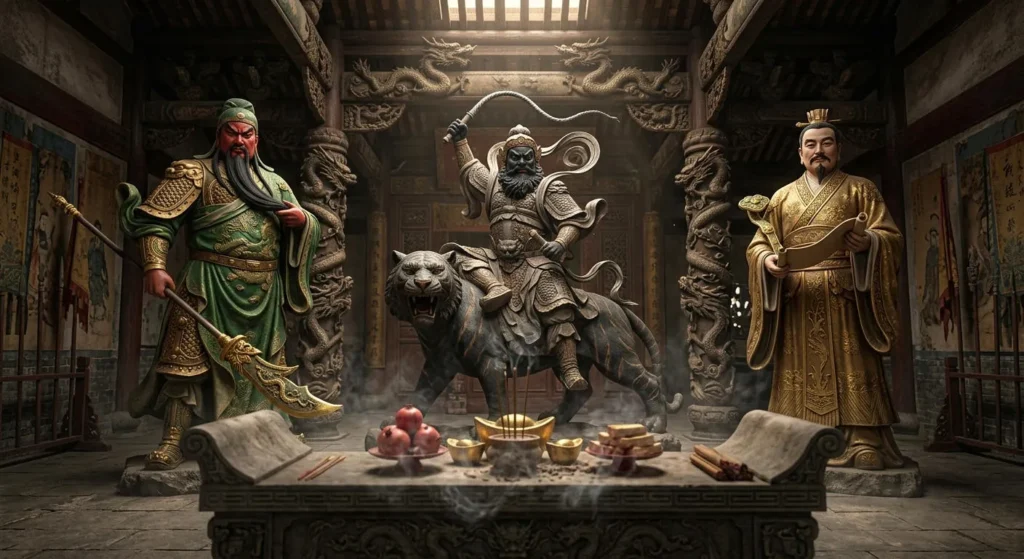
Three Major Gods of Wealth in Taoism: Zhao Gongming, Guan Yu, Fan Li — Which One Should You Worship?
Preface
This article details the three major gods of wealth in Taoism — Zhao Gongming, Guan Yu, and Fan Li. It distinguishes the functional differences between Martial Gods of Wealth and Civilian Gods of Wealth①, breaks down each god’s identity, wealth philosophy, suitable groups, and worship methods. With comparison tables, practical cases, and frequently asked questions, it helps readers accurately find the god of wealth that suits them and conveys Taoism’s core concept: “morality is the foundation of wealth.”
I. Introduction: Why Are There Three Core Gods of Wealth in Taoism?
In Western culture, the concept of “god of wealth” is relatively simple. For example, Plutus in Roman mythology and Hermes in Greek mythology are only gods of commerce, with limited functions related to wealth.
But Chinese culture has a complete lineage of gods of wealth, among which Zhao Gongming, Guan Yu, and Fan Li are the three most widely worshipped and influential core gods of wealth.
This difference stems from Taoism’s unique view of wealth — wealth is not merely material gain, but the result of virtue, wisdom, and opportunity working together.
We can compare the three gods to three distinct roles in the world of wealth, each corresponding to a core type of support on the path to seeking wealth.
Imagine: on the road to pursuing wealth, you need three types of help:
- A bodyguard who can “remove obstacles” for you (Zhao Gongming);
- A business partner who values “integrity” (Guan Yu);
- A mentor who understands “wise wealth distribution” (Fan Li).
This article will answer two core questions: What kind of wealth philosophy does each of these three gods represent? In which cases should you worship which one?
The full text progresses from macro to specific: it first summarizes the overall background of the three gods of wealth in Taoism, then details the core information of each god individually, clearly distinguishes their differences through comparison, and finally provides a practical selection guide to elevate the theme.
II. Core Positioning and Overall Differences of the Three Gods of Wealth in Taoism
Taoism’s system of gods of wealth is well-organized. The emergence of the three gods — Zhao Gongming, Guan Yu, and Fan Li — corresponds to the wealth-seeking needs of different groups and different dimensions of Taoism’s view of wealth.
The three complement each other, each with its own focus, together forming the core of Taoism’s wealth belief. This also reflects Taoism’s belief logic of “teaching students in accordance with their aptitude” and “adapting to local conditions.”
In terms of core positioning, the three gods can be divided into two categories: Martial Gods of Wealth and Civilian Gods of Wealth. They have clear differences in functions and suitable groups, as follows:
1. Martial Gods of Wealth: Zhao Gongming and Guan Yu belong to this category. They focus on “protecting wealth and breaking through difficulties,” suitable for people in the competitive and pioneering stage who need to overcome difficulties and protect their wealth;
2. Civilian Gods of Wealth: Fan Li belongs to this category. He focuses on “generating and preserving wealth,” suitable for people who pursue stable, moral wealth and need to accumulate wealth in the long term through wisdom.
According to the “Taoist Canon,” the core of classifying Taoism’s god of wealth system is “adaptability” — in other words, “different paths to wealth require different protecting gods.” This concept has run through folk worship customs from start to finish.
III. Detailed Explanation of the Three Gods: Background, Functions and Suitable Groups
1. Zhao Gongming
Zhao Gongming is one of the most representative Martial Gods of Wealth in Taoism. His core function is “removing obstacles and ensuring justice,” specifically providing protection for those who encounter obstacles while seeking wealth. His image and functions align perfectly with the needs of a “difficulty breaker.”
Identity and Image
Legend has it that Zhao Gongming practiced Taoism in Zhongnan Mountain during the Qin Dynasty (221-207 BC). Later, he was accepted as a disciple by Zhang Daoling, the founder of Taoism, and was responsible for guarding the alchemy furnace.
Finally, he was granted the title “Zhengyi Xuantan Marshal” by the Jade Emperor, also known as “Zhao Xuantan” or “Black Tiger Xuantan,” an important Dharma Protector God② in Taoism.
His iconic image is very distinctive: black face with thick beard, wearing an iron crown, holding a silver whip, riding a black tiger, and dressed in full military uniform.
It should be noted that in Chinese culture, “black face” symbolizes dignity and justice, not a negative connotation. This is highly consistent with Taoism’s concept of “using power to drive away evil spirits.”
In Chinese folk belief, many powerful Dharma Protector Gods have this image, and Zhao Gongming is a typical representative, which is highly consistent with Taoism’s concept of “using power to drive away evil spirits.”
The Evolution from God of Plague to God of Wealth
Zhao Gongming’s evolution from “god of plague” to “god of wealth” is a fascinating case in the transformation of Chinese gods’ images, and also a typical example of how Taoist gods’ functions “keep pace with the times.”
Initially, he was recorded as a god of plague and the underworld, responsible for spreading or driving away plagues. Relevant records can be found in ancient books such as “Records of Searching for Gods” and “Comprehensive Records of the Origins of the Three Religions and Searching for Gods.”
It was not until the Ming Dynasty novel “Investiture of the Gods” was published that his role underwent a major transformation. In the novel, Jiang Ziya bestowed upon Zhao Gongming the title “Golden Dragon Ruyi Zhengyi Dragon and Tiger Xuantan True Lord” and ordered him to lead four subordinates.
These four subordinates are the Heavenly Lord of Attracting Treasures, the Heavenly Lord of Collecting Treasures, the Envoy of Attracting Wealth, and the Immortal Official of Profits, forming a complete “wealth team” specifically responsible for various wealth-related affairs.
This setting also established his core status as a god of wealth. Since then, the folk custom of worshipping Zhao Gongming has gradually become prevalent, making him the most influential Martial God of Wealth in Taoism.
Functions and Suitable Groups
Zhao Gongming’s core functions include controlling thunder and lightning, eliminating plagues and disasters, and protecting against diseases. His role as a god of wealth is highlighted in the Taoist classic “Xuantan Baogao” (Imperial Edict of Xuantan).
“Xuantan Baogao” records: “For business and seeking wealth, he can make transactions smooth and harmonious. As long as it is a fair matter, you can pray to the god, and everything will go as you wish.”
His biggest feature is seeking wealth through justice — he not only helps you make money, but also ensures fair transactions and resolves disputes. His core philosophy is “remove obstacles first, then gather wealth.”
[Practical Case]
Scenario: An entrepreneur opened a building materials store. In the early stage, he faced vicious low-price competition from peers and frequent customer disputes, making it hard to advance his business and trapping him in a bottleneck.
Solution: Follow the norms for worshipping Zhao Gongming — place the statue facing outside the house, burn a stick of incense every morning and evening, offer light vegetarian food, and pray sincerely on the first and fifteenth day of each lunar month.
Result: After three months, vicious competition from peers decreased, the incidence of customer disputes dropped by 80%, the store’s reputation improved, and its turnover gradually recovered.
Limitation: This solution can only help resolve external obstacles; it cannot directly improve operational capabilities and has limited effect on difficulties caused by poor internal operations.
Suggestion: While worshipping, optimize the store’s operation strategy, improve product quality and service level, and achieve steady development with dual efforts.
Suitable Groups: Entrepreneurs and operators who face many obstacles while seeking wealth, work in highly competitive environments, encounter numerous difficulties, or frequently deal with disputes.
It is particularly suitable for those in the “breakthrough” stage (such as the early days of entrepreneurship, developing new markets, or breaking through business bottlenecks).
Unsuitable Groups: People engaged in clerical work or those who hope to seek wealth steadily (Civilian Gods of Wealth are more suitable for such people).
Worship Methods
1. Birthday and Wealth Receiving Day: His birthday is the 15th day of the third lunar month (another tradition says it is the 2nd day of the first lunar month).
The custom of receiving the god of wealth is usually held on the early morning of the 5th day of the first lunar month. People set off firecrackers and perform lion dances to drive away evil spirits and welcome wealth.
2. Worship Norms: The statue must face outside the house to deter evil spirits and remove obstacles.
Offerings should be light vegetarian food (such as green vegetables, tofu, fruits), avoiding meat and fish; burn a stick of incense every morning and evening, and perform a Greeting Ritual③ when worshipping.
2. Guan Yu
As a Martial God of Wealth evolved from a historical figure, Guan Yu’s core function is “protecting merchants and upholding integrity.” His identity as a god of wealth is closely tied to his “loyalty and righteousness,” making him the most revered god of wealth in the business world.
Identity and Image
Guan Yu (? – 219 AD) was a famous general of Shu Han at the end of the Eastern Han Dynasty, a real historical figure whose deeds are recorded in official histories like “Records of the Three Kingdoms.”
His iconic image is: a red face with a long beard, wearing a green robe and golden armor, holding a Green Dragon Crescent Blade, with a majestic temperament, which is a concrete symbol of “loyalty and righteousness.”
He has a unique status in Chinese culture — he is jointly revered by Confucianism, Buddhism, and Taoism, with the title “Emperor Guan Sheng,” belonging to the Emperor-level God in Taoism.
From an international perspective, Guan Yu is one of the most well-known Chinese gods overseas. Many Chinese restaurants, police stations, and even gang headquarters worship him.
The Evolution from Defeated General to Almighty God
Guan Yu’s evolution from a defeated general to an almighty god is a legendary story. His status gradually improved in successive dynasties, with the core turning point being the promotion of his “loyalty and righteousness”.
Song Dynasty: Emperor Huizong of Song granted him titles four times, from “Duke Zhonghui” to “King Yiyong Wu’an”, officially including him in the official sacrificial system for the first time.
Ming Dynasty: Emperor Wanli conferred upon him the title “Great Emperor of Subduing Demons in the Three Realms”, elevating his status to its peak and officially incorporating him into the Taoist pantheon.
Qing Dynasty: Guan Yu was completely “deified as the God of Wealth” and was granted the title “Emperor Guan Sheng, the Loyal, Righteous, Divine, Blessed, Benevolent, Courageous, Majestic and Manifest”, becoming the patron saint of merchants, money shops and escort agencies.
The business community particularly reveres Guan Yu, with the core reason lying in his “integrity”. According to “A History of Chinese Commerce”, merchants from Shanxi and Anhui during the Ming and Qing dynasties all regarded Guan Yu as a spiritual symbol of “integrity in business”.
Legend has it that he was good at financial management during his lifetime and invented the “daily clear bookkeeping method”. More importantly, he was an embodiment of loyalty, righteousness, trustworthiness and courage, which aligns with merchants’ pursuit of “integrity in business” — this is the core reason why he is revered in the business world.
Functions and Suitable Groups
Guan Yu’s core functions are not limited to being the God of Wealth; he is also a God of War, Dharma Protector God and City God, making him one of the most versatile gods in Taoism.
As the God of Wealth, his main role is to protect merchants, attract wealth and treasure, and safeguard business integrity. His core feature is seeking wealth through integrity — wealth is built on honesty and credibility.
[Practical Case]
Scenario: The founder of a foreign trade company, mainly engaged in cross-border e-commerce, faced fierce industry competition, insufficient customer trust, a continuous decline in orders, and difficulty in establishing long-term cooperation.
Solution: Place a statue of Guan Yu at the company’s front desk, facing outside the house. Hold a simple worship ceremony on his birthday (the 24th day of the sixth lunar month) and adhere to integrity in business daily.
Result: After six months, customer trust improved significantly, the repurchase rate of old customers increased by 60%, 12 new long-term cooperative customers were added, and the order volume grew steadily.
Limitation: This solution relies on the practice of “integrity in business”. If you cannot uphold integrity yourself, worship alone cannot bring protection, and it has no obvious help for short-term rapid profit.
Suggestion: Combine worship with practicing integrity yourself, optimize products and services, enhance core competitiveness, and achieve long-term and steady development.
Suitable Groups: People engaged in business, trade and service industries, especially business owners who need to establish long-term cooperative relationships and rely on customer trust.
Even the Hong Kong Police worship Guan Yu because he represents “upholding justice”; interestingly, both the police and gangsters worship Guan Yu, but with different motives — the former seek justice, while the latter seek “brotherhood”.
Unsuitable Groups: Like Zhao Gongming, Guan Yu is not suitable for people engaged in pure clerical work or those who hope to seek wealth steadily.
Worship Methods
1. Birthday and Worship Ceremony: His birthday is the 24th day of the sixth lunar month. On this day every year, many merchants hold grand worship ceremonies.
Offer fruits and pastries to pray for smooth business and abundant wealth — this is an important folk custom of worshipping Guan Yu.
2. Worship Norms: As a Martial God of Wealth, the statue should face outside the house, consistent with the way of worshipping Zhao Gongming.
Key Taboo: Both Guan Yu and Zhao Gongming are Martial Gods of Wealth. As the folk saying goes, “two tigers cannot live in one mountain”. They can only be worshipped one at a time and cannot be placed in the same hall.
Offerings can be fruits and pastries, avoiding meat and fish. Perform a Greeting Ritual when worshipping — this is the core norm for worshipping Guan Yu.
3. Fan Li
As a real “Sage of Commerce” in history, Fan Li is the core representative of the Civilian God of Wealth in Taoism. His core function is “imparting wisdom and upholding integrity”, emphasizing obtaining sustainable wealth through wisdom and morality, which complements the Martial Gods of Wealth’s role of “breaking through difficulties and protecting wealth”.
Identity and Background
Fan Li (c. 536-448 BC) was a native of Wan in the State of Chu at the end of the Spring and Autumn Period, with the identities of statesman, strategist and industrialist.
He was the first recorded great merchant in Chinese history, honored as the “Sage of Commerce” and “Gong Zhu of Tao”, whose business ideas have far-reaching influence.
His life story is full of Taoist wisdom: he was born in poverty, assisted King Gou Jian of Yue in defeating the State of Wu, and then retired after achieving success and fame to engage in business under a new name.
This choice of “retreating bravely after achieving success” itself contains the Taoist philosophical thought of “retreating after achieving merit”, which also laid the foundation for his wealth philosophy.
The Evolution to the God of Wealth
The most legendary reason why Fan Li is revered as the God of Wealth is that “he made a fortune three times in nineteen years and then distributed it to poor friends and distant relatives”.
In plain terms, he became extremely rich three times in nineteen years and gave away all his wealth three times to help poor relatives and friends, making him a model of moral wealth.
As a real “Sage of Commerce” in history, his wealth philosophy is recorded in official histories such as “Records of the Grand Historian · Biographies of Merchants” and he is revered as the Civilian God of Wealth in Taoism.
His business philosophy was compiled into “The Commercial Instructions of Gong Zhu of Tao”, which is still a classic textbook in the business field today, and the concepts of “small profits but quick turnover” and “integrity-based” are still widely used.
Wealth Philosophy and Functions
Fan Li’s core philosophy is: “When wealthy, one should practice virtue; when gathering wealth, one should enrich the people”, meaning that the best use of wealth is to benefit others.
This concept is highly consistent with Taoism’s core thought of “The highest good is like water, which benefits all things without contention”, and is also the core of his view of wealth.
1. Small Profits but Quick Turnover: Only pursue a 10% “eleven-percent profit”, do not exploit the people, and achieve long-term profits through high sales volume;
2. Integrity in Business: Even if the market price falls, still purchase at the contracted price and do not deceive partners and the people;
3. Win-Win Cooperation: Do not engage in speculation, pursue “business skills that do not harm the people”, and share profits with partners;
4. Giving Back to the People: Open granaries to relieve disasters, help the poor, and practice the concept of “distributing wealth to gather people”.
His biggest feature is seeking wealth through wisdom and morality — wealth comes from a profound understanding of business rules and giving back to society.
It does not rely on magic or divine power, but on wisdom, integrity and foresight — this is the core reason why he is honored as the “Sage of Commerce”.
Suitable Groups and Worship Methods
[Practical Case]
Scenario: A practitioner in an educational consulting company, mainly engaged in academic and career planning consulting, hopes to develop steadily, obtain long-term wealth through professional capabilities, and refuses speculation.
Solution: Place a statue of Fan Li in the office, facing inside the house. Practice the concept of “integrity consulting and helping others” daily, do not exaggerate effects or make false promises.
Result: After one year, the company has a good reputation, the customer referral rate reaches 70%, the business expands steadily, a stable customer group is formed, and sustainable profits are achieved.
Limitation: This solution takes effect slowly and requires long-term adherence to integrity and professionalism. It is not suitable for people who pursue “get rich quickly” and has limited help for short-term performance improvement.
Suggestion: Combine worship with improving professional capabilities, appropriately expand promotion channels, and balance long-term development and short-term performance improvement.
Suitable Groups: Confucian merchants, knowledge-based entrepreneurs, and people engaged in legitimate industries.
It is particularly suitable for those who hope to obtain “legitimate wealth” and seek wealth steadily in legitimate industries and careers, which aligns with Fan Li’s concept of “upholding integrity to generate wealth”.
It is also suitable for people engaged in knowledge-based industries such as clerical work, education and consulting, as well as those who pursue “sustainable wealth” and “moral wealth”.
Unsuitable Groups: People who hope to “get rich quickly” or “get rich overnight” — such people are more suitable to worship the Martial Gods of Wealth.
Worship Methods: 1. Worship Norms: As a Civilian God of Wealth, the statue must face inside the house — opposite to the way of placing the Martial Gods of Wealth.
2. Offerings: Light vegetarian food such as fruits and sweets are suitable, avoiding meat and fish; 3. Core: Worshipping Fan Li is more of a “spiritual tribute”.
A fun trivia: The folk legend of Fan Li and Xi Shi can be used as an interesting supplement to the article — it is said that after retiring, Fan Li traveled around the world with Xi Shi and lived a free and happy life.
This legend also reflects his pursuit of the Taoist realm of freedom, which is consistent with his life choice of “retreating after achieving success and fame”, and also adds a touch of romance to this Civilian God of Wealth.
IV. Comparison Table of Core Information of the Three Gods of Wealth
To help you quickly distinguish the three gods of wealth and accurately match your own needs, combined with the content above, the following comparison table of core information is sorted out to clearly present the differences and core points of the three.
|
Comparison Dimensions |
Zhao Gongming |
Guan Yu |
Fan Li |
|
Identity Category |
Martial God of Wealth |
Martial God of Wealth |
Civilian God of Wealth |
|
Origin |
Mythical Figure (Cultivated Taoism and became immortal in the Qin Dynasty) |
Historical Figure (Famous general of the Three Kingdoms) |
Historical Figure (Statesman and merchant of the Spring and Autumn Period) |
|
Core Features |
Black face, holding a whip, riding a black tiger |
Red face, green robe, holding a Green Dragon Crescent Blade |
Dressed in brocade and jade belt, a clean and white civil official image |
|
Wealth Philosophy |
Seeking wealth through justice |
Seeking wealth through integrity |
Seeking wealth through wisdom and morality |
|
Core Functions |
Removing obstacles and ensuring fair transactions |
Protecting merchants and attracting wealth and treasure |
Imparting business wisdom and guarding legitimate wealth |
|
Most Suitable Groups |
Entrepreneurs, those in fierce competition, those with many disputes |
People engaged in business, trade and service industries |
Clerical staff, people in knowledge-based industries, Confucian merchants |
|
Worship Placement |
Facing outside the house |
Facing outside the house |
Facing inside the house |
|
Key Taboos |
Cannot be worshipped in the same hall as Guan Yu |
Cannot be worshipped in the same hall as Zhao Gongming |
Suitable to be placed opposite or beside the Martial Gods of Wealth |
V. Practical Decision Guide: Which of the Three Gods of Wealth Should You Worship?
Combined with the detailed explanation and comparison of the three gods of wealth above, there is no need to follow the trend blindly. You can quickly find the god of wealth that suits you by combining your own occupation, wealth difficulties and personality traits.
The following three key questions will help you make accurate decisions and quickly match the Taoist god of wealth that suits you.
1. Which God of Wealth Should You Worship Based on Your Occupation?
- If you are engaged in business, running a store or starting your own business → Guan Yu;
- Core Reason: He protects merchants, emphasizes integrity, which is the key to long-term business development.
- If you are in a state of fierce competition, many disputes or need to break through bottlenecks → Zhao Gongming;
- Core Reason: He is good at removing obstacles and helping you get out of difficulties.
- If you are engaged in legitimate industries such as clerical work, education and consulting → Fan Li;
- Core Reason: He guards legitimate wealth and teaches you to seek wealth through wisdom and morality.
2. Which God of Wealth Should You Worship Based on Your Wealth Difficulties?
- If your career development is blocked and you are in great difficulty → Zhao Gongming;
- Core Role: He can help you remove obstacles and pave the way for wealth.
- If you need to gain customer trust and establish long-term cooperative relationships → Guan Yu;
- Core Role: His image of integrity can help you win the trust of others.
- If you hope to develop steadily and obtain wealth in legitimate industries → Fan Li;
- Core Role: He advocates a sustainable and moral view of wealth, suitable for long-term development.
3. Which God of Wealth Should You Worship Based on Your Personality Traits?
- If you like to “break through difficulties” and dare to fight and work hard → Zhao Gongming;
- Connection: His warrior spirit aligns with your personality.
- If you value integrity and reputation and regard them as the foundation of your life → Guan Yu;
- Connection: He is the embodiment of loyalty, righteousness and integrity.
- If you value wisdom, pursue moral wealth and believe that wealth should benefit society → Fan Li;
- Connection: His philosophy is consistent with your values.
Summary: The three gods of wealth are not in a competitive relationship, but three different aspects of the same wealth proposition.
You only need to choose the one that is most suitable for your current situation, without blind worship.
The real “blessing of the God of Wealth” comes from your resonance with the virtues represented by the gods — justice, integrity and wisdom.
Worshipping the God of Wealth is not only a ritual, but also a reminder to adhere to these virtues in the process of seeking wealth — this is the core of Taoist belief in the God of Wealth.
VI. Conclusion: The Essence of Wealth is the Symbiosis of Morality and Wisdom
Through the step-by-step analysis from macro to specific, this article clearly answers the core question of “which God of Wealth to worship”.
Running through it all is Taoism’s view of wealth — morality is the foundation of wealth, which is also the core concept jointly conveyed by the three gods of wealth.
Zhao Gongming emphasizes “fair transactions”, Guan Yu emphasizes “business integrity”, and Fan Li emphasizes “benevolence in wealth”.
These three virtues are not only the key to seeking wealth in Chinese culture, but also universally recognized values in the world, and even the core of Taoism’s view of wealth.
Wealth is not only material gain, but also a reflection of personal morality and wisdom.
Only by adhering to fairness, integrity and benevolence can we obtain sustainable wealth and true happiness.
Finally, the key dates for receiving the God of Wealth in the lunar calendar are attached for your reference:
1. The 5th day of the first lunar month (February 23, 2026 in the Gregorian calendar, the 5th day of the first lunar month of the Bingwu Year, the general day for receiving the God of Wealth);
2. The 15th day of the third lunar month (May 2, 2026 in the Gregorian calendar, the 15th day of the third lunar month of the Bingwu Year, Zhao Gongming’s birthday);
3. The 24th day of the sixth lunar month (August 7, 2026 in the Gregorian calendar, the 24th day of the sixth lunar month of the Bingwu Year, Guan Yu’s birthday);
4. The 5th day of the first lunar month (February 23, 2026 in the Gregorian calendar, the 5th day of the first lunar month of the Bingwu Year, the day for receiving the God of Wealth for Fan Li).
When worshipping, you can combine the corresponding birthday according to the God of Wealth that suits you to express your sincerity, which is more in line with Taoist worship customs.
Glossary
The metaphysical professional terms marked in the main text of this article are interpreted as follows in combination with Taoist classics and folk customs to facilitate readers’ understanding:
① Martial Gods of Wealth and Civilian Gods of Wealth: The two core categories of Taoism’s God of Wealth system. The core difference lies in the different focus of their functions. Martial Gods of Wealth focus on “protecting wealth, breaking through difficulties and driving away evil spirits”, mostly in the image of warriors or Dharma Protector Gods; Civilian Gods of Wealth focus on “generating wealth, preserving wealth and imparting wisdom”, mostly in the image of civil officials or sages. The two together form the core of Taoist wealth belief.
② Dharma Protector God: A god in Taoism responsible for protecting Taoist Dharma and driving away evil spirits and disasters. As the “Zhengyi Xuantan Marshal”, one of Zhao Gongming’s core functions is to protect Taoist teachings and believers, and he also has the function of the God of Wealth. He is a typical representative of the dual functions of “Dharma protection + attracting wealth” in Taoism, which also explains why he can “remove obstacles and gather wealth”.
③ Greeting Ritual: One of the core rituals for worshipping gods in Taoism, also known as “bowing”. The specific action is to hold the right hand with the left hand (left hand outside, right hand inside), symbolizing “yang on the left and yin on the right, harmony between yin and yang”, to express respect for the gods, which is different from the Buddhist greeting with palms together.
④ Emperor-level God: A high-level rank in the Taoist pantheon, second only to “Tianzun” (Celestial Venerable) and “Dadi” (Great Emperor). Guan Yu was granted the title “Emperor Guan Sheng”, belonging to the Emperor-level God, with a lofty status. He has multiple functions such as God of War, God of Wealth and Dharma Protector God, and is an important god jointly revered by the three religions.
Can I worship both Zhao Gongming and Guan Yu, the two Martial Gods of Wealth, at home?
No. Both Zhao Gongming and Guan Yu are Martial Gods of Wealth. As the folk saying goes, “two tigers cannot live in one mountain”. Worshipping them in the same hall is likely to cause “aura conflict”, which is not in line with Taoist worship norms. It is recommended to worship one of them. If you need both obstacle removal and integrity protection, you can choose to worship Guan Yu (focusing on integrity) together with Fan Li (the Civilian God of Wealth). The two complement each other in aura and functions, with no taboos.
Must I worship the God of Wealth strictly on their birthday? Is daily worship effective?
Not necessarily. The birthday is a folk “important worship day”, and worship at this time has a stronger meaning. However, the core of Taoism emphasizes “sincerity is the key”. Burning incense every morning and evening and praying sincerely can also express respect and obtain blessings. The core is to adhere to the virtues represented by the God of Wealth (justice, integrity, wisdom), rather than simply pursuing the ritual sense of the date.
Can worshipping Fan Li really help clerical staff improve their financial fortune? Do I need to take other actions?
As the Civilian God of Wealth, Fan Li’s core is “imparting wisdom and upholding integrity”. Worshipping Fan Li can play a psychological hint role and guide a positive view of wealth, but it cannot directly improve financial fortune. It is recommended to combine it with your own actions: adhere to integrity, improve professional capabilities, and accumulate steadily. Only by combining worship with practical actions can we achieve steady growth in wealth. If you only rely on worship without taking action, the effect will be limited.
Can Zhao Gongming’s “obstacle removal” function resolve all business difficulties?
No. Zhao Gongming’s “obstacle removal” mainly targets “external obstacles” (such as vicious competition from peers, unwarranted disputes, evil interference, etc.). It cannot directly resolve difficulties caused by poor internal operations or insufficient capabilities. It is recommended to reflect on and optimize your own strategies while worshipping, solve core problems, and break through difficulties with dual efforts.
Are there any general taboos to pay attention to when worshipping Taoist Gods of Wealth?
There are 4 core points:
① Offerings should avoid meat, fish and unclean things, mainly light vegetarian food and fruits;
② Maintain sincerity when worshipping, do not laugh and play, and do not place the statue casually;
③ Martial Gods of Wealth face outside the house, and Civilian Gods of Wealth face inside the house, which cannot be reversed;
④ The statue should be kept clean and tidy, wiped regularly to avoid dust accumulation — this is the basic respect for the gods.