Tired of tossing and turning at night, relying on melatonin and sleep apps that only work temporarily? Constant work stress, endless screen time, and overactive thinking leave millions of Americans stuck in a cycle of anxiety and sleeplessness, with no long-term relief from mainstream Western sleep solutions.
Forget complicated routines and quick-fix supplements. Thousands of years of Taoist wisdom holds a gentle, proven remedy for insomnia: the timeless rest philosophy of Chen Tuan, the legendary Sleeping Immortal. These simple, zero-belief practices calm your racing mind, reset your body’s natural rhythm, and help you unlock deep, restorative sleep tonight.
I. Why Insomnia & Anxiety Plague Modern Americans
Have you ever spent hours staring at your ceiling at 2 a.m., counting sheep until your eyes burn, yet your brain just refuses to shut down?
You scroll through your phone mindlessly, overwhelmed by work stress and endless notifications. Racing thoughts make peaceful sleep feel like an impossible luxury. If this sounds familiar, you’re far from alone.
Insomnia has become a widespread epidemic across the United States. According to modern sleep research:
- Nearly 30% of American adults struggle with persistent insomnia
- More than half report frequent nighttime anxiety and mental overstimulation
Modern life has rewired our brains for constant alertness. Blue light blurs day and night boundaries, burnout lingers after work hours, and information overload traps the mind in a permanent “on” state.
Western sleep remedies have clear limitations:
- Melatonin and sleep apps only deliver temporary effects
- Sleep medications often cause daytime grogginess and dependence
- No Western solution addresses the mental and emotional root of insomnia
If you are tired of band-aid fixes, ancient Taoist wisdom offers a unique, under-explored solution. At its core lies one legendary figure: Chen Tuan, known as the Sleeping Immortal — the only sage in history celebrated exclusively for mastering deep, restorative sleep and spiritual rest.
II. Who Is Chen Tuan? The Taoist Sleeping Immortal
Chen Tuan is not a fictional deity. He was a real historical Taoist master whose life and philosophy redefined the meaning of sleep and self-healing.
1. Chen Tuan: Taoist Sleep God Biography
Chen Tuan (871–989 AD) was a prestigious Taoist sage and health preservation master of the Five Dynasties and Early Song Dynasty in China.
Honored as Aged Ancestor Chen Tuan, he earned the unique title “Sleeping Immortal” — an honor no other ancient philosopher or spiritual teacher has ever received.
He lived 118 years, refused to kneel before emperors, and devoted his entire life to studying the harmony of human body, mind, and nature.
2. Legendary Sleeping Qigong Feats
Chen Tuan’s sleep was never ordinary rest. It was a high-level Taoist spiritual practice.
- His single sleep cycle could last one month, half a year, or even three full years
- Emperor Shizong of the Zhou once sealed him in a room for one month without food or water; Chen Tuan remained completely unharmed
- His extraordinary rest state stemmed from fetal breathing① and nasal locking technique② — advanced Taoist internal cultivation methods
3. Core Taoist Sleep Philosophy
Modern society views sleep as a passive, productive-time-consuming chore. Chen Tuan’s Taoist philosophy completely reverses this cognition.
Sleep is not a waste of time — it is daily spiritual cultivation.
He founded Sleeping Qigong③, with the core tenet of “entering the Dao through sleep”.
His core insight: True deep sleep generates true vital breath, eliminates chaotic dreams and mental distractions, and repairs mental anxiety fundamentally.
His famous maxim summarizes his lifelong wisdom perfectly:
“Rather seek a sleep formula than an immortal formula.”
The best health and anxiety cure is simply high-quality, natural sleep.
III. Taoist Rituals & Deities for Better Sleep & Anxiety Relief
Beyond Chen Tuan’s signature sleeping practice, Taoism has developed a full set of gentle rituals and spiritual traditions to soothe restlessness, stabilize the spirit, and cure insomnia.
1. Chuangshen: The Chinese Bed God
Chuangshen (Bed God)④ refers to a pair of residential patron deities in Chinese folk Taoism: Bed Father and Bed Mother.
They govern household sleep safety, emotional stability, and bedroom aura. Since the Song Dynasty, Chinese people have followed the custom of “tea for men, wine for women” to worship bed gods before bedtime, praying for undisturbed rest.
For Western readers, the bed god couple acts as a gentle, symbolic bedroom guardian that eliminates subtle negative interference during sleep.
2. An Shen Dou Deng: Calming Lamp Ritual
An Shen Dou Deng⑤ is a professional Taoist ritual designed specifically for anxiety, irritability, and stubborn insomnia.
Taoist theory holds that sleeplessness originates from scattered soul and disturbed vital energy. The lit ritual lamp symbolizes divine positive light that dispels inner darkness, calms chaotic thoughts, and stabilizes the human spirit.
It is most suitable for people with long-term mental stress, new house relocation, or persistent low mood.
3. Jing Xin Shen Zhou: Calm Sleep Mantra
Jing Xin Shen Zhou⑥, the first of the Eight Great Taoist Divine Mantras, is a 32-character core formula for purifying the mind and calming the spirit.
It eliminates overthinking, cuts off trivial worries, and resets restless mental states. Its core essence lies in the sentence: “Wisdom is pure and bright, the spirit and mind are peaceful.”
This mantra serves as a portable pre-bed mindfulness tool for modern anxious people.
4. Daily Rules to Fix Midnight Insomnia
Taoism believes midnight insomnia is caused by heart-kidney disharmony⑦ — an internal energy imbalance that leads to hyperactive heart fire and restless spirit.
Two daily practical rules relieve this root cause:
- Noon quiet sitting: 10–15 minutes of midday rest to nourish heart energy and prevent nighttime emotional overdraft
- Fixed bedtime rituals: teeth cleaning, mouth rinsing, warm foot soaking, and slow hair combing to signal the brain to exit tension mode
IV. Easy Taoist Sleep Practices for Beginners
All Taoist sleep practices below require no religious belief, no professional equipment, and no prior experience. They are zero-threshold mental healing tools suitable for Western daily life.
1. Simple Bedtime Immortal Invocation
This is the most direct and beginner-friendly practice to obtain peaceful sleep energy.
Pre-bed operation steps:
- Lie down comfortably and take three slow deep breaths to relax the whole body
- Silently recite: Ancestor Chen Tuan, grant me peaceful sleep
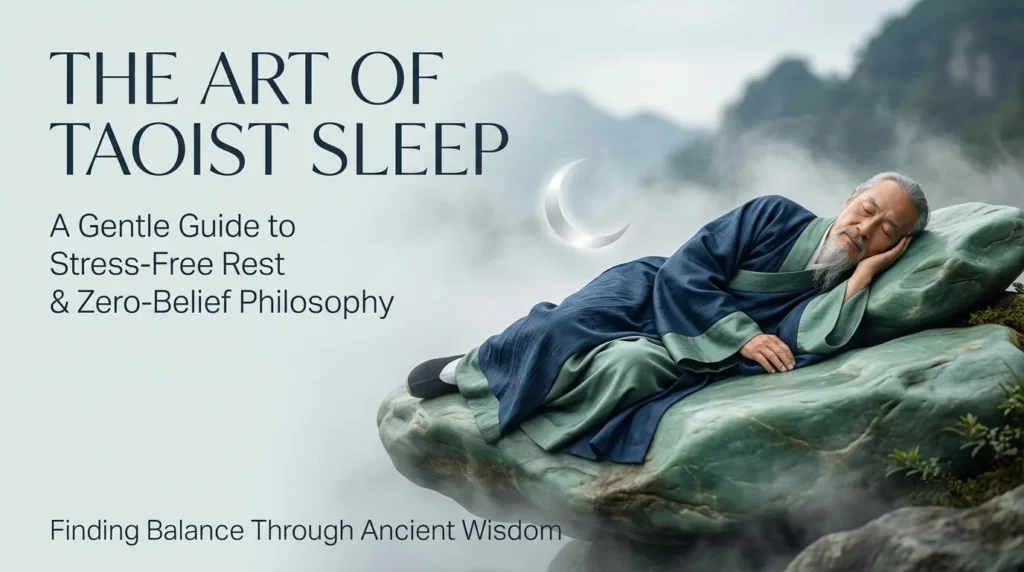
- Visualize lying high above the clouds like Chen Tuan, letting go of all work and trivial worries
- Adopt the Sleeping Tiger Posture (lateral lying) to relax body meridians and speed up falling asleep
2. How to Recite Jing Xin Shen Zhou
Recite 3–7 times before bed to shut down overactive brain thinking:
Pinyin: Yu qing wu zhu, xin wu xian yuan, zhi hui chun ming, xin shen an ning.
English Translation: Let all worldly attachments fade away, let all trivial worries vanish. May my wisdom be pure and bright, and may my spirit and mind gain true peace and calm.
The repetitive rhythm switches the brain from “logical working mode” to “resting meditation mode”, which aligns with modern mindfulness therapy principles.
3. Build a Taoist-Friendly Bedroom
Ancient Taoist bedroom taboos adapted for modern homes:
- Keep the bedroom away from direct cold wind and overheated heating equipment to maintain stable energy
- Completely store all electronic devices before bed to avoid informational and light interference
- Keep the room tidy, quiet and warm to stabilize indoor aura and subconscious mood
4. Beginner Lamp Visualization Practice
No need to visit Taoist temples for the ritual. Remote visualization practice for daily use:
- Close your eyes and adjust your breathing to slow and even
- Visualize a warm, soft lamp lighting up in your chest
- Let the light spread to the whole body, dispelling anxiety, restlessness and negative energy
- Keep the peaceful light state until you fall asleep
Strict Medical Disclaimer: All practices are cultural health preservation and mental adjustment tools, not medical treatment. They cannot replace professional diagnosis and therapy. Severe insomnia and clinical anxiety require timely medical intervention.
V. Taoism vs Western Sleep Science: Root Cause Fix
Western mainstream cognition defines sleep as passive physical rest, only for physical strength recovery. It ignores the core cause of modern insomnia: mental and emotional exhaustion.
Taoism puts forward a more advanced view: sleep is active spiritual cultivation and the core way to balance yin and yang energy.
Taoist theory points out that long-term stress and overthinking cause heart fire hyperactivity⑧, leading to restless spirit and inability to sleep — which perfectly explains modern burnout insomnia.
Essentially, Chen Tuan’s Sleeping Qigong is an ancient deep mindfulness system. It focuses on letting go of control and quieting internal chatter, highly overlapping with modern evidence-based stress relief therapies, yet simpler and more suitable for long-term adherence.
VI. Final Takeaways: Restful Sleep With Chen Tuan
In a society that worships busyness and efficiency, Chen Tuan’s wisdom awakens a forgotten truth: Peaceful sleep is the most precious self-healing ritual.
Taoist sleep wisdom is not superstition. It is a practical ancient philosophy tailored for modern anxious crowds.
You can start tonight with three simple changes:
- Recite the calming mantra or pray to the Sleeping Immortal before bed to quiet your racing mind
- Treat sleep as sacred self-cultivation instead of a boring daily task
- Keep in mind: The best health prescription is a stable, peaceful night’s sleep
Modern life is inevitably fast and stressful, but your sleep can always be calm and peaceful.
Sweet dreams, and may the Sleeping Immortal watch over your rest.
VII. Glossary of Taoist Sleep Terms
① fetal breathing: A high-level Taoist internal cultivation breathing method. Practitioners abandon shallow chest breathing, simulate the quiet and gentle breathing state of a fetus in the womb, realize deep internal energy circulation, and achieve extreme physical and mental tranquility.
② nasal locking technique: A matching auxiliary practice of Taoist sleep cultivation. It stabilizes breathing through nasal convergence and locking, prevents energy leakage, helps the brain enter a deep meditative sleep state, and eliminates fragmented dreams and mental restlessness.
③ Sleeping Qigong: A unique health preservation and spiritual cultivation system created by Chen Tuan. It takes sleep as the carrier, unifies rest and cultivation, realizes energy repair and spiritual purification during sleep, and differs from ordinary passive rest.
④ Chuangshen (Bed God): Traditional Chinese folk Taoist patron deity system, consisting of Bed Father and Bed Mother. In charge of bedroom aura stability, sleep quality and family peace, it is the most accessible residential protective deity in folk Taoism.
⑤ An Shen Dou Deng: Classic Taoist spiritual calming ritual. Through lighting ritual lamps, it dispels negative aura, stabilizes scattered soul and disturbed vital energy, relieves emotional anxiety, and improves stubborn insomnia caused by spiritual instability.
⑥ Jing Xin Shen Zhou: The first of the Eight Great Taoist Divine Mantras, a core 32-character purification mantra. It clears mental distractions, calms restless mood, purifies spiritual state, and is the most commonly used daily self-calming practice in Taoism.
⑦ heart-kidney disharmony: Core terminology of Taoist health preservation and traditional Chinese energy theory. It refers to the imbalance of upper heart fire and lower kidney water, resulting in upward fire disturbance, mental irritability, midnight insomnia and frequent dreaminess.
⑧ heart fire hyperactivity: A common internal energy imbalance state. Long-term overthinking, anxiety and pressure lead to excessive heart fire, which cannot descend and coordinate with kidney energy, resulting in continuous brain excitation and difficulty falling asleep.
Do I need to believe in Taoism to practice these sleep methods?
No religious belief is required at all. All the methods shared in the article are summarized from Taoist health preservation and mindfulness philosophy. They serve as mental adjustment and sleep relaxation tools, suitable for people of all beliefs and cultural backgrounds.
How long does it take to see sleep improvement after practicing these methods?
Most people can feel obvious mental relaxation and reduced tossing and turning on the first night. Stable sleep quality improvement usually takes 3–7 days of consistent practice, as the brain gradually adapts to the new pre-bed relaxation mode.
Can these practices replace melatonin and sleep medication?
For mild insomnia and anxiety, these practices can gradually reduce dependence on auxiliary sleep products. For severe insomnia and patients taking long-term medication, please do not stop drugs by yourself. These methods can only be used as auxiliary conditioning means, with professional medical treatment as the core.
Is the bed god worship and lamp visualization practice superstitious?
No. They are essentially spiritual suggestion and visualization mindfulness practices. The core is to build a safe psychological hint through traditional cultural symbols, eliminate subconscious anxiety, and create a stable pre-bed mental state.
Can I practice the mantra and Sleeping Immortal prayer together before bed?
Yes, the two practices can be matched freely. You can recite the mantra first to calm your mind, then pray quietly and cooperate with visualization, which will achieve a better relaxing and sleeping effect.
Why do Western sleep methods fail to cure root insomnia while Taoist wisdom works?
Western sleep solutions focus on physical relaxation and biological adjustment, ignoring mental and spiritual restlessness. Taoist sleep wisdom starts from balancing internal energy and calming the spirit, targeting the emotional and mental root of modern insomnia, so it has more long-term effects.