Taoist vs. Buddhist Worship: 5 Key Differences You Need to Know!
1. Worship Objects: Gods in Charge vs. Enlightened Teachers
This is the most obvious difference—and the starting point of all others! What you worship directly shapes your purpose and rituals.
It’s the key to understanding how Taoist worship and Buddhist worship differ at their core.
1.1 Taoism’s Polytheistic System
Taoism is polytheistic—all gods are incarnations of “Tao” (the Way) and enforcers of cosmic order. The Chinese Taoist Association says Taoism’s god system is well-structured, not random!
There are 4 main types of Taoist gods:
- Primordial Gods: The Three Pure Ones—incarnations of Tao, the highest gods in Taoism. They’re usually in the main hall of Taoist temples.
- Administrative Gods: Jade Emperor, Ziwei Emperor—they manage the universe, like “heavenly leaders.”
- Functional Gods: God of Wealth, God of Culture, City God—they handle daily human needs (money, safety, etc.) and are closest to ordinary people.
- Immortals: Lü Dongbin, Zhang Tianshi—people who cultivated into immortals. They show Taoism’s core idea: humans can become immortals!
Core idea: Gods have supreme power—they reward good, punish evil, and control cosmic rules. Worshipping them is about respecting and obeying the universe’s order.
1.2 Buddhism’s Atheistic Nature
Unlike Taoism’s many gods, Buddhism is essentially atheistic! What you worship are “enlightened ones,” not gods who control everything.
This is one of the biggest differences between Taoist worship and Buddhist worship.
- Buddhas: Sakyamuni, Amitabha—they’re “enlightened truth-seekers,” not creators or rulers. They’re just pioneers who show others the way to enlightenment.
- Bodhisattvas: Guanyin, Ksitigarbha—compassionate beings who help Buddha guide others to enlightenment. Their job is to “save people,” not “rule them.”
- Dharma Protectors: Wei Tuo, Ksitigarbha—beings who protect Buddhism and practitioners. They’re not the focus of worship—they just guard the practice environment.
Core idea (from the Buddhist Sutra of the Lankavatara): “Depend on the Dharma, not on people.” Buddha is just a teacher—he points the way to liberation, but you’re responsible for your own karma and practice.
2. Worship Purpose: Immortality vs. Enlightenment
Because they worship different things, Taoism and Buddhism have totally different goals.
This difference shapes their rituals and practice logic—let’s take a closer look!
2.1 Taoist Worship: Earthly Blessings & Immortal Life
Taoist worship has two core goals: earthly peace and ultimate immortality.
It’s all about “harmony with Tao”—balancing a happy life in the present and eternal life in the future.
- Earthly goals: Avoid disasters, live longer, safe home, wealth, fame—all the practical things people want!
- Ultimate goal: Live forever, become an immortal, and unite with Tao to control your own fate (no more reincarnation!)
- Contract feature: “Make a vow, repay the vow.” Use rituals (like fasting, talismans) to communicate with gods—it’s like signing a contract with them!
Classic quote (Taoist Text: “Treatise on the Response of the Tao”): “Blessings and misfortunes come from your own actions—gods just reward or punish based on what you do.”
Real-life example:
Scene: A shop owner wants their new store to succeed and avoid losses, so they choose Taoist worship.
Plan: Go to a Taoist temple, prepare 5 offerings (incense, flowers, lamps, water, fruit), ask a Taoist priest to hold a ritual, write a prayer on paper, and vow: “If my shop succeeds, I’ll donate to the temple and renovate the God of Wealth statue.”
Result: The shop gets steady customers and makes more money than expected. The owner keeps their vow—contract complete!
Downside: Some people rely too much on gods and forget to work hard themselves.
Tip: Use worship as encouragement, but also plan and work hard—balance “god’s blessing” with “self-cultivation” (that’s Taoism’s core: “Your fate is in your own hands, not the gods’”).
2.2 Buddhist Worship: Surface Blessings & Deep Enlightenment
Unlike Taoism’s “contract” style, Buddhist worship’s “blessings” are just a way to get people interested in the faith.
The real goal is enlightenment—it’s all about self-practice, not asking gods for favors!
- Surface purpose: Peace, removing bad karma, more blessings—it’s a simple way to get people close to Buddhism.
- Deep reasons: Humble yourself (bowing to Buddha breaks pride), accumulate merit for enlightenment, and awaken the Buddha-nature inside you (everyone has it!)
- Ultimate goal: Become enlightened (see your true nature) and end reincarnation. It’s about “becoming a Buddha yourself,” not asking Buddha for rewards.
Real-life example:
Scene: A person feels anxious and unhappy, so they go to a Buddhist temple to find peace.
Plan: Bow to Buddha with hands pressed together, offer water and fruit, chant scriptures with monks, and pray: “May all beings be peaceful, and may I let go of my worries and awaken my heart.” Chant for 10 minutes every day at home.
Result: After 1 month, they feel less anxious, see problems more rationally, and learn to find peace within themselves—not from others.
Downside: Some people misunderstand chanting—they only want “material blessings” and forget to practice kindness or self-reflection.
Tip: The point of chanting is to purify your heart and help others. Pair it with good deeds and self-reflection to truly become enlightened.
3. Rituals: Small Details, Big Differences
Different worship objects and purposes mean different rituals!
From greetings to offerings to prayers—every small detail shows their core differences. Let’s make it easy to understand!
3.1 Basic Etiquette: Yin-Yang Harmony vs. Unity of Sacred & Ordinary
Etiquette is simple but meaningful—you can learn it in minutes!
It directly reflects the core beliefs of Taoism and Buddhism.
- Taoist greeting: Left hand covers right hand (called “Ziwujue”). It symbolizes yin-yang harmony—just stand straight and greet respectfully.
- Buddhist greeting: Hands pressed together (palms touching, fingers closed). It symbolizes unity of sacred and ordinary—hold hands to your chest, focus, and be respectful.
- Bow differences: Taoists bow with palms down, touching the ground (often 3 bows and 9 kowtows). It’s like ancient court etiquette—respect hierarchy, bow to heaven first, then earth, then gods.
- Buddhists bow and then turn their palms up (touching Buddha’s feet symbolically). It’s about longing for enlightenment and letting go of pride—no hierarchy, just sincerity.
3.2 Offerings: Ancient Sacrifice vs. Pure Symbolism
Offerings are how you communicate with gods (Taoism) or Buddha (Buddhism)—they’re not random!
Both traditions have clear rules for offerings, and these rules show big differences.
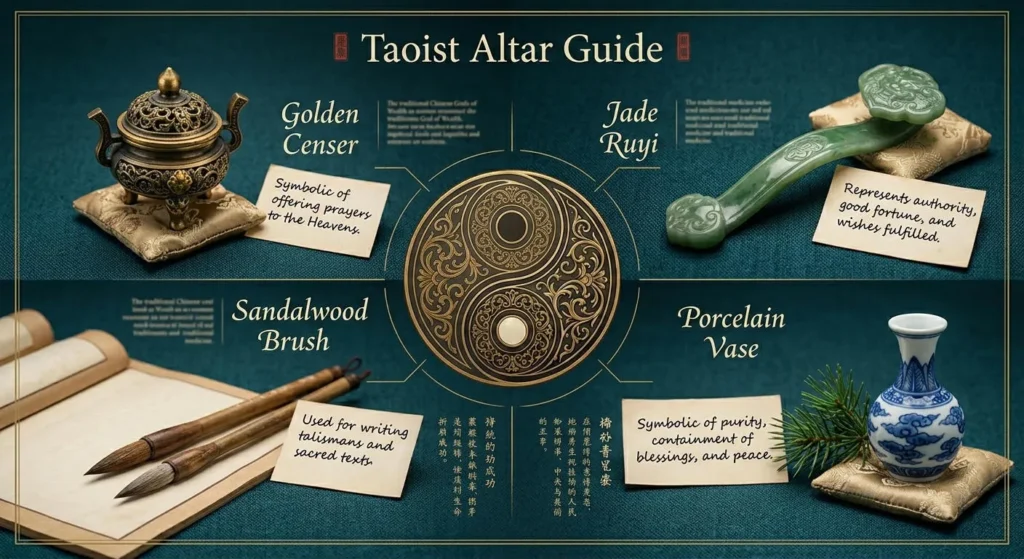
- Taoist offerings: 5 core offerings (incense, flowers, lamps, water, fruit). Water symbolizes “simplicity and non-action.” Tea and wine are often offered to show respect—some gods (like the Three Pure Ones) don’t eat meat, so keep offerings fresh and clean.
- Buddhist offerings: Incense, flowers, lamps, ointment, fruit, music. No meat or wine (wine is a big no in Buddhism)! Water symbolizes a pure heart—offerings don’t need to be expensive, just sincere.
Meaning: Taoism follows ancient Chinese sacrifice traditions—incense aroma helps “connect with gods.” Buddhism uses offerings as symbols—let go of material attachment and focus on enlightenment.
3.3 Prayer Methods: Contract vs. Heartfelt Intention
How you pray shows your core purpose! Taoism is “contract-based,” while Buddhism is “heart-based”—they’re total opposites.
- Taoism: Burn a prayer paper (write your wish on it) to “send it to heaven.” It’s like signing a contract with gods—be specific so they can “approve” your wish.
- Buddhism: Chant scriptures and share merit with all beings. It’s about heartfelt intention, not paper—no need for gods to “approve,” just be sincere!
Real-life example:
Scene: Someone’s family member is sick—they try both Taoist and Buddhist prayers to help them recover.
Taoist plan: Ask a priest to write a prayer paper, vow: “If they recover, I’ll go back to the temple to repay the vow and chant the ‘Treatise on the Response of the Tao’ 100 times.” The priest holds a ritual, and they burn incense at home every day.
Buddhist plan: Ask a monk to guide them in chanting the “Heart Sutra.” Chant every day at home, then share merit: “May this merit help the patient recover, free from pain—and may all beings be free from pain too.”
Result: The patient gets better in a week! The Taoist keeps their vow, and the Buddhist feels more peaceful from daily chanting.
Downside: Taoist prayer needs a priest (hard to do alone); Buddhist chanting needs patience (some people give up).
Tip: Ask a Taoist priest for help with prayer papers; for Buddhist chanting, make a simple daily plan and pair it with good deeds.
4. Space & Time: Temples Reflect Core Beliefs
Where and when you worship matters a lot! Taoist and Buddhist temples, as well as their festivals, reflect their cosmic views.
This is the 4th key difference between the two traditions.
4.1 Temple Layout: Yin-Yang Five Elements vs. Three Jewels
Temple layout isn’t random—it’s a direct reflection of their core beliefs!
The Chinese Taoist Association says Taoist temples need to “gather energy”; Buddhist temples highlight the “Three Jewels.”
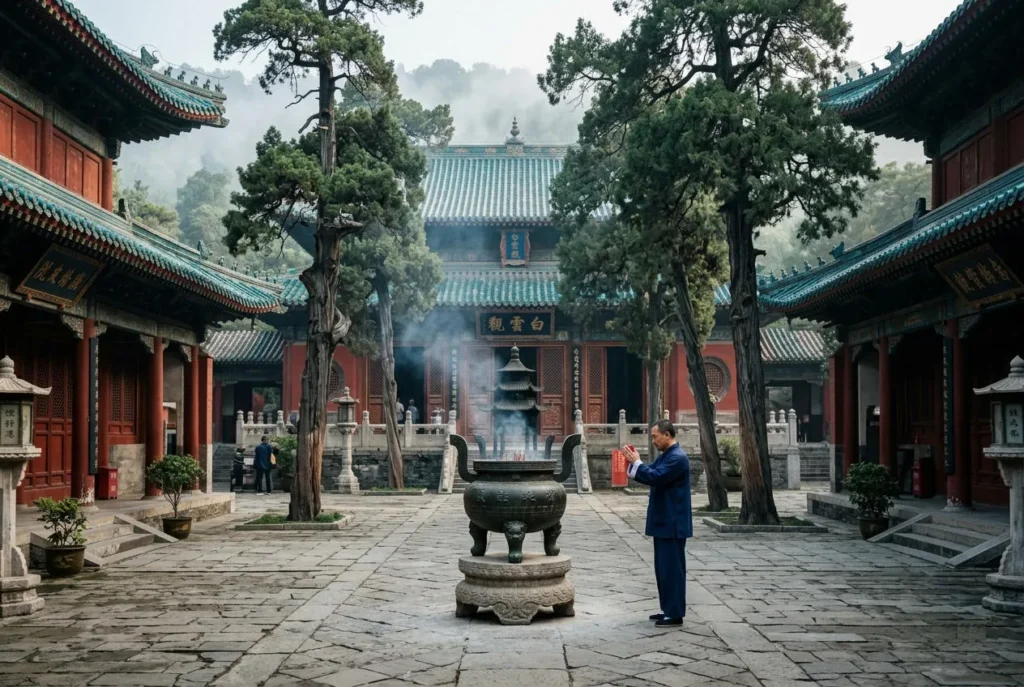
- Taoist temples: A Spirit Official Hall at the gate, main hall for the Three Pure Ones or Jade Emperor. Layout follows yin-yang five elements and “harmony between humans and nature.”
- Buddhist temples: A three-door gate (symbolizing “three liberations”), Heavenly King Hall to welcome visitors, and Main Buddha Hall as the core. Symmetrical layout highlights the Three Jewels.
4.2 Festival Focus: God Birthdays vs. Collective Practice
Festivals show how Taoism and Buddhism practice over time—they perfectly match their worship objects and goals.
- Taoist festivals: God birthdays, Three Yuan Festivals, worshipping the God of the Year. Focus on lucky dates and rituals to pray for blessings.
- Buddhist festivals: Buddha’s Birthday, Ullambana Festival. Focus on collective practice (chanting, good deeds) to improve enlightenment.
5. Core Philosophy: Divine Blessing + Self-Cultivation vs. Self-Enlightenment
This is the most important difference! All other differences come from their core philosophies—how they see “help” and “practice.”
5.1 Taoism: Divine Blessing + Self-Cultivation
Taoism’s core: Combine “divine help” with “self-cultivation.” They believe in gods’ power, but also in your own effort.
This matches Taoism’s key idea: “Your fate is in your own hands, not the gods’.”
- Divine help: Gods can influence fate—use rituals to avoid disasters and get blessings. It’s a key part of Taoist worship.
- Self-cultivation: Focus on inner alchemy (cultivating energy) and good deeds. Eventually, you won’t need to rely on gods—you’ll control your own fate.
Real-life example:
Scene: Someone wants to improve their practice and “unite with Tao,” so they choose Taoism.
Plan: Visit a Taoist temple regularly for rituals to get divine blessings. At home, practice basic inner alchemy, chant the “Tao Te Ching” daily, and be kind, selfless, and avoid evil.
Result: After 6 months, they feel calmer, healthier, and understand “Tao” better—practice works!
Downside: Inner alchemy is hard—without a teacher, you might go wrong. Some people focus too much on divine help and forget self-cultivation.
Tip: Get a Taoist priest to guide you in inner alchemy. Balance divine help and self-cultivation—respect gods, but work on your own virtue and practice.
5.2 Buddhism: Self-Reliance & Self-Enlightenment
Unlike Taoism, Buddhism’s core is “self-reliance”—no divine help is needed!
This matches Buddhism’s idea: “Buddha is a teacher, not a ruler.” The “Dhammapada” says: “Depend on yourself, depend on the Dharma.”
- Core rule: “Depend on yourself, depend on the Dharma, don’t depend on others.” Buddha guides you, but you’re responsible for your own enlightenment.
- Key practice: Break the gap between “you who bow” and “Buddha you bow to.” Focus on “looking inward,” not asking for external help.
- Core logic: Use Buddha statues as a mirror to reflect on your heart. Purify your mind through chanting and good deeds—eventually, you’ll see your true nature and become a Buddha.
5.3 Simple Analogy: Subjects Bowing to the King vs. Students Respecting Teachers
Want an easy way to remember the core difference? Here’s a perfect analogy that sums up everything:
- Taoist worship: Like subjects bowing to a king. You ask for blessings, follow the king’s rules (cosmic order), and work hard to gain approval.
- Buddhist worship: Like students respecting a teacher. You learn the way to enlightenment, the teacher (Buddha) points the way, but you have to work hard to understand it yourself.
Taoist vs. Buddhist: Different Paths, Different Goals
To sum up: Taoist and Buddhist worship look similar on the surface, but they’re totally different in core logic.
The differences cover everything—from what you worship to why, how, where, and when you worship.
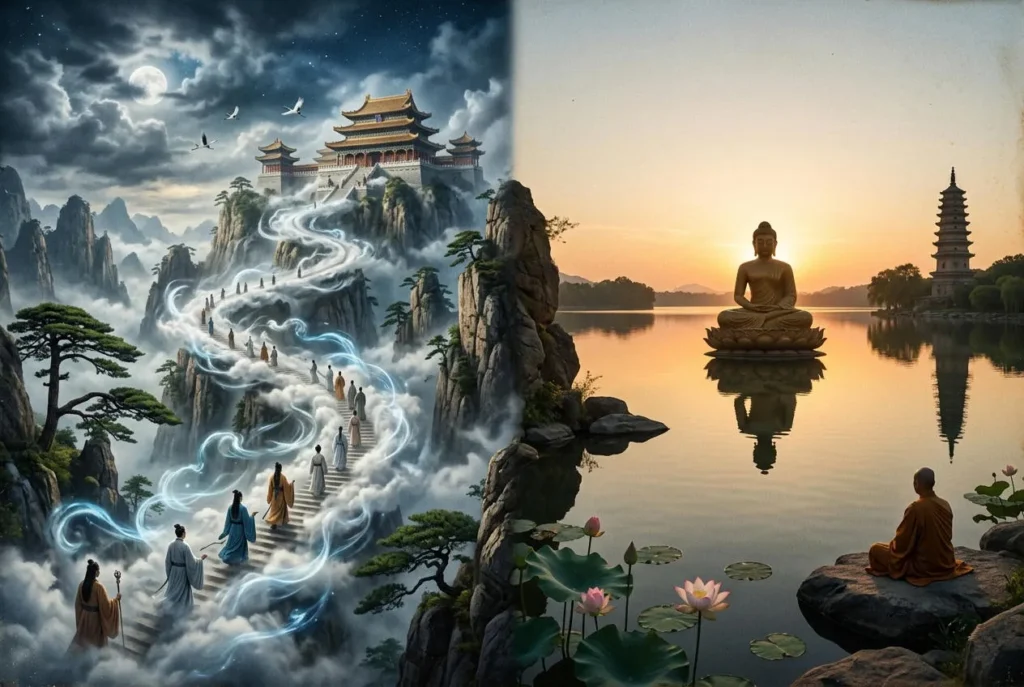
Taoist worship is a “path to heaven”: Use gods’ power to protect your family and yourself, eventually becoming an immortal and controlling your own fate.
Buddhist worship is a “path to your heart”: Use enlightenment to see the truth, purify your mind, and end reincarnation to become a Buddha.
Understanding these differences is a respect for both cultures. It also helps you know “why you bow” and “what you’re bowing to” when you visit a temple.
No more confusion—just appreciation for these two amazing traditions!
Glossary
① Three Pure Ones: Taoism’s highest gods, incarnations of Tao.
② Feathering into Immortality: Taoism’s ultimate goal—become an immortal and leave reincarnation.
③ Unity with Tao: Taoism’s core—merge your mind and body with Tao to achieve “harmony between humans and nature.”
④ Zhaijiao: Taoist rituals (fasting, chanting) to communicate with gods.
⑤ Talismans: Taoist symbols drawn by priests to communicate with gods and ward off evil.
⑥ 5 Offerings: Core offerings (incense, flowers, lamps, water, fruit) for both Taoism and Buddhism.
⑦ Burning Prayer Paper: Taoist way to send wishes to gods.
⑧ Human-Heaven Vehicle: Basic Buddhist practice to get earthly blessings and guide people to enlightenment.
⑨ Seeing Your True Nature to Become a Buddha: Buddhism’s core—awaken your inner Buddha-nature to become enlightened.
⑩ Reincarnation: Buddhist idea—beings cycle through 6 realms (heaven, human, asura, animal, hungry ghost, hell) due to karma.
⑪ Chanting and Sharing Merit: Buddhist practice—chant scriptures and share good karma with all beings.
⑫ Ziwujue: Taoist greeting (left hand covers right hand). The left hand represents yang, the right represents yin—it symbolizes yin-yang harmony and controlling the outside from within. It’s an important symbol of Taoist etiquette.
⑬ Yin-Yang and Five Elements: Taoism’s core philosophy—two opposing yet unified energies (yin and yang) and five basic elements (metal, wood, water, fire, earth). All things in the universe are made of them, interacting and balancing each other.
⑭ Three Yuan Festivals: Important Taoist festivals—Shangyuan (15th day of the first lunar month), Zhongyuan (15th day of the seventh lunar month), Xiayuan (15th day of the tenth lunar month). They correspond to the Gods of Heaven, Earth, and Water, with rituals held to pray for blessings, prosperity, and longevity.
⑮ Worshipping the God of the Year: A traditional Taoist custom. The God of the Year is in charge of good and bad luck for the year—worshipping him prays for protection from disasters and a smooth year.
⑯ Buddha Week (Da Fo Qi): A Buddhist group practice—focus on chanting and reciting Buddha’s name for 7 consecutive days to improve enlightenment and purify the heart. It’s an important Buddhist practice.
⑰ Inner Alchemy Cultivation: Taoism’s core practice—adjust your essence, energy, and spirit to cultivate an “inner elixir” in the body. The goal is to live a long life, unite with Tao, and it’s the core of Taoist practice.
What’s the core difference between Taoist worship and Buddhist worship?
The core difference lies in their philosophy. Taoism combines divine blessing and self-cultivation, worshipping gods who rule the universe, aiming to become an immortal. Buddhism focuses on self-enlightenment, worshipping enlightened teachers, aiming to achieve liberation and become a Buddha.
What etiquette should I pay attention to when entering Taoist and Buddhist temples?
For Taoist temples, greet with left hand covering right hand and bow with palms down. For Buddhist temples, greet with hands pressed together and turn palms up after bowing. Be sincere and keep quiet in both.
Do I have to make and repay vows in Taoism? What about Buddhism?
Taoism often follows “make a vow, repay the vow”—keep your promise if your wish is fulfilled. Buddhism has no mandatory vow requirement; the core is inner enlightenment and sincerity.
Should I choose Taoism or Buddhism to pray for blessings?
Choose Taoism if you focus on earthly wishes (wealth, safety). Choose Buddhism if you seek inner peace or enlightenment. Be sincere and understand their core logic.
Is there a difference between Taoism’s gods and Buddhism’s Dharma Protectors?
Yes. Taoism’s gods rule cosmic laws with supreme power. Buddhism’s Dharma Protectors only protect the faith and practitioners, not ruling fate.