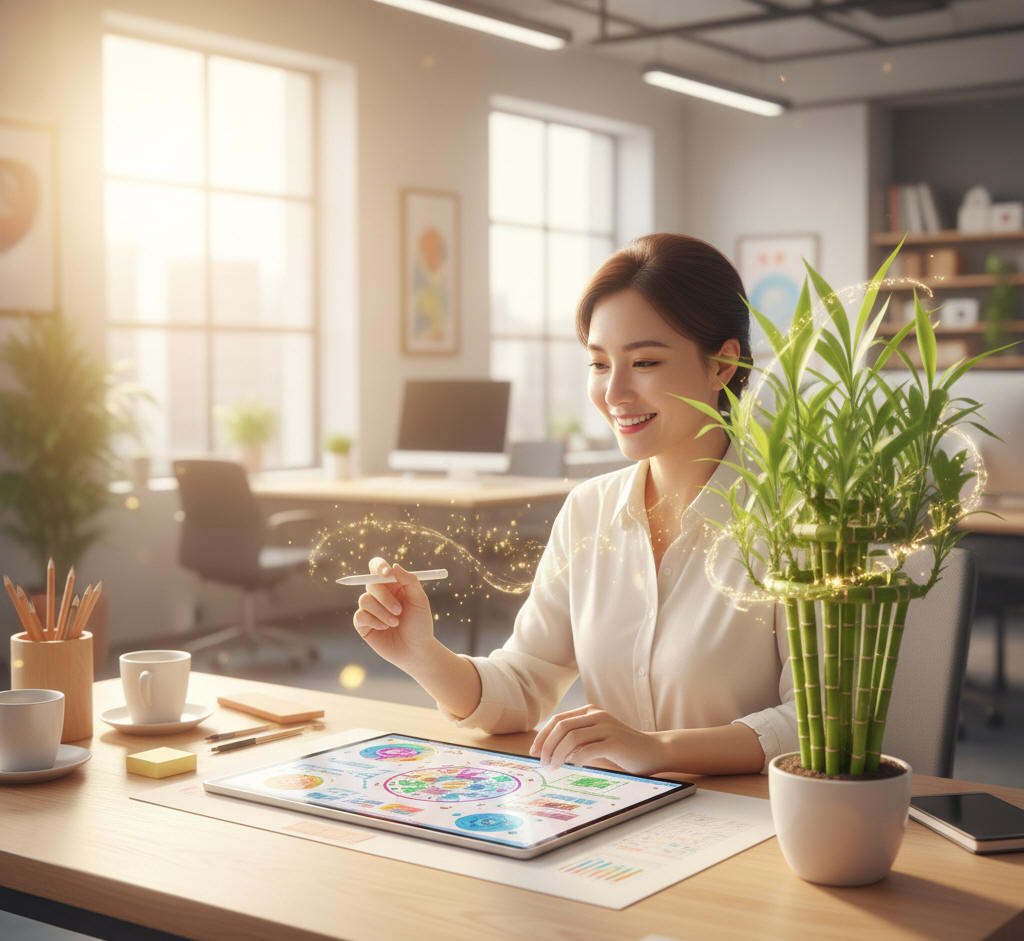
Feng Shui for Creative Workstations: Activate the Wen Chang Position to Overcome Creative Block
Creative block for creative professionals may stem from unbalanced workstation energy flow, not just capability. With 8 years of design and planning experience, I’ve summarized 10-minute practical tips to activate the Wen Chang Position, with terminology explanations, helping regain inspiration quickly. Refer to the endnotes for key Feng Shui terms.
I. Introduction: Creative Block? Blame Your Workstation Feng Shui
I once faced severe creative block: struggling with blank screens while revising client brand upgrade plans for days; getting stuck in brainstorming, with plans rejected for two weeks straight. Despite relying on coffee to cope, I couldn’t break through the mental barrier.
Initially attributing it to stress, I tried changing workplaces and drinking more coffee, but effects were short-lived. A senior colleague pointed out: “Your workstation’s southeast corner is blocked by a filing cabinet, cutting energy flow.” I then realized the 8-hour daily workstation was the issue—creativity needs a free-thinking environment, not forced effort. To solve this, let’s first break down why the Wen Chang Position is key.
II. Analysis: Why Is the Wen Chang Position the Golden Spot for Creative Roles?
In traditional Chinese metaphysics, the southeast corner of a creative workstation corresponds to “Xun Gua” (Wind Trigram) in the Early Heaven Bagua. The “Green Satchel Classic” notes: “The Xun Position is the Wen Chang Position, governing smooth thinking and literary talent.”
Xun Gua is associated with the Wood element, symbolizing benevolence, wisdom and growth—aligning with creativity’s “from nothing to something” nature. Wood energy thrives on Water (Water nurtures Wood) and is suppressed by Metal (Metal restrains Wood), making the Wen Chang Position a golden spot for creative workstations.
Modern environmental psychology supports this: a 2023 study “The Relationship Between Office Environment and Creative Productivity” found bright, well-organized offices boost creative output by 27%.
In fact, the southeast corner of creative workstations is often the brightest and most open area, fostering relaxation and clear thinking. With this logic in mind, we can activate the Wen Chang Position quickly by focusing on 3 key dimensions.
Below are practical methods for creative roles.
III. Activating the Wen Chang Position: Core Practical Methods + Advanced Tips for Creative Roles
The priority for creative workstation layout is: Lighting > Desk Tidiness > Stable Backing. These are the basics for activating the Wen Chang Position—only with stable energy flow and focus can its “smooth thinking” power fully work. Below are essential basic operations and optional advanced tips.
1. Basic Operations: How to Activate Wen Chang Position
Lighting Optimization: Boost Inspiration
The southeast Wen Chang Position of creative workstations needs bright, soft light to gather positive energy.
Prioritize window seats; use warm white desk lamps for supplementary lighting without windows, and adjust screen brightness on rainy days.
Avoid metal obstructions (Metal restrains Wood, suppressing creativity) and cool white desk lamps (causing eye strain and distraction).
Desk Organization: Smooth Energy Flow
Organize the desk by the “Green Dragon (Left) and White Tiger (Right)” Feng Shui principle: Clear clutter from the southeast Wen Chang Position.
Move the computer 10cm left, place Wen Chang brushes or green plants on the left (Green Dragon side), and keep only a pen holder and mouse on the right (White Tiger side) to ensure an open “Bright Hall” (front desk area).
Avoid large or sharp objects on the right to prevent disrupting energy flow of the Wen Chang Position.
Backing Reinforcement: Enhance Focus
The back of the seat should lean against a solid wall or high partition (“stable backing”) to stabilize energy and improve focus, avoiding weakening the Wen Chang Position’s positive energy. Avoid direct exposure to “Path Rush Sha” (corridors/doors) and “Sharp Angle Sha” (sharp wall corners). If unavoidable, place a short green radish or paste a simple landscape painting to buffer.
2. Advanced Operations (Optional): Strengthening Energy at the Wen Chang Position for Creative Roles
Strengthen the Wen Chang Position’s energy with the following zero-cost tips to boost creativity and enhance its effectiveness:
Cultivate Living Wood: Stimulate Growth Energy
Prioritize a 15-20cm young green radish in a shallow ceramic pot at the southeast Wen Chang Position.
Water it weekly to keep the soil moist but not waterlogged.
For advanced optimization, use 4 hydroponic lucky bamboo stalks in a transparent glass bottle, changing water weekly to nourish Wood energy of the Wen Chang Position.
Color Harmony: Nurture Creative Energy
Place 1-2 small natural-material objects to strengthen Wood energy: Main color (grass green/light green), secondary color (sky blue/dark black), accent color (light purple). Avoid bright, garish colors and follow a 7:2:1 ratio to nourish the energy field.
Inspiration Objects: Activate Thinking Vitality
Choose small, natural, meaningful inspiration objects (e.g., seashells, wooden commemorative coins) and place them stably at the edge of the southeast Wen Chang Position (height ≤5cm, quantity 1-2). Update regularly to keep the energy field fresh and activate thinking.
These zero-cost advanced tips can be combined with the basic layout. Next, we share customized adjustment plans for three core creative roles—design, copywriting, and planning—to better suit specific job needs.
IV. Role-Specific Adaptation: Customized Wen Chang Position Adjustments for Design/Copywriting/Planning Roles
After the general Wen Chang Position layout, targeted adjustments for different creative roles yield better results. General taboos: Avoid thorny plants, excessive metal objects, cluttered waste paper, and damp items at the southeast workplace as they disrupt the energy field and hinder creativity.
1. Design Roles: Adaptation Plan (Color + Green Plants)
Design roles need enhanced color sensitivity. Optimize the Wen Chang Position layout around the “Water nurtures Wood” principle with the following core points:
• Use light-colored wooden art supply boxes to organize brushes near the workplace, avoiding dark colors that absorb heat and disrupt energy;
• Place a small to medium-sized green radish (pot diameter ≤15cm) at the southeast of workplace to nourish Wood energy;
• Use blue file folders (Water element) to store design materials around the Wen Chang Position;
After optimization, my colleague Xiao A significantly improved color matching inspiration, shortened the illustration design cycle, and reduced client revision requests. Control green objects to 1-2 pieces, and use a white pen holder to balance vision and avoid eye fatigue affecting color judgment.
2. Copywriting Roles: Adaptation Plan (Wen Chang Tower + Inspiration Notebook)
Copywriting roles need clear thinking. A mini Wen Chang Tower is ideal for their workstation’s Wen Chang Position. Key selection and layout points:
• Choose a 5cm tall 9-story wooden Wen Chang Tower, placed at the southeast of workplace facing yourself (height ≤10cm to avoid blocking vision);
• Match with a green inspiration notebook (light yellow inner pages) placed to the right of the Wen Chang Tower;
• Form a neat “Tower on the Left, Notebook on the Right” layout to facilitate smooth thinking;
This combination helped me increase weekly high-quality creative ideas and improve proposal approval rates. Colleague Xiao B also shortened the time to outline promotional articles. For narrow desks, place the Wen Chang Tower at the edge of the southeast drawer (mini version ≤5cm, wooden/ceramic materials) to avoid blocking the operating area.
3. Planning Roles: Adaptation Plan (Map + Water Feature)
Planning roles need an open perspective. The core layout for the southeast workplace Position is “Map + Water Feature”. Key requirements:
• Hang an A4-sized world map or strategic mind map (light blue frame, green annotations) on the wall around the workplace, aligning with the “Water nurtures Wood” logic;
• Place a mini sealed, noise-free flowing water ornament at the workplace (water flow facing yourself symbolizes “inspiration converging”);
After adjustment, colleague Xiao C’s plan risk prediction rate reached 100%. If water features are prohibited, use a sealed cold evaporation humidifier or blue glass ornament (Water element) instead. Clean weekly to keep water/mist pure, avoiding stagnant water, mold, and leaks.
V. Core of Feng Shui for Creative Workstations – Harmony Between People and Environment
Implementing the general layout, advanced optimization, and role-specific adjustments of the workplace solved my creative block. I also understood Feng Shui’s core logic—it’s not metaphysics, but harmony between people and the environment.
Optimizing the southeast workstation layout for creative roles essentially follows the logic of “Bagua positioning, Five Elements balance, and activating auspicious positions” to create a free-thinking environment at the workplace.
The core of Feng Shui is “harmony between heaven and humanity”. No matter how good the workplace layout is, it needs to be paired with a positive attitude and continuous learning.
While adjusting the workplace, I spent 30 minutes daily learning industry cases and creative insights. This combination solved my creative block, improved my proposal approval rate from 40% to 70%, and helped me win the company’s “High-Quality Creative Award” for three consecutive months. In fact, the Wen Chang Position’s Feng Shui layout is only an auxiliary tool, not a panacea. It provides a good creative environment but cannot replace accumulation and thinking—the true source of inspiration is one’s own knowledge and experience.
VI. Glossary
• Xun Gua (Wind Trigram): One of the Early Heaven Bagua, corresponding to the southeast corner of creative workstations (Wood element). It governs energy flow, symbolizes flexible thinking and creativity, and is the core trigram for the workplace;
• Wen Chang Position: An auspicious Feng Shui position governing literary fortune, wisdom and strategy. The southeast corner of creative workstations is its core area, key to activating creativity;
• Five Elements Attributes: A core Feng Shui concept. Xun Gua (Wood element) symbolizes benevolence, wisdom and growth, aligning with creativity’s needs. It’s the basis for arranging the Feng shui (Water nurtures Wood, avoid Metal restrains Wood);
• Water Nurtures Wood: A Five Elements generation relationship. Water energy nourishes Wood energy, the core logic for arranging the Wen Chang Position to boost creativity;
• Metal Restrains Wood: A Five Elements restriction relationship. Metal energy suppresses Wood energy, a key taboo for the Wen Chang Position that hinders creativity;
• Wen Chang Star: An auspicious star governing literary fortune, wisdom and reputation, focusing on organization and depth;
• Wen Qu Star: Complements the Wen Chang Star, governing inspiration and creativity;
• Green Dragon: A Feng Shui symbol for the left side, governing growth and creativity (suitable for being high and dynamic);
• White Tiger: A Feng Shui symbol for the right side, governing convergence and execution (suitable for being low and static);
• Bright Hall (Ming Tang): The open area directly in front of the desk, symbolizing smooth literary fortune and a bright future;
• Sha Qi (Negative Energy): Feng Shui negative energy hindering energy flow, e.g., Sharp Angle Sha, Path Rush Sha, impure energy;
• Stable Backing (Kao Shan): A solid wall or high partition behind the seat, symbolizing support and mental stability.
• Path Rush Sha: Negative energy from facing corridors/doors directly, disrupting energy flow and suppressing creativity;
• Sharp Angle Sha: Negative energy from facing sharp wall corners directly, triggering anxiety and hindering thinking;
• Wen Chang Tower: A core Feng Shui artifact for the Wen Chang Position (commonly 9/13 stories). Suitable for copywriting and other creative roles, helping to stimulate smooth thinking;