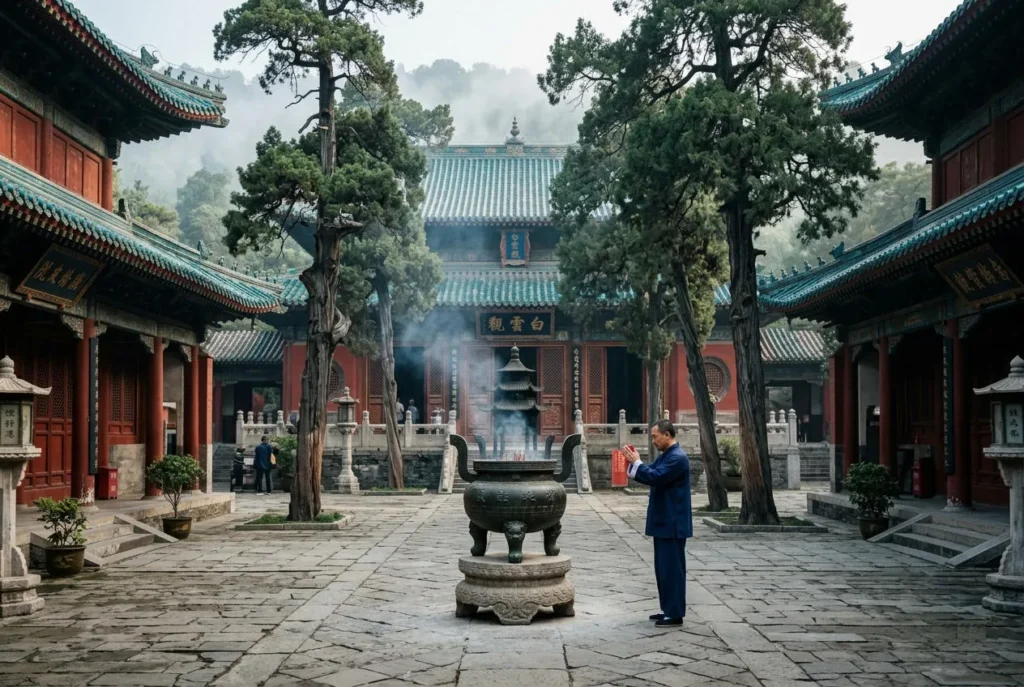
10 Taboos in Taoist Temples: Avoid Mistakes and Worship Correctly
I. Introduction
From a cross-cultural perspective, most Western societies advocate “individual freedom.” When tourists enter religious sites of other cultures, they often lack sensitivity to local etiquette.
In Taoist belief, Taoist temples (Gongguan) are not only scenic spots for visiting but also sacred places for Taoist priests to practice and believers to pilgrimage.
Let’s use an analogy to understand: If someone stepped onto the altar of a church with shoes on, or laughed loudly in a mosque, you would definitely think it’s inappropriate, right?
Similarly, Taoist temples have their own etiquette system. Following these etiquettes is not “superstition” but basic politeness to respect Taoist culture.
The purpose of this article is not to scare you, but to help you sort out these 10 most easily violated taboos — knowing “what not to do” allows you to safely do “what you should do.”
Structure preview: These 10 taboos are divided into four categories by scenario. Each taboo will explain in detail “why you can’t do it” and “what the correct way is,” from macro etiquette concepts to specific behavioral norms.
II. Taboos for Entering the Hall
1. Don’t Step on the Threshold
When entering or exiting the hall, never step on or sit on the threshold — be sure to lift your feet and cross it.
When entering the hall, if you enter from the left side of the door, step with your left foot first; if from the right side, step with your right foot first.
In Taoist concept, the threshold is regarded as the “shoulders” or “head” of the gods. Stepping on it is an offense to the gods.
At the same time, in ancient architecture, the threshold symbolizes the boundary between inside and outside the door. Stepping on it is equivalent to “trampling the boundary” — a typical disrespectful act.
Cross-cultural analogy: Many cultures have similar taboos, such as shrines and temples in Japan, where stepping on the threshold is also prohibited.
[Practical Example]
Scenario: A first-time visitor to the main hall of a Taoist temple is not familiar with the threshold etiquette and habitually steps on the edge of the threshold.
Solution: A Taoist priest traveling with him promptly reminds him of the sacred meaning of the threshold, guides him to lift his feet and cross smoothly, and step with his left foot when entering from the left.
Result: The visitor enters the hall in a standardized manner without causing disrespect and masters the basic etiquette for entering the hall.
Shortcoming: Some Taoist temples do not have threshold etiquette prompts, which easily lead to visitors stepping on it by mistake.
Suggestion: Taoist temples can post simple prompts beside the threshold (such as “Lift your feet to cross the threshold, worship the gods with reverence”) to help visitors understand quickly.
Correct Practice: When entering the door, just lift your feet and cross the threshold — no need to hesitate. Keep a natural pace, enter from both sides of the door, and never walk in the center. When exiting, also avoid stepping on the threshold.
2. Don’t Enter the Hall from the Center
When entering the hall, you must enter from the left or right side — never from the center.
If you enter from the left side of the door, step with your left foot first; if from the right side, step with your right foot first.
The center of the hall is the “divine path” (Shen Dao) — the exclusive path for gods to pass. Mortals cannot occupy it.
This taboo comes from the core Taoist concept of “respecting gods as if they are present” (Jing Shen Ru Zai). The “Taoist Etiquette Norms” (Dao Jiao Yi Fan) clearly records: “The divine path is in the center; mortals walk on the sides to show humility,” which fully reflects the reverence for the gods.
Entering from the sides is both humility to the gods and a specific expression of respect.
Correct Practice: Before entering, observe the left and right sides of the door and choose the closer one to enter. Walk gently — never run or rush. When exiting, also exit from the sides and don’t leave with your back to the gods’ statues — exit sideways or step back a few steps before turning around.
III. Behavioral Taboos in Taoist Temples
1. Don’t Leave with Your Back to the Gods
When walking or leaving the hall, never turn your back to the gods’ statues.
Turning your back to the gods’ statues is regarded as a disrespectful act of “showing your back to others.”
Behind this is the way of respecting the gods — facing the gods is the basic way to express reverence. If you turn around and face away, it is equivalent to “turning your back to the gods,” which is an obvious disrespectful act.
[Practical Example]
Scenario: After worshiping, a visitor is in a hurry to leave and turns around, walking quickly out of the hall with his back directly to the gods’ statues.
Solution: A temple staff member comes forward to gently remind him, guiding him to step back 3 steps, bow to the gods’ statues, and then exit the hall sideways.
Result: The visitor corrects his behavior in time, makes up for the disrespect, and masters the correct etiquette for exiting the hall.
Shortcoming: Some visitors easily ignore the exit etiquette because they are in a hurry and may feel rushed after being reminded.
Suggestion: Prompts can be set inside the hall door to guide visitors to exit in an orderly and respectful manner.
Correct Practice: When exiting the hall, exit sideways or step back a few steps before turning around. When moving inside the hall, try to keep facing the gods’ statues and don’t turn your back casually. If you need to go to the other side of the hall, never cross directly in front of the gods’ statues — take the passages on both sides of the hall.
2. Don’t Point at or Touch the Gods’ Statues
Never point directly at the gods’ statues with your finger, no matter how exquisite or unique they are.
At the same time, never touch, climb, or lean on the statues, nor make inappropriate gestures such as V-signs or grimaces when taking photos in front of them.
Taoism believes that statues that have undergone the consecration ceremony (Kai Guang) carry the spirituality of the gods. Pointing casually with your finger is a great disrespect.
Statues are sacred symbols. Touching, climbing, and other behaviors will damage their solemnity. The Chinese Taoist Association (Zhong Guo Dao Jiao Xie Hui) also clearly stipulates that statues in Taoist temples must be kept solemn, and any profane touching is prohibited.
Correct Practice:
1. If you want to know the identity of the statue or related stories, gesture with your whole hand (palm up, fingers together) — never point with one finger.
2. Keep an appropriate distance when viewing the statue — don’t get too close.
3. If the temple allows taking photos, maintain a dignified posture and don’t make inappropriate gestures when taking photos with the statue. Some temples clearly prohibit taking photos — please pay attention to the relevant notices in advance.
3. Don’t Be Loud or Take Photos Without Permission
Keep quiet in the Taoist temple — never speak loudly, laugh, or make noise, nor answer or make calls casually.
Do not take photos, record videos, or record audio without permission, especially when Taoist priests are performing rituals (Zhai Jiao Ke Yi) — never take photos or make noises to interfere.
Taoist temples are quiet places for practice. Being loud will not only disturb the Taoist priests’ practice but also affect other believers’ worship.
Zhai Jiao Ke Yi (Zhai Jiao rituals) are sacred Taoist religious rituals. The “Taoist Zhai Jiao Rituals” (Dao Jiao Zhai Jiao Yi Gui) clearly emphasizes that the Zhai Jiao process must be “quiet and solemn, no noise or reckless movement.” Taking photos and making noises will seriously damage the solemnity of the ceremony.
[Practical Example]
Scenario: A visitor is answering a call loudly in the Taoist temple, just as the Taoist priests are performing a Zhai Jiao ceremony.
Solution: A temple volunteer comes forward to signal him, reminding him to hang up the phone and take the call in the designated rest area of the temple, informing him of the solemnity of the Zhai Jiao ceremony.
Result: The visitor hangs up the phone immediately and apologizes actively, keeping quiet for the rest of the time and not interfering with the ceremony again.
Shortcoming: Some visitors are not clear about the specific time of the Zhai Jiao ceremony and easily interfere unintentionally.
Suggestion: Taoist temples can post prompts about the time of Zhai Jiao ceremonies at the entrance and beside the hall in advance, and arrange volunteers to guide during the ceremony.
Correct Practice:
1. After entering the Taoist temple, set your phone to silent mode and speak as softly as possible.
2. If you see a “No Photos” sign, strictly follow the rules.
3. If the temple allows taking photos, be sure to turn off the flash — the flash will disturb the Taoist priests’ practice and damage the spiritual environment of the statue.
4. If you see Taoist priests performing rituals, watch quietly and respectfully — never disturb them.
4. Don’t Touch Ritual Tools Without Permission
Never touch or knock on ritual tools (Fa Qi) such as bells, drums, chimes, wooden fish, and bells in the hall casually. Also, don’t move offerings such as fruits, incense burners, and candlesticks on the offering table casually.
Ritual tools (Fa Qi) are sacred tools used by Taoist priests in Zhai Jiao ceremonies. Each tool has a specific playing method, rhythm, and purpose. Knocking casually is a profanity to the tools.
The Taoist classic “Taoist Canon” (Dao Zang) records: “Ritual tools play the fairy music to respect the saints and worship the gods; they cannot be randomly touched by ordinary people,” which clearly points out the sacredness of ritual tools. They cannot be knocked casually, otherwise, “the gods will blame and bring disasters.”
Correct Practice: Follow the principle of “look but don’t touch.” If you are interested in the ritual tools (Fa Qi), observe quietly or ask the Taoist priests politely. Don’t lean on the offering table or walls. Stand with your palms naturally or bow your hands (Gong Shou) to show respect.
5. Don’t Stand in Front of Those Kneeling to Worship
If someone is kneeling on the mat to worship the ancestors, never pass in front of the kneeling person or stand in front of them.
Imagine: When you worship the gods, the statue is right in front of you. If someone stands between you and the statue, it will not only interfere with your worship (an impolite act) but also block the “line of sight” between you and the gods.
This etiquette reflects the Taoist concept of “respecting others as respecting gods” (Jing Ren Ru Jing Shen), which not only respects the piety of the worshiper but also reveres the majesty of the gods.
Correct Practice: If you see someone kneeling to worship, walk around from behind the mat — never cross directly in front of the kneeling person. You can wait patiently for them to finish worshiping before going forward to salute.
IV. Taboos for Interacting with Taoist Priests
1. Don’t Use the Buddhist Prayer Gesture — Use the Taoist Hand-Clasping Gesture Instead
In Taoist temples, never salute the gods or Taoist priests with the Buddhist prayer gesture (palms together).
This is the most common mistake many overseas visitors make, just because the “Asian religious etiquette” they see on TV and the Internet is mostly the Buddhist prayer gesture.
Taoism has its own independent etiquette tradition. The prayer gesture is an exclusive worship gesture of Buddhism. Using it in Taoist temples is equivalent to worshiping Taoist gods in the way of other religions — a disrespect to Taoist culture.
The correct way is to use the unique Taoist hand-clasping gesture (Gong Shou Li): hold your right hand with your left hand, raise it to your chest, and bow your head slightly to express respect.
Why hold the left hand outside and the right hand inside? In traditional Chinese concepts, the left is respected. The left hand symbolizes “yang,” “goodness,” and “civilization,” while the right hand represents “yin,” “evil,” and “force.” Wrapping the right hand with the left hand means promoting good and hiding evil.
This meaning comes from Laozi’s “Tao Te Ching” (Dao De Jing): “The gentleman values the left at home and the right in warfare,” which is one of the core connotations of Taoist etiquette.
Additional Explanation:
1. For peers, the hand-clasping gesture (Gong Shou Li) is enough.
2. For elders or gods, you need to perform the bow gesture (Zuo Yi) — bow your body and hold your hands together in front of your abdomen to bow.
3. If you need to salute the gods more formally, you can use the Taoist kowtow ceremony (Kou Bai Li). The most common one is one bow and three kowtows (Yi Li San Kou), and the most grand one is three bows and nine kowtows (San Li Jiu Kou).
Cross-cultural Tip: The hand-clasping gesture (Gong Shou Li) originated in the era of Laozi, more than 2,500 years ago. Before the Qing Dynasty, it was a common etiquette for all Chinese people when meeting.
2. Don’t Ask About Age, Marriage, or Family Affairs
When talking to Taoist priests, never ask about personal matters such as age, marital status, family origin, or reasons for becoming a monk. This is called “Three Don’t Asks” (San Bu Wen) in Taoism.
[Authoritative Interpretation] The “Code of Conduct for Taoist Clergy” (Dao Jiao Jiao Zhi Ren Yuan Xing Wei Gui Fan) issued by the Chinese Taoist Association (Zhong Guo Dao Jiao Xie Hui) clearly stipulates that we should respect the personal practice privacy of Taoist priests and not casually ask about their secular personal affairs — this is the basic respect for Taoist priests’ practice.
Specific Interpretation:
1. Don’t ask about age: Taoism pursues “longevity and eternal vision” (Chang Sheng Jiu Shi), with cultivating to become immortals as the core goal of practice. Taoist priests practice the way of longevity and avoid talking about age, believing that a person’s cultivation level has nothing to do with their age.
Asking about age is equivalent to implying that “people will eventually grow old and die,” which is contrary to the Taoist practice concept of “immortality.”
2. Don’t ask about secular affairs: Quanzhen School (Quan Zhen Pai) Taoist priests are monks who have long “left the mundane world.” Asking about their family, origin, and other information is asking about the secular identity they have long let go of — very inappropriate.
3. Don’t ask about cultivation level: Never ask Taoist priests questions like “What level of cultivation have you reached?” or “Can you fortune-tell?” Taoism, magic, and divination (Dao Fa Shu Shu) are personal practice matters of Taoist priests. Casually asking about their cultivation level is impolite.
Cross-cultural Comparison: In Western culture, asking “How old are you?” when meeting for the first time is acceptable in some occasions, but in Taoist culture, it is a serious taboo.
Interestingly, Buddhism has “monks don’t talk about their surnames” (don’t ask Taoist priests’ secular surnames), and Taoism has “Taoists don’t talk about their age” (Dao Bu Yan Shou) — the two form an interesting contrast in religious culture.
As an old Chinese saying goes: “Monks don’t talk about their names; Taoists don’t talk about their age.”
[Practical Example]
Scenario: A visitor sees a Taoist priest and curiously asks, “How old are you, Master?” and “Why did you become a monk?” The Taoist priest looks embarrassed and does not respond.
Solution: A companion promptly reminds the visitor of the “Three Don’t Asks” (San Bu Wen) taboo, guiding him to change the topic to ask about the temple’s ancestor worship, Taoist doctrines, and other related content.
Result: The visitor realizes his disrespect and apologizes actively. The subsequent conversation is very pleasant, and he also learns more about Taoist culture.
Shortcoming: Some visitors easily offend Taoist priests unintentionally because they are not familiar with the “Three Don’t Asks” (San Bu Wen) taboo.
Suggestion: Taoist temples can post “Etiquette for Talking to Taoist Priests” in the visitor rest area, clarifying the content of “Three Don’t Asks” (San Bu Wen) to guide in advance.
Correct Practice: When talking to Taoist priests, you can ask about sects, Taoist names, Taoist doctrines, and other related topics. In daily communication, you can talk to them like ordinary people — Taoist priests also come from the secular world. They don’t require everyone to be “overly cautious,” just basic mutual respect.
Here’s a safe opening line for you: “Hello, Master. May I ask which ancestor is enshrined in this Taoist temple (Gongguan)?”
V. Taboos for Offerings
Taoist offerings are centered on the “Five Offerings” (Wu Gong): incense, flowers, lamps, water, and fruits. Regarding offerings, the following key taboos need to be noted:
[Authoritative Citation] At the end of 2025, the Chinese Taoist Association (Zhong Guo Dao Jiao Xie Hui) issued the “Measures for the Administration of Offering Worship in Taoist Activity Venues” (Dao Jiao Huo Dong Chang Suo Dian Tang Gong Pin Gong Feng Guan Li Ban Fa), which clearly regulates the types of offerings and related taboos, providing clear guidance for believers and visitors.
Specific Taboos:
1. No Meat, Seafood, Eggs, or Alcohol
Taoism advocates reverence for life and non-killing. Offerings to gods must be vegetarian. The Chinese Taoist Association (Zhong Guo Dao Jiao Xie Hui) clearly stipulates that Taoist activity venues should not offer meat, seafood, tobacco, alcohol, or alcoholic beverages in principle.
2. No Fruits with Special Taboos
(1) Plums cannot be offered to Taishang Laojun — because the 18th incarnation of Taishang Laojun is Laozi, whose surname is Li and given name is Er. Offering plums is a taboo to avoid his given name.
(2) Pomegranates cannot be offered to Xuantian Shangdi (Zhenwu Dadi) — pomegranate seeds are spread through animal feces, which are considered unclean. In addition, Zhenwu Dadi “threw away his intestines and stomach” when cultivating, and the meaning of pomegranate “many seeds” is contrary to his cultivation story.
(3) Pears cannot be offered to gods — “pear” (li) sounds the same as “separation” (li) in Chinese, symbolizing separation. Such fruits are specially offered to lonely ghosts.
(4) Offerings of fruits must be fresh and intact. Do not offer cut fruits (such as cut watermelons, muskmelons, etc.), rotten or spoiled fruits, nor fruits that have been eaten or used to worship the dead.
3. Do Not Blow Out Incense with Your Mouth
If the flame is too large after lighting the incense, never blow it out with your mouth — blowing with your mouth is considered to emit turbid qi, which is disrespectful to the gods. The correct way is to gently fan it with your hand or shake the incense stick slightly to put out the flame.
4. It Is Advisable to Hold Incense with Your Left Hand
When inserting incense, you should hold it with your left hand — in traditional Chinese culture, the left hand is regarded as the clean hand (the ancients mostly used their right hand for labor, so the right hand is regarded as the “dirty hand”). Holding incense with the left hand can better show respect for the gods.
[Practical Example]
Scenario: A visitor is about to place offerings to the gods, carrying pork, white wine, and cut watermelons, when he is stopped by a Taoist priest.
Solution: The Taoist priest patiently explains the taboos of offerings, tells him that meat, seafood, alcohol, and cut fruits cannot be offered to the gods, and suggests that he replace them with fresh apples, oranges, and mineral water.
Result: The visitor replaces the offerings in time, completes the worship correctly, and masters the core taboos of offerings.
Shortcoming: Some visitors are not familiar with the taboos of offerings, and the offerings they prepared in advance do not meet the requirements and need to be replaced temporarily.
Suggestion: Taoist temples can post offering guidelines beside the offering table, clarifying the items that can be offered and prohibited, and set up an information desk at the entrance to facilitate visitors’ inquiries.
Additional Tip: If you are an overseas visitor and are not sure what offerings to bring, the simplest way is: do not bring any offerings, only a respectful heart; you can also bring a bunch of fresh flowers and a bottle of mineral water — these are safe choices that will not go wrong.
VI. Conclusion
Respect the gods, respect the Taoist priests, respect the sacred place of the Taoist temple, and respect every believer around you.
To help you remember easily, here are three golden rules summarized:
1. Keep quiet — Taoist temples are quiet places for practice, so do not make noise.
2. Keep a distance — do not touch, point, or disturb, and reverence the sacred.
3. Keep humble — ask if you don’t understand, learn if you can’t do it, and observe quietly if you are not familiar with it.
Cross-cultural Perspective: Every religion has its unique etiquette traditions. Buddhism has the prayer gesture (palms together), Christianity has the cross gesture, Islam has bowing and kowtowing, while Taoism has the hand-clasping gesture (Gong Shou Li) and a series of exclusive taboos.
Understanding and following these etiquettes is not “superstition,” but respect for different cultures, and even a specific practice of cross-cultural understanding and tolerance.
Conclusion: Next time you walk into a Taoist temple, remember these 10 taboos, and you can visit, worship, and pray with peace of mind, without worrying about offending the gods or Taoist priests. And the most important thing is — with sincerity, all ways are accessible.
Glossary
[1] Consecration (Kai Guang): A Taoist term, referring to the process of endowing statues and ritual tools (Fa Qi) with spirituality through specific Zhai Jiao ceremonies, making them sacred carriers that can be enshrined and worshipped. It is a very solemn ceremony in Taoism.
[2] Zhai Jiao Ke Yi (Zhai Jiao Rituals): A Taoist term, referred to as “Zhai Jiao” for short. It is a general term for various Taoist religious ceremonies, including praying for blessings, eliminating disasters, and transcending the dead. The ceremony process must follow strict rituals and require being quiet and solemn.
[3] Ritual Tools (Fa Qi): A Taoist term, referring to various tools used by Taoist priests in Zhai Jiao ceremonies and practice, such as bells, drums, chimes, wooden fish, etc. Each ritual tool has a specific purpose and symbolic meaning and is sacred.
[4] Hand-Clasping Gesture (Gong Shou Li): One of the core etiquettes of Taoism, also known as “Zuo Yi.” The gesture is to hold the right hand with the left hand, raise it to the chest, and bow the head slightly to express respect. The hand-clasping gesture (Gong Shou Li) varies slightly on different occasions (peers, elders, gods).
[5] Kowtow Ceremony (Kou Bai Li): A grand Taoist etiquette, divided into one bow and three kowtows (common) and three bows and nine kowtows (most grand). It is used to formally worship gods or elders, and the movements must be standardized and pious.
[6] Quanzhen School (Quan Zhen Pai): One of the main sects of Taoism, founded in the Jin Dynasty. It advocates the integration of Confucianism, Buddhism, and Taoism. Taoist priests must become monks to practice, not marry, not eat meat, and take cultivating to become immortals as the core goal.
[7] Taoism, Magic, and Divination (Dao Fa Shu Shu): A Taoist term, an important part of Taoist practice. “Dao” is the core, “Fa” is the method, “Shu” is the skill, and “Shu” (number) is the law. It covers divination, talismans, health preservation, and other contents, which are the personal practice scope of Taoist priests.
[8] Five Offerings (Wu Gong): The core form of Taoist offerings, referring to five kinds of offerings: incense, flowers, lamps, water, and fruits, which symbolize “purity, auspiciousness, light, purity, and completeness” respectively. They are the most basic and solemn combination of offerings for worshipping gods.
What should I do if I accidentally step on the threshold when entering a Taoist temple?
There is no need to be overly nervous. You can immediately stop stepping, lift your feet to cross the threshold, and bow to the gods’ statues to express apology. The core is to be respectful; unintentional mistakes will not be severely blamed.
If I am not sure whether taking photos is allowed in the Taoist temple, what should I do?
First, observe the prompt signs in the Taoist temple. If there is no clear prompt, you can politely ask the Taoist priests or staff. Take photos only after getting permission. Be sure to turn off the flash when taking photos and maintain a dignified posture.
What should I do if I accidentally ask a Taoist priest about his age when talking to him?
You can apologize immediately, explain that you are not familiar with the taboo of “Taoists don’t talk about their age” (Dao Bu Yan Shou), and then quickly change the topic, such as asking about the history of the Taoist temple or the deeds of the ancestors, to avoid focusing on personal matters.
If there are no suitable fruits for offerings, can I use mineral water instead?
Yes. Mineral water belongs to “water” in the “Five Offerings” (Wu Gong), which is a safe and appropriate offering. When offering, keep respectful and place it with both hands; there is no need to deliberately pursue expensive offerings.
The ritual tools (Fa Qi) in the Taoist temple look very special. Can I ask the Taoist priest how to use them?
Yes. You need to bow to the Taoist priest first, politely explain your curiosity, and ask if he can explain the use of the ritual tools (Fa Qi). If the Taoist priest agrees, listen carefully and never take the initiative to ask to touch or operate them.
If I accidentally turn my back to the gods’ statues when exiting the hall, do I need to re-enter the hall to salute?
There is no need to re-enter the hall. You can turn around slightly outside the hall door, bow to the gods’ statues to express apology, and remember to exit sideways or step back and turn around when exiting later.