Beginner’s Guide to Bazi Reading 3: Bazi Gods and Spirits System
In the last episode, we mastered the core of Four Pillars of Destiny — the Shi Shen system. This lesson focuses on the Gods and Spirits system, helping beginners refine judgments on good and bad fortune, avoid common misunderstandings in interpreting Gods and Spirits, and quickly grasp the key usage of Gods and Spirits with authoritative numerology theories and practical cases. Let’s lay a solid foundation for your Four Pillars learning journey!
V. Brief to Bazi Gods and Spirits
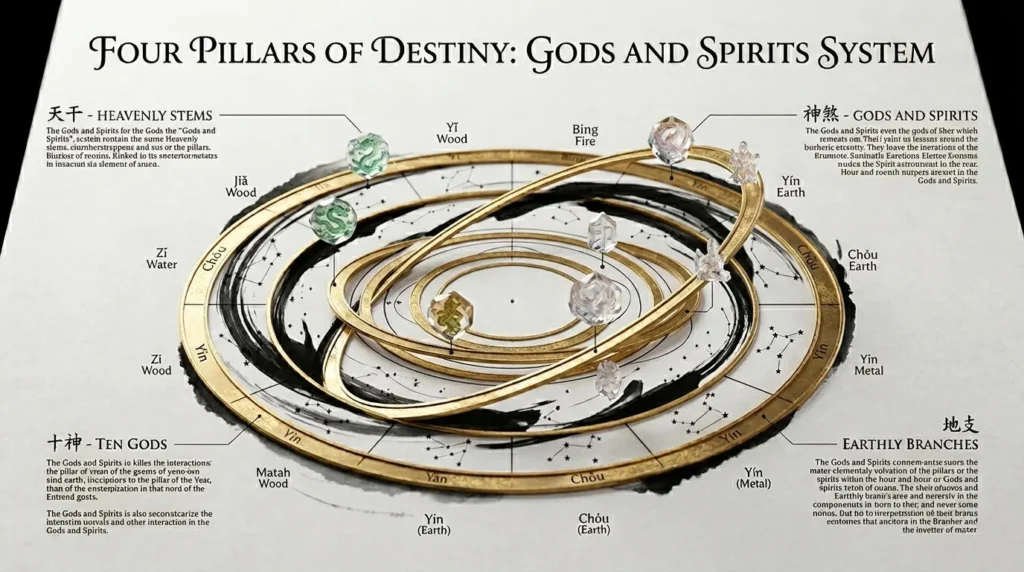
The core of this section is to supplement the details of good and bad fortune in Four Pillars of Destiny. It helps you understand the nature and role of Gods and Spirits, as well as their practical application in interpretation — so you won’t fall into the trap of “only focusing on Gods and Spirits” when interpreting Four Pillars.
Many beginners become overly obsessed with Gods and Spirits after starting to learn Four Pillars of Destiny. Some even replace the Five Elements and Shi Shen system with Gods and Spirits — this is a common mistake for beginners in Four Pillars of Destiny.
Simply put, the essence of Gods and Spirits in Four Pillars of Destiny is “labels of good and bad fortune information”, and their core roles are twofold:
1. They cannot replace the Five Elements (or the Shi Shen system) — Gods and Spirits are only auxiliary tools for interpreting Four Pillars of Destiny;
2. They can refine the details of good and bad fortune in your destiny, just like “adding or subtracting” to your life fortune — lucky spirits add luster to your blessings, while unlucky spirits warn you of potential risks.
Here is a core principle that all beginners of Four Pillars of Destiny must remember:
The Five Elements (and the Shi Shen system) are the “main line” of interpreting Four Pillars of Destiny — they determine the overall direction of your life;
Gods and Spirits are the “side line” — they only supplement details and refine judgments on good and bad fortune, and you must never put the cart before the horse.
“San Ming Tong Hui”, an authoritative numerology book from the Qing Dynasty, clearly records: “Gods and Spirits assist the Five Elements, distinguish good from bad, and cannot be discussed alone.” This sentence accurately defines the position of Gods and Spirits in Four Pillars of Destiny — they are auxiliary to the Five Elements and Shi Shen. Interpreting Gods and Spirits separately from the Shi Shen system will lead to one-sided and inaccurate judgments, and even mislead you.
1. Detailed Explanation of Common Bazi Gods and Spirits
We have sorted out the most common and frequently used Gods and Spirits for beginners in Four Pillars of Destiny. We have abandoned complex checking methods (beginners can directly query using Four Pillars of Destiny tools), explained their core meanings in plain language, and matched them with practical cases of Four Pillars of Destiny. There is no need to memorize them by heart — focus on understanding the specific impact of Gods and Spirits on your life.
Tianyi Noble Person: The luckiest spirit in Four Pillars of Destiny! Its core is “turning misfortunes into blessings and receiving help from noble people.”
Explanation: No matter which stage of life you are in, someone will always reach out to help you get out of trouble and turn danger into safety, which overall improves your Four Pillars of Destiny fortune. You will rarely encounter desperate situations — it is the core embodiment of “noble people luck” in Four Pillars of Destiny.
Practical Case: A consultant had Tianyi Noble Person in his Year Pillar of Four Pillars of Destiny. When he was a child, his parents’ business failed and the family fell into trouble. His grandfather (a noble elder) stepped forward to connect resources and resolve the crisis. This not only helped the family get through the difficult times but also made the consultant develop a grateful and down-to-earth personality from an early age.
Peach Blossom (Xianchi): A “barometer” of popularity and relationships in Four Pillars of Destiny — neither lucky nor unlucky.
Explanation: It represents popularity and personal charm in your Four Pillars of Destiny, and is closely related to relationships and opposite-sex attraction. Whether it is lucky or not depends on the overall combination of your Four Pillars of Destiny.
Advantage: You’re born with good popularity and charm, easy to attract others’ attention, and have strong social skills;
Disadvantage: You may get distracted by relationships, affecting your focus on studies or career;
Advice: Grasp the proper measure, treat relationships rationally, distinguish between primary and secondary priorities, avoid letting love interfere with your plans — and align with the overall fortune of your Four Pillars of Destiny.
Practical Case: A professional woman had Peach Blossom in her Month Pillar of Four Pillars of Destiny. She was extremely popular — both colleagues and clients were willing to cooperate with her. She was successfully promoted to supervisor with her network. Later, she adjusted her mindset, balanced love and work, and both developed steadily.
Yi Ma (Traveling Horse): A “signal” of busyness and changes in Four Pillars of Destiny — no absolute luck or misfortune.
Explanation: It mainly represents busyness, changes, travel, studying abroad, and working away from home in your Four Pillars of Destiny. You are naturally not fond of staying in the same place — it is a key spirit for judging change fortune in Four Pillars of Destiny.
Advantage: Changes hide new opportunities! You can broaden your horizons, gain experience, and are suitable for working abroad, starting a business, or furthering your studies;
Disadvantage: It comes with busyness and tiredness. You may not have a fixed home and lack a sense of stability;
Advice: Combine it with the overall combination of your Four Pillars of Destiny, actively seize opportunities in changes, rationally plan your travels and development, and balance busyness and stability.
Hua Gai: A trait of coexisting loneliness and talent in Four Pillars of Destiny.
Explanation: It represents loneliness, artistic talent, and karmic connection with metaphysics in your Four Pillars of Destiny. You are introverted, unsociable, and not good at socializing — it is an important spirit for judging talent and personality in Four Pillars of Destiny.
Advantage: You’re likely to stand out and achieve success in fields that require focus, such as art, metaphysics, culture, and scientific research;
Disadvantage: Poor social skills, easy to feel lonely, and hard to integrate into lively occasions;
Advice: No need to force yourself to change! Use your talent to excel in your field, and expand your social circle appropriately.
Gu Chen & Gua Su: “Independent tendency” in relationships — NOT a “lonely fate”!
Explanation: It represents loneliness and independence in your Four Pillars of Destiny. Contrary to popular misunderstanding, it is not a “lonely fate” — you are just more inclined to be independent and not good at relying on others. It is an important detailed spirit for interpreting relationship fortune in Four Pillars of Destiny.
Impact: You’re likely to marry late, or prefer being alone after marriage. You’re not good at expressing feelings, which may cause estrangement with your partner;
Advice: Communicate and tolerate your partner more, learn to express your feelings, and take the initiative to get closer — improve your relationship model.
Fu Xing Noble Person: A “blessing” for prosperity, happiness, and health in Four Pillars of Destiny — lucky!
Explanation: It represents blessings, health, and good luck in your Four Pillars of Destiny. You have a lucky life overall, with smooth progress, and rarely encounter major disasters. It is the core lucky spirit for blessings in Four Pillars of Destiny.
Core Trait: You have a calm mind, are kind to others, and gentle in dealing with things. Whether in career or life, you can get through difficulties smoothly without too much hard work.
Lu Shen: A “guarantee” for food, clothing, and career in Four Pillars of Destiny — lucky!
Explanation: It represents salary, food, clothing, and career foundation in your Four Pillars of Destiny. You are likely to have a stable income in your career and a prosperous life. It is the core lucky spirit for interpreting career and wealth fortune in Four Pillars of Destiny.
Suitable Scenarios: Especially suitable for public office or stable jobs. You can obtain long-term development and security, with steady career progress and stable income.
Yang Ren: A “double-edged sword” of toughness and risk in Four Pillars of Destiny — unlucky, need to be cautious!
Explanation: It represents toughness, impulsiveness, and disasters in your Four Pillars of Destiny. You are irritable, stubborn, lack patience, and prone to quarrels with others. It is a key unlucky spirit to be wary of in Four Pillars of Destiny.
Risk: You may encounter unexpected disasters, financial losses, and great ups and downs in your Four Pillars of Destiny fortune;
Advice: Restrain your temperament, act cautiously, learn to control your emotions, and turn your “toughness” into the courage to do things — not a trigger for disasters.
Jie Sha: A “warning” of storms and obstacles in Four Pillars of Destiny — unlucky, need to avoid!
Explanation: It represents storms, obstacles, accidents, and verbal disputes in your Four Pillars of Destiny. You are likely to encounter sudden situations in life, and things often go through twists and turns. It is a key unlucky spirit to avoid in Four Pillars of Destiny.
Advice: Avoid risks in advance, make decisions carefully, stay calm when facing problems, don’t be impulsive, and reduce obstacles.
Tian De Noble Person: A “gospel” for resolving disasters in Four Pillars of Destiny — lucky!
Explanation: It represents virtue, noble people, and disaster resolution in your Four Pillars of Destiny. You are kind-hearted, generous to others, and have good moral character, which can resolve your own disasters and misfortunes. It is the core lucky spirit for disaster resolution in Four Pillars of Destiny.
Core Advantage: You often receive help from noble people in life, and your Four Pillars of Destiny fortune is stable. Even if you encounter difficulties, you can turn misfortunes into blessings, with few major twists and turns.
Xue Tang (School): A “boost” for studies and wisdom in Four Pillars of Destiny — lucky!
Explanation: It represents studies, wisdom, and comprehension in your Four Pillars of Destiny. You have strong learning ability, high understanding, and can easily accept new knowledge and skills. It is the core lucky spirit for interpreting study fortune in Four Pillars of Destiny.
Suitable Scenarios: Whether you’re a student or a professional, you can gain an advantage in learning and self-improvement. It’s suitable for deepening your professional field and mastering core skills quickly.
Tian Luo Di Wang (Heavenly Net & Earthly Net): A “symbol” of difficulties and constraints in Four Pillars of Destiny — unlucky, need to pay attention!
Explanation: It represents constraints and difficulties in your Four Pillars of Destiny (not necessarily imprisonment, mostly being trapped in difficulties). You are prone to falling into predicaments and finding it hard to display your talents. It is a key unlucky spirit to pay attention to in Four Pillars of Destiny.
Advice: Learn to be flexible, relax your mind, adjust your direction in time when facing difficulties, don’t be stubborn, and get rid of constraints.
De Xiu Noble Person: A “manifestation” of talent and character in Four Pillars of Destiny — neither lucky nor unlucky.
Explanation: It represents talent, character, and temperament in your Four Pillars of Destiny. You have an outstanding temperament, good character, and talent. It is a supplementary spirit for interpreting personality and talent in Four Pillars of Destiny.
Disadvantage: You’re too gentle, lack drive, not decisive enough, and easy to miss opportunities;
Advice: Balance gentleness and decisiveness. Keep your good character and cultivate the courage to do things — give full play to your advantages!
Jin Yu (Golden Chariot): A “symbol” of wealth and noble people in Four Pillars of Destiny — also known as “Golden Car”, lucky!
Explanation: It represents blessings, support from noble people, and smooth travels in your Four Pillars of Destiny. You often receive help from noble people in life and are likely to gain wealth and social status. It is the core lucky spirit for nobility in Four Pillars of Destiny.
Suitable Scenarios: Suitable for working abroad, doing business, or public office. You can achieve your goals with the help of noble people;
Simple Checking Method (beginners can refer directly):
– If your Day Stem is Jia or Yi, Jin Yu is in Yin;
– If your Day Stem is Bing or Ding, Jin Yu is in Wu;
– If your Day Stem is Wu or Ji, Jin Yu is in Shen;
– If your Day Stem is Geng or Xin, Jin Yu is in Xu;
– If your Day Stem is Ren or Gui, Jin Yu is in Zi.
2. Position Impact: The Role of Gods and Spirits in the Positions of Four Pillars of Destiny
The impact of Gods and Spirits is inseparable from their “positions” in Four Pillars of Destiny. The core logic is: The same God or Spirit, in different positions, corresponds to different life stages, and its meaning and impact scenarios are also completely different.
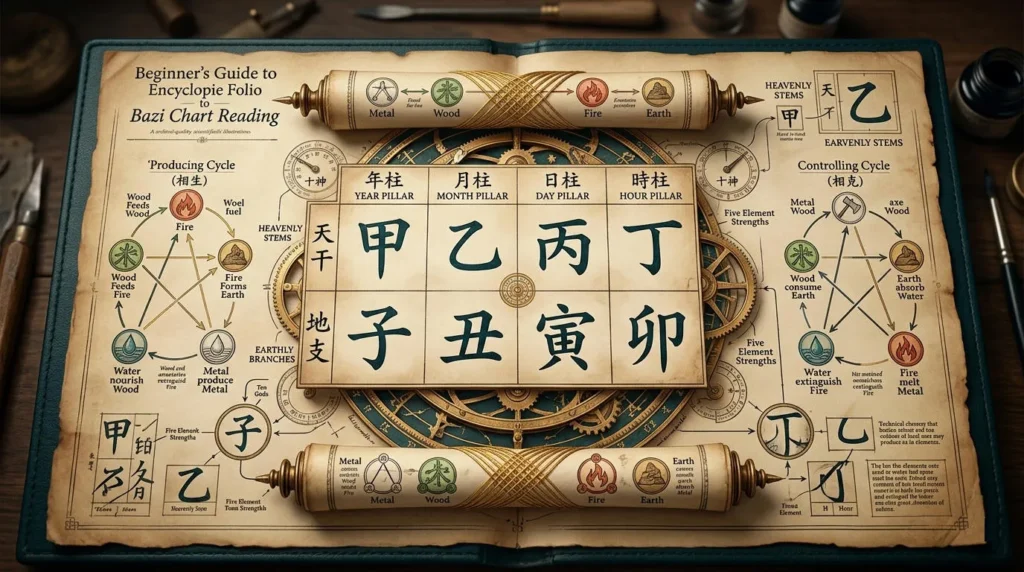
Correspondence between positions and life stages: Year Pillar (childhood 0-18 years old), Month Pillar (youth 18-40 years old), Day Pillar (middle age 40-60 years old), Hour Pillar (old age after 60 years old). This is the key basis for interpreting Gods and Spirits in Four Pillars of Destiny.
We have selected two of the most common and practical Gods and Spirits (Tianyi Noble Person — lucky spirit; Peach Blossom — neutral spirit), combined with practical cases of Four Pillars of Destiny, to detailedly analyze their different impacts in the four pillars, making it easy for beginners of Four Pillars of Destiny to understand and apply.
2.1 Example 1: The Impact of Tianyi Noble Person (Lucky) in Different Positions
The core of Tianyi Noble Person is “help from noble people”. As the luckiest spirit in Four Pillars of Destiny, different positions correspond to different sources of noble people, which accurately match the needs of different life stages. Details are as follows:
– Year Pillar: Noble people are mostly ancestors and elders (parents, grandparents, family elders)
Impact Stage: Childhood and adolescence (0-18 years old);
Core Role: You are likely to receive protection and help from elders, laying a good foundation for your life and boosting your early Four Pillars of Destiny fortune;
Practical Case: A consultant had Tianyi Noble Person in his Year Pillar of Four Pillars of Destiny. When he was a child, his parents’ business suffered setbacks. His grandfather stepped forward to help connect resources, allowing the family to successfully get through the crisis, and also made the consultant develop a grateful and down-to-earth personality.
– Month Pillar: Noble people are mostly friends, colleagues, and teachers
Impact Stage: Youth (18-40 years old);
Core Role: You are likely to receive support and guidance in studies and career, helping you start your career, improve your studies, and avoid detours;
Practical Case: A professional had Tianyi Noble Person in his Month Pillar of Four Pillars of Destiny. When he first joined the company, he was unfamiliar with his work. Colleagues took the initiative to guide him, and his teacher often gave him advice, enabling him to quickly adapt to the position and independently take charge of core work within half a year.
– Day Pillar: Noble people are mostly your spouse or partner
Impact Stage: Middle age (40-60 years old);
Core Role: Your spouse can become a solid backing, giving you maximum support when you are in trouble, and even helping your career develop;
Practical Case: An entrepreneur had Tianyi Noble Person in his Day Pillar of Four Pillars of Destiny. In the early stage of his business, the capital chain was broken. His spouse took out savings and connected network resources, allowing the company to successfully get through the crisis, and his career developed steadily afterward.
– Hour Pillar: Noble people are mostly your children, juniors, and subordinates
Impact Stage: Old age (after 60 years old);
Core Role: You can receive filial care from your children, and may also receive support from juniors or former subordinates, leading a smooth and worry-free old age;
Practical Case: An elderly person had Tianyi Noble Person in his Hour Pillar of Four Pillars of Destiny. In his old age, his children were filial and accompanied him often, juniors visited him regularly, and his former subordinates also came to his home to provide living help, making his old age happy and stable.
2.2 Example 2: The Impact of Peach Blossom (Neutral) in Different Positions
The core of Peach Blossom is “popularity and charm”. As a neutral spirit in Four Pillars of Destiny, different positions correspond to different popularity and relationship states in different stages, with no absolute luck or misfortune — the key lies in your own grasp. Details are as follows:
– Year Pillar: Extremely popular when young
Impact Stage: Childhood and adolescence (0-18 years old);
Core Performance: You have many friends around you, strong opposite-sex attraction, and are prone to early relationships (with a tendency to puppy love or early marriage);
Disadvantage: You are young and mentally immature, prone to taking wrong paths in relationships and neglecting your studies and growth;
Advice: Treat relationships rationally, distinguish between primary and secondary priorities, and focus on your studies and self-growth first;
Practical Case: A consultant had Peach Blossom in his Year Pillar of Four Pillars of Destiny. He had puppy love in high school, which led to a decline in his grades and failure in the college entrance examination. Later, he came to his senses and focused on self-improvement, successfully being admitted to graduate school and eventually gaining a happy relationship.
– Month Pillar: Outstanding charm in youth
Impact Stage: Youth (18-40 years old);
Core Performance: You are likely to attract attention from others in studies and work, with good popularity and stable opposite-sex attraction, making it suitable for expanding your network;
Disadvantage: You may be distracted by relationships, affecting your studies and work;
Advice: Balance the relationship between love, career, and studies, and avoid letting love interfere with your work;
Practical Case: A professional woman had Peach Blossom in her Month Pillar of Four Pillars of Destiny. She was successfully promoted to supervisor with her good popularity. She once made a work mistake due to being distracted by a relationship, but after adjusting her mindset, both her love and work developed steadily.
– Day Pillar: Your spouse is very charming
Impact Stage: Middle age (40-60 years old);
Core Performance: Your spouse is outstanding in appearance or temperament, with good popularity. You two have a rich and interesting relationship and get along harmoniously;
Disadvantage: Your spouse has good opposite-sex attraction, which may cause conflicts and suspicion, affecting the harmony of your relationship;
Advice: Trust and tolerate each other, respect each other’s social circles, and maintain a stable relationship;
Practical Case: A couple had Peach Blossom in their Day Pillar of Four Pillars of Destiny. They often felt suspicious because the spouse had good opposite-sex attraction. Later, they communicated openly and tolerated each other, making their relationship more harmonious.
– Hour Pillar: Still popular in old age
Impact Stage: Old age (after 60 years old);
Core Performance: You are likely to be loved by juniors, may have friends of the opposite sex of the same age, and your life is full of fun without loneliness;
Disadvantage: If you do not grasp the proper measure, you may encounter unnecessary troubles;
Advice: Keep an appropriate distance, focus on enjoying your old age and accompanying your family;
Practical Case: An elderly person had Peach Blossom in his Hour Pillar of Four Pillars of Destiny. He was cheerful and deeply loved by juniors. By keeping an appropriate distance, he avoided unnecessary troubles caused by excessive concern from opposite-sex juniors and enjoyed his old age in peace.
3. Summary: Principles of Using Gods and Spirits in Four Pillars of Destiny
Combined with the above detailed explanations of Gods and Spirits and practical cases, beginners of Four Pillars of Destiny must remember these 3 core principles when interpreting Gods and Spirits — avoid falling into misunderstandings in interpreting Four Pillars of Destiny!
1. Distinguish primary and secondary: Take the Five Elements (Shi Shen system) as the main line and Gods and Spirits as the side line. Do not put the cart before the horse or judge the overall fortune of Four Pillars of Destiny by Gods and Spirits alone;
2. Combine with positions: The same God or Spirit has different impacts in different positions, corresponding to different life stages. Judge its specific role based on the corresponding stage of the position;
3. Treat rationally: Do not exaggerate the role of Gods and Spirits in good and bad fortune. Lucky spirits do not mean everything goes smoothly, and unlucky spirits do not mean you are destined to have bad luck. The key lies in the overall combination of your Four Pillars of Destiny and your own response.
Only by combining the Shi Shen system, position rules, and supplementing details with Gods and Spirits can you truly understand the good and bad information in your Four Pillars of Destiny and provide reference for your life decisions — this is also the core logic of getting started with Four Pillars of Destiny.
The more Gods and Spirits, the better? Does having more lucky spirits mean better Four Pillars of Destiny fortune?
No. The core of the good or bad fortune of Gods and Spirits lies in the “overall combination of your Four Pillars of Destiny”, not the quantity. Too many lucky spirits that contradict the Shi Shen system and the Five Elements may even drag down your Four Pillars of Destiny fortune; a few unlucky spirits that conflict with the core of your Four Pillars of Destiny can also affect your fortune. The key is to rationally treat the supplementary role of Gods and Spirits in combination with the Shi Shen system.
If there are no Gods and Spirits in my Four Pillars, does that mean there’s no good or bad in my destiny?
No! Gods and Spirits are only “supplementary details” of good and bad in Four Pillars. The core good and bad are determined by the Five Elements and Shi Shen system. For Four Pillars without Gods and Spirits, you just need to focus on interpreting the relationship between Shi Shen and Five Elements — you can still judge your overall life direction and core good and bad.
Does the same God or Spirit have the same impact in different Four Pillars?
No! The impact of Gods and Spirits is affected by many factors, such as the overall destiny of Four Pillars, the strength of the Five Elements, and positions. For example, Yang Ren can easily bring disasters to those with strong Five Elements, but may help those with weak Five Elements. You need to judge comprehensively based on the overall Four Pillars.
As a beginner, should I look at Gods and Spirits or Shi Shen first when interpreting my own Four Pillars?
Look at Shi Shen first, then Gods and Spirits! The Shi Shen system determines your overall life direction — it’s the foundation of Four Pillars interpretation. Gods and Spirits only supplement details. Grasp the main line first, then the details — your interpretation will be accurate!
The checking method for Jin Yu is too complicated. Is there an easier way for beginners to remember?
Yes! Remember this core rule: Jia/Yi → Yin, Bing/Ding → Wu, Wu/Ji → Shen, Geng/Xin → Xu, Ren/Gui → Zi. Compare it with your Day Stem in Four Pillars, and you can find Jin Yu quickly — no need to memorize complicated rules!
If my Four Pillars have Gu Chen & Gua Su, does that mean I have a “lonely fate” and can’t find a partner?
No! The core of Gu Chen & Gua Su is “independence”, not “loneliness”. It just makes you prefer being alone in relationships and likely to marry late — not that you can’t find a partner. As long as you learn to communicate actively and express your feelings, you can still gain a happy relationship!