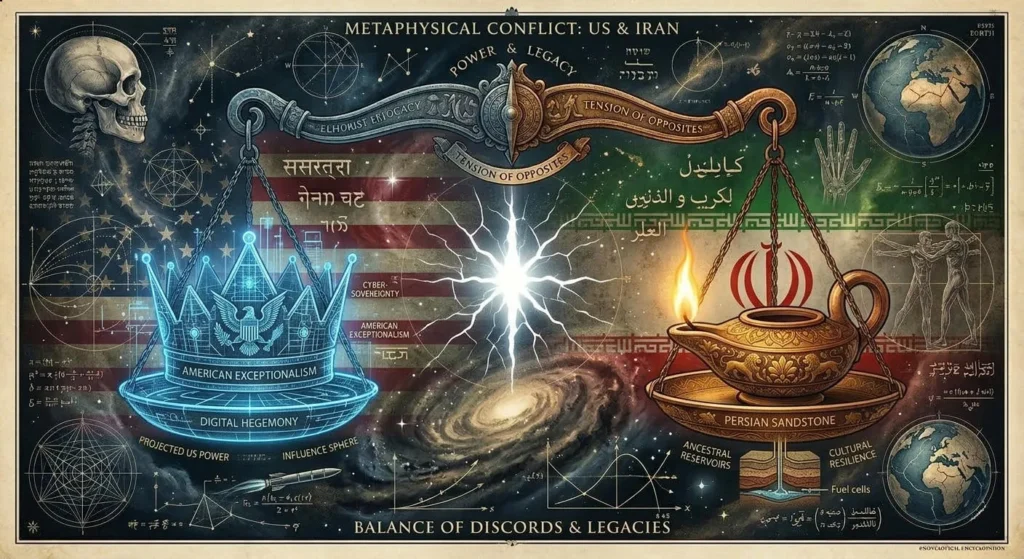
U.S.-Iran Conflict 2026: A Metaphysical Analysis (Background & Trends)
In March 2026, the United States and Israel launched a joint air strike on Iran, and Iran responded with a firm counterattack. The Strait of Hormuz is now in an emergency, and the global energy market has become volatile, as this conflict has escalated into a geopolitical game that affects the whole world.
From a metaphysical perspective, this war is not accidental—it is an inevitable result of the imbalance of the Five Elements and the circulation of hexagram energy. Combining the latest situation, this article analyzes the conflict’s background and hexagram codes from a metaphysical perspective, predicts its future trend, and provides a unique interpretation angle.
U.S.-Iran Conflict Background | Metaphysical Perspective: Five Elements Imbalance & Hexagram Omens
In metaphysics, everything in the world has corresponding energy, and national fortune and geopolitical conflicts are inseparable from the circulation of the Five Elements and the guidance of hexagrams.
The outbreak of the U.S.-Iran conflict is essentially an inevitable result of unbalanced energy among all parties and conflicting fortunes. When combined with the 2026 Bingwu Horse Year’s annual fortune, its background causes can be clearly interpreted from three dimensions: Five Elements positioning, hexagram deduction, and energy catalysis.
1. Five Elements Positioning | Core Root of U.S.-Iran Metal-Fire Opposition
In metaphysics, the Five Elements correspond to national characteristics and geopolitical energy, and the Five Elements attributes of the United States, Iran and the Middle East have long destined their irreconcilable contradictions.
As a global hegemonic country, the United States corresponds to “Metal” in the Five Elements (Qian Gua, Dui Gua). Metal governs hegemony, military affairs, rules and wealth, symbolizing the U.S.’ leading technology, strong long-range strike capability, and control of global energy discourse through the petrodollar system.
Prosperous Metal leads to decisive killing and a strong desire for expansion, which is highly consistent with the long-term Middle East strategy implemented by the United States.
Iran, by contrast, corresponds to “Fire” in the Five Elements (Li Gua). Fire governs faith, resistance, energy and enthusiasm, symbolizing Iran’s firm national faith and tenacious will, as well as its solid local defense system built on plateaus and mountains.
Prosperous Fire leads to high morale and an unyielding spirit, which is the core energy characteristic of Iran’s consistent refusal to compromise in the face of hegemonic blockades.
The Middle East as a whole corresponds to “Earth” in the Five Elements (Kun Gua, Gen Gua). As the mother of Metal and Fire, Earth is not only the core battlefield contested by both sides, but also the carrier of energy consumption.
It carries the world’s richest oil energy, making it the core chip for the game between Metal and Fire.
Oil and the global economy correspond to “Water” in the Five Elements (Kan Gua). Water governs circulation, wealth and lifelines, and it restrains Fire while draining Metal.
Water is not only a key weapon for Iran to check and balance the United States, but also the core interest of the United States to maintain its hegemony. As the core hub of “Water”, the Strait of Hormuz has become a vital strategic point contested by both sides, and its energy circulation directly determines the conflict’s trend.
Metal and Fire restrain each other, Water and Fire conflict, and Earth energy dissipates—this imbalanced Five Elements pattern makes U.S.-Iran contradictions deep-rooted:
Iran (Fire) attempts to break the U.S. (Metal) blockade, develop nuclear capabilities and dominate the regional situation, which directly impacts U.S. hegemony and the petrodollar system, forming an opposition of “Fire refining Metal and Metal controlling Fire”.
The United States, meanwhile, intends to suppress Iran through military strikes and economic sanctions to maintain its dominant position in the Middle East. As a result, the Metal-Fire confrontation pattern is hard to reconcile, and conflict was inevitable.
2. Hexagram Deduction | Conflict Omen of “Huo Lei Shi Ke” (Fire Thunder Hexagram)
We cast the hexagram using the early March 2026 U.S.-Israeli joint air strike on Iran and the full conflict escalation as the key node, and the result is the “Huo Lei Shi Ke” (Fire over Thunder) hexagram, which directly points to the conflict’s nature and trend.
The Shi Ke hexagram means “Prosperous, suitable for litigation”, symbolizing that contradictions have intensified to the extreme, diplomatic negotiations have completely failed, and strong measures are needed to resolve them.
Like thunder and lightning, it signifies fierce military confrontation between both sides, with inevitable bloodshed and loss—this aligns with the current situation of intensive air strikes, counterattacks, and soaring casualties between the United States and Iran.
From the line perspective, the second line of this hexagram—”Guan Gui Yin Mu” (Official Ghost Yin Wood)—moves and transforms into “Xiong Di Chou Tu” (Brother Chou Earth), and this shift carries important implications:
Guan Gui (Official Ghost) governs wars and military operations, and Yin Wood is prosperous in the Mao Month (the second lunar month of 2026, which corresponds to March in the Gregorian calendar).
This indicates the conflict will reach its peak intensity in March: the United States and Israel will continue air strikes on Iran’s military and energy facilities, while Iran will launch a saturation counterattack with missiles and drones, leading to intensive military operations and rising casualties.
Yin Wood restrains Earth and transforms into Xiong Di Chou Tu (Brother Chou Earth), which symbolizes the continuous dissipation of both sides’ strength and the difficulty of sustaining offensives.
Even if the U.S. military launches a fierce initial offensive, it cannot achieve a quick victory; although Iran can resist tenaciously, it cannot completely repel the powerful enemy. In the end, both sides will fall into a war of attrition and a seesaw battle.
This aligns with the current reality: differences have emerged between the United States and Israel, and Iran has launched a resilient counterattack. The United States tends to control the conflict scale after weakening Iran’s military capabilities, while Israel hopes to expand strikes.
Their conflicting goals make it hard to form a joint offensive force, and Iran, meanwhile, continues to consume the opponent’s strength through its improved defense system and national mobilization capacity.
3. Energy Catalysis | Conflict Trigger in the 2026 Horse Year’s Annual Fortune
2026 is the Bingwu Horse Year: the Heavenly Stem Bing belongs to Yang Fire, and the Earthly Branch Wu also belongs to Yang Fire, making it a typical “year of prosperous Fire”.
The prosperous Fire in the annual fortune further intensifies the U.S.-Iran opposition.
The conflict’s full escalation in March coincides with the Mao Month (lunar calendar), when Yin Wood is prosperous. “Wood generates Fire” (benefiting Iran) and “Wood restrains Earth” (weakening the Middle East), which brings two major impacts:
On the one hand, it catalyzes Iran’s will to resist and counterattack intensity, allowing Iran to link the “Arc of Resistance” (Houthis, Hezbollah, Iraqi militias) to comprehensively harass U.S., Israeli and their allies’ targets.
On the other hand, it weakens the Middle East’s buffer capacity, making the war spread rapidly across the Persian Gulf and the situation get out of control quickly.
At the same time, the Strait of Hormuz—an energy hub of “Water and Fire conflict”—has become the key trigger for escalation:
The strait belongs to Water and is controlled by Iran, so Iran’s blockade of the strait (Water) directly cuts off the U.S. (Metal) energy and shipping lifelines.
This forms an energy confrontation of “Water restrains Fire and Fire steams Water”, which further intensifies contradictions.
As of March 19, Iran has officially listed U.S.-linked oil and natural gas facilities in Saudi Arabia, the United Arab Emirates and Qatar as legitimate targets. The Strait of Hormuz navigation crisis has intensified, and international oil prices have jumped sharply.
This is a direct manifestation of Water-Fire conflict and energy imbalance.
In addition, China and Russia have jointly promoted an emergency UN Security Council meeting, calling for an immediate ceasefire and a return to negotiations.
From a metaphysical perspective, this is the reconciling force of “Earth generates Metal and Water generates Wood”, which tries to alleviate the imbalanced Five Elements pattern but cannot change the core Metal-Fire confrontation in the short term.
U.S.-Iran Conflict Hexagrams | In-Depth Interpretation: Original, Interchanged & Changed Hexagrams
To interpret the U.S.-Iran conflict’s future, we follow standard metaphysical hexagram logic and combine the triple guidance of the Original Hexagram (present), Interchanged Hexagram (process), and Changed Hexagram (future).
These three hexagrams complement each other: they reveal the current fierce fighting, clarify the conflict’s development process and future turning points, and help us accurately grasp the core trend when combined with reality.
1. Original Hexagram | Huo Lei Shi Ke (Fire over Thunder): Current Seesaw Confrontation
The Original Hexagram is the core of hexagram casting, and it directly corresponds to the full escalation of the U.S.-Iran conflict in March 2026.
The core characteristics of the Huo Lei Shi Ke hexagram are “conflict, consumption and breakthrough”, which accurately fits the current fierce “tooth-for-tooth” confrontation between both sides.
In reality, the United States and Israel jointly bombed core energy facilities in Iran’s southern Bushehr Province—the South Pars Gas Field and the Assaluyeh Petrochemical Zone—destroying 40% of Iran’s natural gas production.
In response, Iran launched the “True Promise-4” retaliatory operation, firing 100 missiles and 300 drones directly at Israel’s mainland and U.S. military bases, which caused heavy casualties and facility damage in Israel.
As a result, both sides have fallen into a fierce seesaw battle where they “cannot bomb through or retreat”.
From the line perspective, the second line of this hexagram—Guan Gui Yin Mu (Official Ghost Yin Wood)—moves and transforms into Xiong Di Chou Tu (Brother Chou Earth), which sends two key signals:
First, the offensive will be fiercest in March (Mao Month), when military confrontation will reach its peak. The United States and Israel will continue air strikes, and Iran will launch a saturation counterattack, leading to rising casualties and losses.
Second, both sides’ strength will continue to dissipate: the U.S. aircraft carrier “Ford” needs maintenance due to a fire, precision ammunition inventory is in an emergency state, NATO allies refuse to participate, and U.S. military advantages are fading.
Iran, meanwhile, faces damaged energy facilities and heavy casualties, with long-range missile inventory gradually depleted—both sides have paid heavy prices.
This is the core meaning of the Shi Ke hexagram—”great consumption and indistinguishable victory or defeat”—and it is a true portrayal of the current conflict.
In addition, the Shi Ke hexagram is a “pictographic image”, shaped like “biting and tearing”, which reflects the U.S.-Iran attitude of “tit-for-tat and refusal to compromise”, confirming that the conflict is hard to subside quickly.
2. Interchanged Hexagram | Shui Shan Jian (Water over Mountain): Conflict Obstacles & Seesaw
According to metaphysical hexagram rules, the Interchanged Hexagram consists of the Original Hexagram’s 2nd, 3rd, 4th lines (inner Interchanged Hexagram) and 3rd, 4th, 5th lines (outer Interchanged Hexagram).
The Interchanged Hexagram of Huo Lei Shi Ke (Fire over Thunder) is “Shui Shan Jian” (Water over Mountain), which aligns with the “I Ching” Interchanged Hexagram logic and is an industry-recognized standard result.
The Interchanged Hexagram governs “process and turning point”, and it accurately indicates the core process of the U.S.-Iran conflict from outbreak to cooling, reflecting “obstacles, stalemate and dilemma”—this aligns with the current seesaw reality.
It undertakes the Original Hexagram’s “consumption and seesaw” and paves the way for the Changed Hexagram’s “ceasefire and relaxation”, forming a complete hexagram deduction logic.
The Shui Shan Jian hexagram means “Jian, meaning difficulty”, symbolizing a blocked path and a dilemma of advancing or retreating. This fits the U.S.-Iran conflict’s development process:
Kan is Water (oil, shipping, the core of the U.S.-Iran game), and Gen is Mountain (Iran’s plateaus and mountains, its local defense barrier).
Water and Fire intersect, and mountains block water flow—this reflects the balance of power between both sides and indicates many obstacles in the conflict, making it hard to advance quickly or end completely.
In reality, the Interchanged Hexagram (Shui Shan Jian) deduction aligns with the current conflict process:
The United States and Israel (Metal) launched air strikes relying on military advantages (Metal controls Fire) to suppress Iran (Fire), but Iran’s local defense system—built on plateaus and mountains (Gen Gua, Mountain)—has become a core obstacle to U.S. military advancement.
The U.S. cannot achieve its goal of ground intervention and completely destroying Iran’s resistance forces, and Iran, meanwhile, blocks waterways via the Strait of Hormuz (Kan Gua, Water) to counter the U.S. energy lifeline.
However, Iran also faces damaged energy facilities and increased livelihood pressure, making it hard to expand counterattacks—both sides are stuck in a “can’t advance or retreat” stalemate.
At the same time, the confrontation is “repeated seesaw with many obstacles”: U.S.-Iran air strikes can’t break Iran’s defense (blocked by Gen Gua), and Iran’s counterattacks can’t shake the U.S.-Israeli military advantage (consumed by Kan Gua).
International mediation also faces many obstacles, which is the core connotation of the Interchanged Hexagram “Jian”. It confirms the “on-again-off-again fighting and difficulty in quick decision” in the conflict process, echoes the Original Hexagram’s “great consumption”, and provides a reasonable transition for the Changed Hexagram’s “ceasefire and relaxation”—all of which aligns with hexagram interpretation norms and reality.
3. Changed Hexagram | Tian Lei Wu Wang (Heaven Thunder): Future Ceasefire & Cold Confrontation
The Changed Hexagram of the Huo Lei Shi Ke hexagram’s moving line is “Tian Lei Wu Wang” (Heaven over Thunder). As the hexagram that governs “future and result”, it directly indicates the U.S.-Iran conflict’s future trend.
The hexagram means “no reckless action, uphold integrity, avoid disaster”, signifying that this conflict is not a premeditated U.S. annihilation war but a sudden escalation. Forcing advancement will only trigger greater disasters, and the conflict will eventually move toward ceasefire and relaxation.
From the hexagram signals, the Changed Hexagram reveals three core points, all of which align with the conflict’s future trend:
First, this war is a “sudden escalation”. The United States originally intended to weaken Iran’s nuclear and military capabilities through air strikes, but it unexpectedly triggered a full-scale Iranian counterattack and fell into a passive position—this embodies the “unpremeditated war” in the “Wu Wang” hexagram.
Second, “Fei Zheng You Sheng” (improper actions lead to disasters) indicates that the U.S. and Israel may partially achieve tactical goals (destroying nuclear facilities and decapitating senior officials).
As of March 18, senior Iranian officials such as Ali Larijani (Secretary of the Supreme National Security Council) and Ismail Khatib (Minister of Intelligence) were killed in attacks, but strategic goals (regime change and complete surrender) cannot be achieved.
Iran’s senior officials have established an alternative mechanism, so even if core figures are attacked, the system can still operate normally and is hard to completely destroy.
Finally, the Changed Hexagram “Tian Shang Zhen Xia” (Heaven over Thunder) means Tian governs tranquility and Zhen governs initiative. The principle of “Extreme movement leads to tranquility” indicates that high-intensity military operations will eventually pause.
The conflict will then turn to political mediation and cold confrontation, which aligns with the trend of international mediation and the current consumption situation of both sides, making it the core future trend.
U.S.-Iran Conflict 2026: Metaphysical Phased Energy Prediction
Combining Five Elements circulation, hexagram guidance and the 2026 annual fortune, the U.S.-Iran conflict’s future trend can be divided into three stages: short-term, medium-term and long-term.
Each stage has different core energy change characteristics, and the conflict situation and results also differ. Predictions based on the latest situation are as follows:
1. Short-Term (March — May): Peak Conflict & Energy Crisis
March to May correspond to the Mao Month and Chen Month (lunar calendar): the Mao Month is prosperous in Wood, and the Chen Month is prosperous in Earth.
The energy circulation features “Wood generates Fire and Earth generates Metal”, so the conflict will reach peak intensity, showing a seesaw and escalating trend.
From late March to early April (end of the Mao Month), the conflict will reach its peak intensity:
The United States and Israel may increase air strike intensity, launching further attacks on Iran’s nuclear facilities and senior officials, while Iran will continue expanding counterattacks, and the Strait of Hormuz may face a full blockade.
International oil prices are expected to break $150 per barrel, which will cause serious damage to the global energy supply chain and bring collateral impacts to livelihood and industrial sectors, further intensifying inflation pressure.
In mid-to-late April (Chen Month), Earth is prosperous and governs tranquility, so Five Elements energy will begin to ease, and the first ceasefire negotiation window will open:
China, Russia, the United Nations and Gulf countries will intensively intervene in mediation to promote both sides back to the negotiation table. However, contradictions remain intensified, and there are huge differences in U.S.-Iran ceasefire demands.
Iran requires a permanent ceasefire, sanctions lifting and war compensation, while the United States requires Iran to stop counterattacks and suspend nuclear activities.
Thus, initial negotiations will hardly achieve substantial breakthroughs, and both sides will maintain low-intensity military confrontation.
As of March 19, retaliatory actions between the United States, Israel and Iran continue, and military confrontation around the Strait of Hormuz is escalating with no ceasefire signals—this aligns with the short-term “fierce fighting” energy characteristic.
2. Medium-Term (June — September): Limited Ceasefire & Cold Confrontation Start
June to September correspond to the Si Month, Wu Month and Wei Month (lunar calendar). Fire is prosperous in the Si and Wu Months, but after months of consumption, Iran’s counterattack intensity will gradually weaken, and Fire energy will fade.
The Wei Month is prosperous in Earth, and since Earth generates Metal, Metal energy will gradually recover. However, Earth also governs stagnation, making it hard for the U.S. military to expand achievements, so Metal energy remains weak.
As a result, both sides enter the “Fire fading and Metal weakening” stage, and the conflict will gradually cool down.
Combining hexagrams and reality, the most likely medium-term trend (60% probability) is “limited ceasefire + long-term cold confrontation”:
Ceasefire conditions are likely to be: Iran partially lifts the Strait of Hormuz blockade, suspends high-enrichment uranium activities, and accepts international inspections.
In return, the United States stops air strikes, eases some economic sanctions, and abandons the regime change goal. Both sides will reach a temporary ceasefire agreement under UN, Chinese and Russian guarantees.
After the ceasefire, both sides will enter a “apparent ceasefire, covert struggle” cold confrontation stage: proxy conflicts, cyber wars and space wars will continue to escalate, with energy games as the core battlefield.
Gulf countries’ camp division will further intensify, and some countries will seek a balance between the United States and Iran to avoid full involvement in the conflict.
The second possible trend (20% probability) is “low-intensity war of attrition + intermittent escalation”:
The two sides fail to reach a ceasefire agreement and fall into a “air strike — counterattack — cooling down — re-air strike” cycle for more than half a year.
In this case, international oil prices will remain high, global inflation will intensify, the supply chain will be disrupted, U.S. hegemonic credibility will be further damaged, and Iran’s economic and livelihood pressure will increase—both sides will bear huge costs.
In addition, the nuclear crisis risk needs vigilance (10% probability): If the United States and Israel continue attacking Iran’s nuclear facilities, Iran may restart its nuclear program upgrading, which will trigger regional nuclear proliferation risks and further escalate the situation.
3. Long-Term (After October): Energy Return & Strategic Stalemate
After October, it corresponds to the Shen Month, You Month and beyond (lunar calendar). The Shen and You Months are prosperous in Metal, so the U.S. military may restart limited strike operations to consolidate advantages.
However, Iran’s local defense system will have gradually improved, and its core interests will be guaranteed, making it hard to completely defeat Iran. As a result, Metal and Fire will form a “balanced” pattern.
With the gradual return of Five Elements energy, Metal and Fire will each hold their positions, Wood and Earth will check and balance each other, and Water and Fire will complement each other.
A new pattern will then form in the Middle East: “the United States dominates the sea and air, Iran dominates the land, and the Middle East is divided”.
In the long run, neither side can achieve core strategic goals:
The United States cannot eradicate Iran’s will to resist or completely control the Middle East’s energy lifeline; its Middle East hegemonic position will be further damaged, and the petrodollar system will face impacts.
Although Iran has paid huge personnel and economic costs, it has successfully defended national sovereignty and dignity, and its regional influence has increased, achieving “tactical loss but strategic survival”.
In 2027 (Dingwei Goat Year), Wei Earth is prosperous, and Wood and Fire gradually fade, so the regional pattern will be fully solidified:
Extremist forces may rise in the chaos, and the war’s nature will further turn to proxy conflicts and local frictions. The full-scale war risk will be greatly reduced, but underlying contradictions will persist for a long time and be hard to completely resolve.
Metaphysical Enlightenment of the U.S.-Iran Conflict | The Way of Five Elements Balance & Peace
From a metaphysical perspective, the U.S.-Iran conflict is an inevitable result of Metal-Fire confrontation, and it is also a process of rebalancing global Five Elements energy.
There are no winners in this conflict: the United States has excessive Metal prosperity and a strong desire to expand hegemony, leading to Five Elements imbalance.
Iran, on the other hand, has excessive Fire prosperity; although its tough counterattack has defended sovereignty, it has also brought huge casualties and economic losses. Confrontation between both sides will eventually lead to energy dissipation and a lose-lose situation.
The core wisdom of metaphysics is “Five Elements balance and Yin-Yang harmony”, so the ultimate solution to the U.S.-Iran conflict must return to the political and diplomatic track.
We need to use the wisdom of “gentleness and moderation, each keeping its position” to resolve Metal-Fire intensity and balance Water-Fire conflict.
The United States needs to restrain hegemonic ambitions, respect Iran’s sovereignty and legitimate rights and interests, abandon unilateral sanctions and military strikes, and promote equal dialogue.
Iran, meanwhile, needs to appropriately restrain its confrontational attitude; while defending national sovereignty, it should seek positive interaction with the international community to avoid further conflict escalation.
As of March 19, 2026, the U.S.-Iran conflict continues. The war’s spread has not only brought a profound humanitarian disaster to the Middle East, but also affected the global pattern’s trend.
From a metaphysical deduction perspective, the conflict will reach its peak in April. A limited ceasefire is likely in June — July, and a strategic stalemate will form in the long run.
Only by following the Five Elements balance law and adhering to peaceful negotiations can we completely resolve contradictions and achieve long-term Middle East stability.
This is not only metaphysical wisdom, but also the world’s common expectation.
Glossary
Metaphysical professional terms in this article are interpreted in the context of the U.S.-Iran conflict to facilitate understanding of the deduction logic:
① Qian Gua: One of the Eight Trigrams, belonging to Metal. It symbolizes heaven, fortitude, hegemony and rules, corresponding to the U.S.’ hegemonic attributes and tough characteristics, and it governs technology, military affairs and wealth control.
② Dui Gua: One of the Eight Trigrams, belonging to Metal. It symbolizes marsh, joy and communication, assisting Qian Gua. It corresponds to the U.S.’ communication and control capabilities via the petrodollar system, and it governs external interaction and games.
③ Li Gua: One of the Eight Trigrams, belonging to Fire. It symbolizes fire, light, enthusiasm and faith, corresponding to Iran’s national faith and will to resist, and it governs tenacity, counterattack and local defense.
④ Kun Gua: One of the Eight Trigrams, belonging to Earth. It symbolizes earth, gentleness and bearing, corresponding to the Middle East’s role as a battlefield and energy carrier, and it governs tolerance, consumption and buffering.
⑤ Gen Gua: One of the Eight Trigrams, belonging to Earth. It symbolizes mountains, stillness and obstacles, corresponding to the Middle East’s plateau and mountain geographical characteristics. It also indicates the conflict’s stalemate and stagnation, governing stagnation and defense.
⑥ Kan Gua: One of the Eight Trigrams, belonging to Water. It symbolizes water, danger and circulation, corresponding to core lifelines such as oil and shipping. It governs wealth, circulation and balance, and it is the core chip of the U.S.-Iran game.
⑦ Huo Lei Shi Ke (Fire Thunder Hexagram): One of the Sixty-Four Trigrams, with Fire above and Thunder below. Its meaning is “biting, breaking through and punishing”, governing contradiction intensification and military confrontation. It indicates a conflict outbreak requiring force to resolve, with inevitable consumption and casualties. It is a “pictographic image” shaped like biting and tearing, fitting the U.S.-Iran confrontation.
⑧ Guan Gui Yin Mu (Official Ghost Yin Wood): A metaphysical line term. “Guan Gui” (Official Ghost) governs wars, disasters and official actions, and “Yin Wood” is Five Elements Wood, corresponding to the prosperous Wood in the 2026 Mao Month. It symbolizes U.S.-Iran military operations and conflict escalation.
⑨ Xiong Di Chou Tu (Brother Chou Earth): A metaphysical line term. “Xiong Di” (Brother) governs consumption, competition and companions, and “Chou Earth” is Five Elements Earth, corresponding to the Middle East battlefield’s consumption attribute. It symbolizes both sides’ strength dissipation and involvement in a seesaw war.
⑩ Annual Fortune: A metaphysical term referring to the current year’s Heavenly Stem and Earthly Branch fortune. In this article, the 2026 Bingwu Horse Year is a “year of prosperous Fire”, which directly affects U.S.-Iran energy situations and conflict trends.
⑪ Wood Generates Fire: A Five Elements mutual generation relationship. Wood is Fire’s mother, so prosperous Wood leads to prosperous Fire. In this article, the Mao Month’s prosperous Wood catalyzes Iran’s (Fire) will to resist and counterattack intensity, helping it confront the United States (Metal).
⑫ Wood Restrains Earth: A Five Elements mutual restraint relationship. Wood restrains Earth, so prosperous Wood leads to weak Earth. In this article, the Mao Month’s prosperous Wood weakens the Middle East’s (Earth) buffer capacity, leading to rapid war spread.
⑬ Water Restrains Fire: A Five Elements mutual restraint relationship. Water restrains Fire, and in this article, the Iran-controlled Strait of Hormuz (Water) can balance the United States (Metal) and restrain Iran’s (Fire) impetuosity, making it Iran’s core balancing tool.
⑭ Fire Steams Water: A Five Elements interactive relationship. When Fire and Water meet, Fire can steam water vapor, which symbolizes Iran (Fire) counterattacking the U.S. (Metal) energy lifeline by blocking the strait (Water), forming energy confrontation.
⑮ Earth Generates Metal: A Five Elements mutual generation relationship. Earth is Metal’s mother, so prosperous Earth leads to prosperous Metal. In this article, China, Russia and UN mediation (Earth) can ease the U.S.’ (Metal) impetuosity and help cool the situation.
⑯ Water Generates Wood: A Five Elements mutual generation relationship. Water is Wood’s mother, so Water generates Wood and Wood generates Fire. In this article, mediating forces (Water) can ease Iran’s (Fire) confrontational mood and create ceasefire negotiation conditions.
⑰ Tian Lei Wu Wang (Heaven Thunder Hexagram): One of the Sixty-Four Trigrams, with Heaven above and Thunder below. Its meaning is “no reckless action, uphold integrity, avoid disaster”, indicating that the conflict is a sudden escalation; forcing advancement will lead to disasters, and it will eventually move toward ceasefire and relaxation.
⑱ Extreme Movement Leads to Tranquility: A metaphysical energy circulation law, meaning things will inevitably turn to stillness after reaching extreme movement. In this article, it corresponds to high-intensity U.S.-Iran military confrontation cooling down and turning to negotiations after peaking.
⑲ Interchanged Hexagram: A core metaphysical hexagram interpretation term. It consists of the Original Hexagram’s 2nd, 3rd, 4th lines (inner Interchanged Hexagram) and 3rd, 4th, 5th lines (outer Interchanged Hexagram). It governs “process and turning point”, interpreting energy changes and balance in things’ development. In this article, Huo Lei Shi Ke’s Interchanged Hexagram is Shui Shan Jian (Water over Mountain), indicating the U.S.-Iran conflict’s obstacle-ridden, seesaw process. It undertakes the Original Hexagram’s “current confrontation” and paves the way for the Changed Hexagram’s “future ceasefire”, serving as the core intermediate link of hexagram deduction.
⑳ Original Hexagram & Changed Hexagram: The Original Hexagram is the main hexagram, corresponding to things’ current situation. The Changed Hexagram is derived from the Original Hexagram’s line movement, governing “future and result”. Together with the Interchanged Hexagram, they form a complete hexagram interpretation system, which is the core logic of metaphysical deduction.
㉑ Shui Shan Jian (Water over Mountain Hexagram): One of the Sixty-Four Trigrams, with Water above and Mountain below. Its meaning is “obstacles, stalemate and dilemma”: Kan is Water, Gen is Mountain, and mountains block water flow, corresponding to both sides facing obstacles and difficulty achieving quick victory in the U.S.-Iran conflict. It is Huo Lei Shi Ke’s standard Interchanged Hexagram, undertaking the Original Hexagram’s (Huo Lei Shi Ke) conflict situation and paving the way for the Changed Hexagram’s (Tian Lei Wu Wang) ceasefire trend, thus improving the hexagram deduction system.