Day Pillar in Four Pillars of Destiny: Sun Sign + Rising Sign Fusion
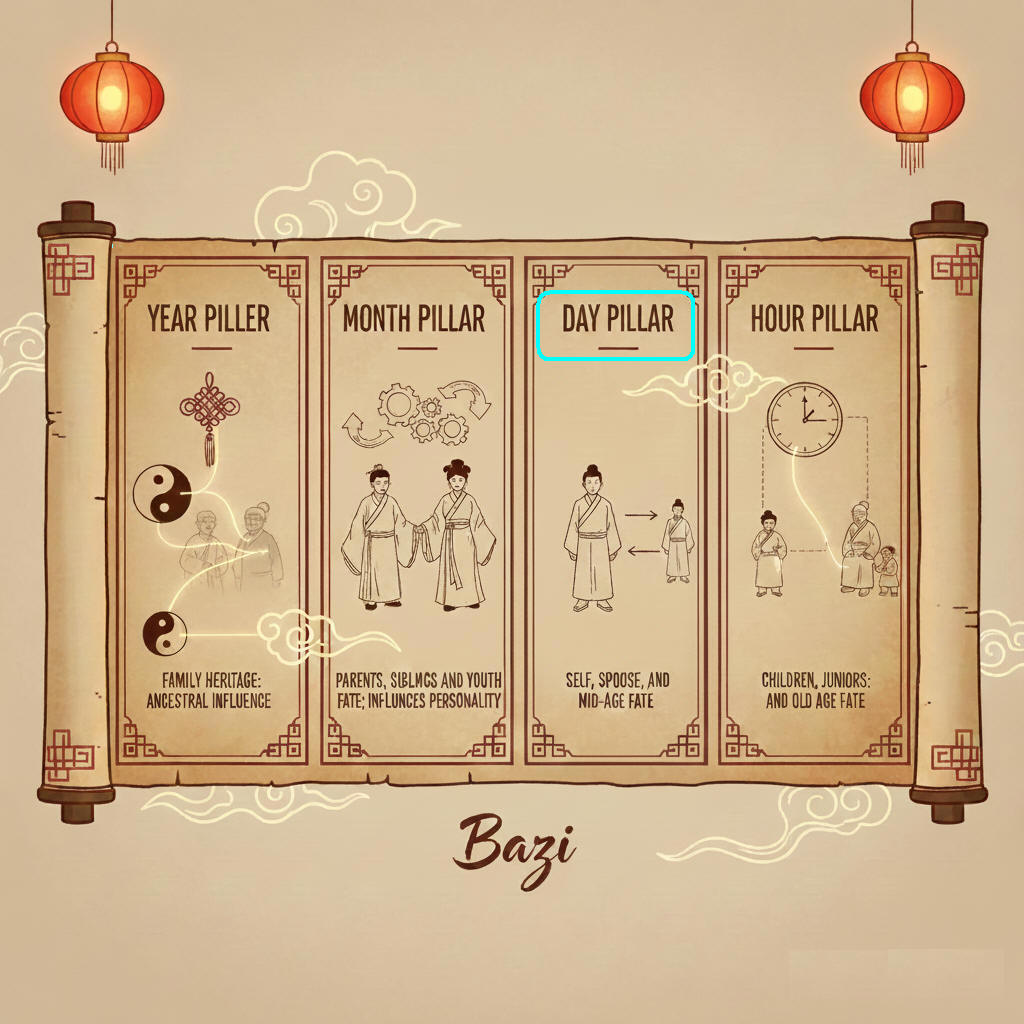
As the core of Four Pillars of Destiny, the Day Pillar sits closest to your true self. Centered on the principle that “Day Master defines your inner core, while Day Branch shapes your relationships”, this article draws a simple analogy: the Day Pillar is like a fusion of Sun Sign and Rising Sign. By decoding the traits of Day Master and Day Branch, it reveals your core essence and relationship patterns, paving the way for in-depth self-exploration.
I. Day Pillar: The Code to Your True Self and Mask
Ever felt confused? Calm alone but reserved in relationships, passionate inside yet indifferent socially? In Four Pillars of Destiny①, the Day Pillar② precisely explains this gap—it’s your personalized manual, revealing the logic of inner self and external performance.
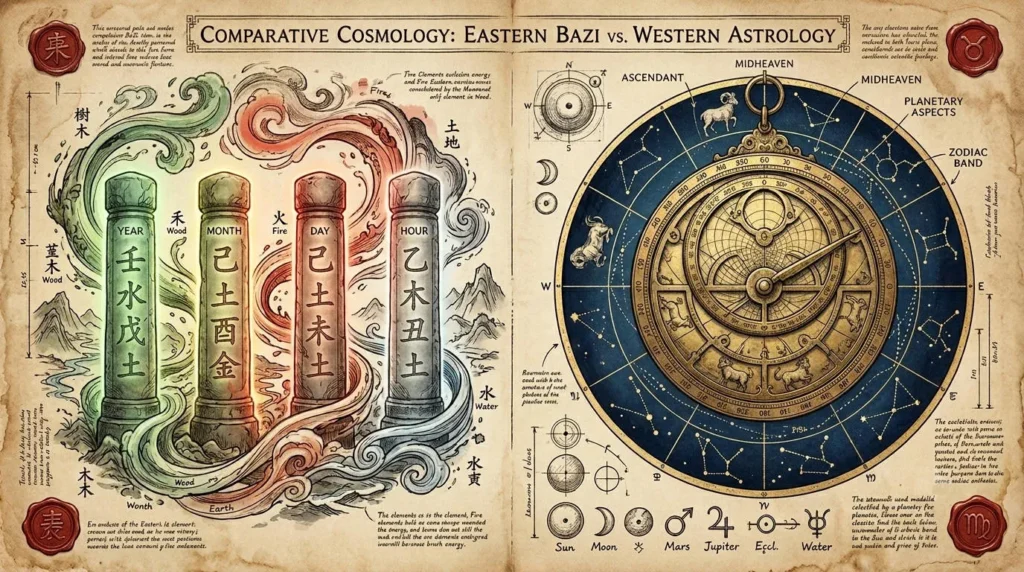
The Day Pillar can be simply compared to Sun Sign + Rising Sign: Day Master③ (Heavenly Stem) is your eternal core (like Sun Sign); Day Branch⑤ (Earthly Branch) reflects relationship/habit tendencies (like Rising Sign). Below, we explore its composition, traits and application.
II. Composition of the Day Pillar: Inner Core and External Mirror
1. Day Master: The Energy Core of Your True Self
In the Day Pillar, the Heavenly Stem is the Day Master (or Day Lord). As the center of the Four Pillars chart, it represents your core existence. If Four Pillars is a life codebook, the Day Master is the key to your fundamental life energy direction.
Its energy manifests much like how a Sun Sign shapes personality: unshaken by external changes, it drives your subconscious aspirations. It dominates your true state when alone and your instinctive choices in critical moments, defining your vitality, willpower, and the most authentic layer of your personality.
In short, the Day Master is the cornerstone of self and unchanging inner energy. Understanding it helps clarify your energy direction and master Day Pillar interpretation—your first key to self-understanding.
2. Day Branch: The Mirror of Intimate Relationships and Habits
The Day Branch, often called “Spouse Palace” in traditional numerology, covers more than marriage. It’s the external projection of Day Master’s energy, focusing on intimate relationships and habitual behaviors.
In relationships, it reveals your undefended interaction patterns (expectations, instincts, dependence/alienation).
In habits, it shows your natural state when relaxed/stressed (daily routines, emotional outbursts)—all authentic expressions of Day Branch energy.
The Day Branch is therefore key to understanding your external behaviors. It translates the inner energy of the Day Master into tangible actions, forming a complete framework for interpreting the Day Pillar. This, in turn, offers valuable guidance for understanding yourself in relationships.
III. Characteristics of the Day Master: Understanding Your Inner Energy
1. Core Characteristics of the Ten Day Masters
The 10 Day Masters correspond to Five Elements⑧ (Metal, Wood, Water, Fire, Earth), divided into Yin and Yang, each with unique energy traits:
• Wood Element Day Masters: Yang Wood (Jia Mu) – Upright, benevolent, leadership-oriented, reliable but stubborn
• Wood Element Day Masters: Yin Wood (Yi Mu) – Flexible, empathetic, adaptable, compassionate but compromising
• Fire Element Day Masters: Yang Fire (Bing Huo) – Warm, cheerful, charismatic, but impulsive
• Fire Element Day Masters: Yin Fire (Ding Huo) – Cultured, perceptive, insightful, but emotionally draining
• Earth Element Day Masters: Yang Earth (Wu Tu) – Steady, honest, reliable, calm but inflexible
• Earth Element Day Masters: Yin Earth (Ji Tu) – Tolerant, nurturing, strategic, adaptable but self-sacrificing
• Metal Element Day Masters: Yang Metal (Geng Jin) – Resolute, loyal, courageous but overly sharp
• Metal Element Day Masters: Yin Metal (Xin Jin) – Elegant, self-respecting, perfectionistic but sensitive
• Water Element Day Masters: Yang Water (Ren Shui) – Wise, flexible, open-minded but inattentive
• Water Element Day Masters: Yin Water (Gui Shui) – Intelligent, calm, resilient but emotionally accumulative
Day Master traits directly reflect inner energy—there’s no inherent superiority or inferiority. Identifying your Day Master type clarifies strengths and potential limitations, laying a solid foundation for interpreting the full Day Pillar and your unique Four Pillars pattern.
2. Comparison Between Day Masters and Astrological Signs
To intuit Day Master traits, we compare them to astrological signs (approximate references, not absolute) to lower understanding barriers, echoing the opening analogy of Day Pillar = Sun Sign + Rising Sign.
• Wood Element: Jia Mu ≈ Leo (leadership focus); Yi Mu ≈ Gemini (agility, more forbearance)
• Fire Element: Bing Huo ≈ Aries (passion, energy); Ding Huo ≈ Virgo (perception, emotional vs. detail stress)
• Earth Element: Wu Tu ≈ Capricorn (steadiness, conservatism); Ji Tu ≈ Libra (tolerance, silent giving vs. mediation)
• Metal Element: Geng Jin ≈ Scorpio (resoluteness, external vs. internal resistance); Xin Jin ≈ Virgo (perfectionism, self-identity vs. tasks)
• Water Element: Ren Shui ≈ Sagittarius (open-mindedness, exploration); Gui Shui ≈ Pisces (resilience, rational forbearance vs. empathy)
This comparison simplifies understanding. Though different systems, they share personality logic—both tools for self-cognition, offering diverse perspectives on Day Pillar interpretation.
3. Core Characteristics of the Day Branch
The Day Branch corresponds to 12 Earthly Branches⑦, corely influencing relationships and habits. Below are high-frequency branches categorized by Five Elements (no superiority, key is compatibility with Day Master):
• Water Element Day Branches: Zi Shui – Calm, introverted, sensitive, defensive in relationships; Hai Shui – Gentle, tolerant, empathetic but compromising
• Fire Element Day Branches: Wu Huo – Passionate, impulsive, straightforward, prone to criticism; Si Huo – Intelligent, recognition-seeking, proactive
• Wood Element Day Branches: Mao Wood – Gentle, nurturing, empathetic, proactive; Yin Wood – Positive, controlling, dominant
• Earth Element Day Branches: Chen Earth – Steady, tolerant, reliable, conservative; Chou Earth – Careful, prudent, over-worrying, planning-oriented
• Metal Element Day Branches: Shen Metal – Resolute, clear boundaries, independent; You Metal – Elegant, sensitive, perfectionistic, critical
The Day Branch is the “default script” for relationships/habits, while the Day Master is the inner core. Their interaction is key to Day Pillar interpretation. Next, we analyze typical combinations with practical advice.
IV. Practical Application of the Day Pillar: Harmonious Coexistence of Inner Core and External Performance
1. Ti-Yong Relationship of the Day Pillar: Inner Core and External Performance
In Day Pillar logic, Day Master is “Ti” (inner core) and Day Branch is “Yong” (external expression)—this is the Ti-Yong Relationship⑨. They interact mutually: core essence drives external performance, and external feedback shapes inner energy release.
Understanding Ti-Yong is key to applying Day Pillar wisdom. For self-growth and relationships, harmonize Day Master and Day Branch energy. Below are 3 typical combinations analyzed from traits, interaction and adjustments.
2. Typical Day Pillar Combination Cases
We analyze 3 typical “Day Master + Day Branch” combinations to illustrate energy interaction, with actionable advice:
Case 1: Bing Huo (Yang Fire) + Zi Shui (Water)
Core Traits: Bing Huo (passionate, outgoing); Zi Shui (calm, defensive).
Analysis: You crave deep connection, yet unconsciously put up defenses in relationships, suppressing your passion to avoid harm. The calm energy of Zi Shui subtly neutralizes Bing Huo’s warmth, creating a “hot inside, cold outside” protective mechanism.
Adjustments: Clarify emotional needs alone; express enthusiasm honestly in interactions, using calmness for rational communication.
Case 2: Geng Jin (Yang Metal) + Wu Huo (Fire)
Core Traits: Geng Jin (resolute, principled); Wu Huo (passionate, impulsive).
Analysis: Your care often comes across as criticism. Geng Jin’s resoluteness combined with Wu Huo’s impulsiveness makes your words sharp, overlooking others’ feelings.
Adjustments: Calm down before interactions; use “I need you to…” instead of “You should…” to soften expressions.
Case 3: Yi Mu (Yin Wood) + Mao Wood (Wood)
Core Traits: Yi Mu (flexible, empathetic); Mao Wood (gentle, nurturing).
Analysis: Mao Wood strengthens Yi Mu’s empathy—you’re gentle, proactive and attentive in relationships, creating harmony.
Notes: Avoid over-giving and losing yourself; clarify boundaries and express needs for mutual nurturing.
V. Conclusion: Embrace Your Complete Self
At its core, every Day Pillar combination revolves around the energy interaction between Day Master and Day Branch. As your personalized life code, it reveals two key aspects: your inner core and how you show up in relationships. Understanding it is not about being controlled by fate—it’s about gaining clear self-awareness and ending the internal conflict between your true self and your external persona.
With clear self-awareness, adjust intentionally: nurture your Day Master energy when alone, and refine your Day Branch behaviors in relationships. Grab your Four Pillars chart, find your Day Pillar, and start exploring your complete self.
VI. Glossary
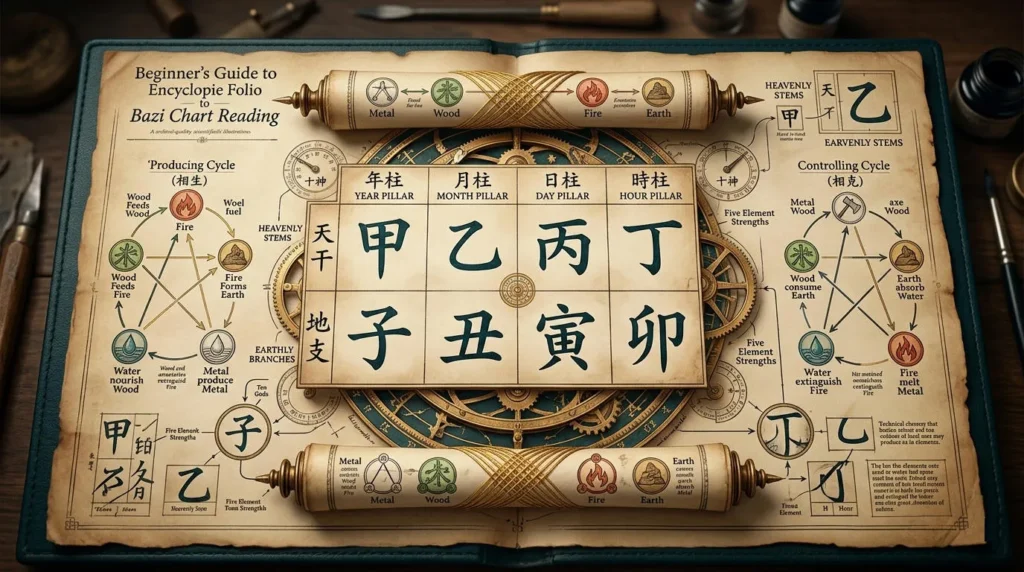
• ① Four Pillars of Destiny: Composed of 8 characters (Heavenly Stems/Earthly Branches of birth time), core for interpreting innate traits and fortune.
• ② Day Pillar: Day’s Heavenly Stem-Earthly Branch combination in Four Pillars, core for self-representation (Day Master + Day Branch).
• ③ Day Master: Day Pillar’s Heavenly Stem, core of Four Pillars, representing inner essence and life energy.
• ④ Day Lord: Alternative name for Day Master, same meaning.
• ⑤ Day Branch: Day Pillar’s Earthly Branch (“Spouse Palace”), influencing intimate relationships and habits, projecting Day Master’s energy.
• ⑥ Heavenly Stems: 10 characters (Jia-Yi etc.), paired with Five Elements, used for time notation and chart building.
• ⑦ Earthly Branches: 12 characters (Zi-Chou etc.), paired with Five Elements/Zodiac, reflecting external behaviors.
• ⑧ Five Elements: Metal/Wood/Water/Fire/Earth, core of Chinese philosophy/numerology, with mutual generation/restriction.
• ⑨ Ti-Yong Relationship: Numerology logic—Ti (inner core: Day Master), Yong (external expression: Day Branch), interacting mutually.