24-Hour Timely Living: Hourly Health & Almanac Practice Guide
I. Your Life Doesn’t Have to Be So Tiring — Core Logic of Timely Living
Have you ever had such experiences? You make an early-morning plan but linger in bed during Mao Hour (5:00-7:00 AM), still constipated after getting up. You rush to work through lunch without resting, feeling drowsy in the afternoon even after drinking coffee.
You sleep 8 hours but still feel tired when waking up? You do nothing major but feel exhausted after a day?
Modern life is filled with schedules, notifications and deadlines. But we overlook the core: the body has its own hourly rhythm, and the universe has its celestial rhythm.
We always rely on willpower to push through. But we forget that Chinese “time wisdom” is never about “fighting against the body”, but “following the rules”. Hourly health preservation and almanac practice are the core methods to follow the rules and the key to timely living.
As early as 2,000 years ago, the Chinese discovered two sets of “time management systems”: hourly health preservation (from Huangdi Neijing) and almanac practice (a life guide summarized by ancient people combining astronomy and calendar).
Using these two timely methods is like installing an “energy-saving mode” for your life. You don’t need extra energy — just follow the rhythm of your body and the universe to get rid of internal friction.
This is not a history lesson or metaphysical popular science, but a practical manual you can use directly.
After reading this article, you will clearly know: What time to sleep at night for best health? Should you start a new project tomorrow? How to reduce small troubles and improve your state without effort?
II. Set Your “Body Alarm Clock” — Quick Start to Hourly Health Preservation
1. Core Principle: Understand “Shi Chen Dang Ling” to Seize Health Opportunities
“Shi Chen Dang Ling” ① is the core of hourly health preservation, a TCM term. It means your body is like a factory with a 12-hour shift system.
Every two hours, there is a “duty manager” — a zang-fu organ — in charge of the whole body. Cooperating with “Shi Chen Dang Ling” doubles health efficiency; opposing it will make your body send warning signals.
The classic TCM work Huangdi Neijing·Suwen·Jingmai Bielun records: “When food qi enters the stomach, it disperses essence to the liver and overflows qi to the tendons; when food qi enters the stomach, turbid qi returns to the heart and overflows essence to the vessels.” This clearly defines the time correlation between zang-fu organs and qi-blood circulation.
This is also the core theoretical basis of hourly health preservation. The 12 Shi Chen ② correspond to 12 zang-fu organs. This chapter focuses on 4 golden hours; other hours need not be memorized and will be mentioned in subsequent scenarios.
Understanding the core logic of “Shi Chen Dang Ling”, we will focus on the 4 most practical golden hours. You can achieve a good state by following the instructions directly and start hourly health preservation quickly.
2. Practice Focus: 4 Golden Hours (Follow Directly)
You don’t need to remember all 12 hours. Start with these 4 golden hours — easy to get started, no complicated operations, just follow:
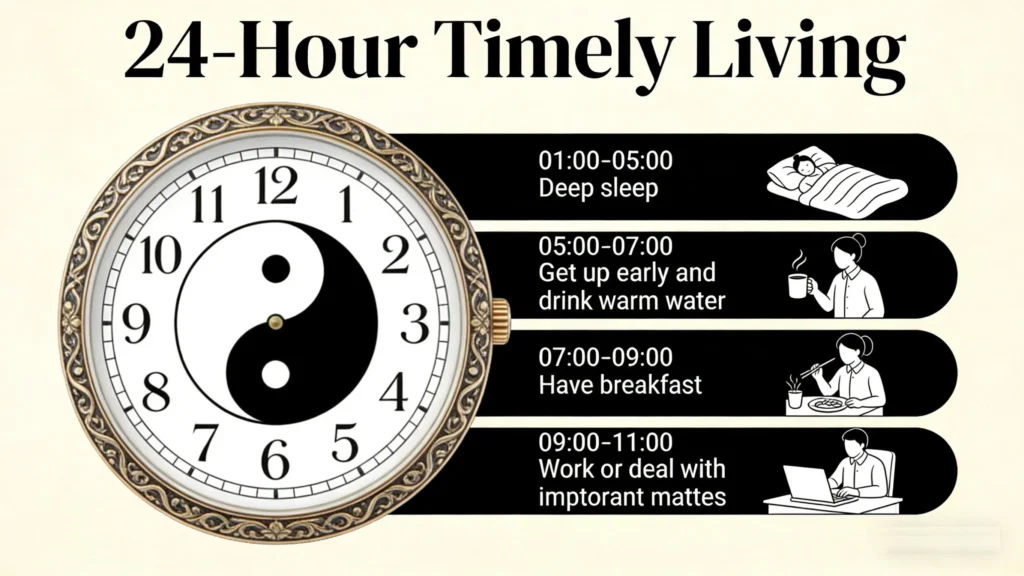
▸ 23:00 – 01:00 Zi Hour (Gallbladder Meridian Dominant): The core period for hourly health preservation. You must sleep. This is when the gallbladder meridian “cleans the system”. The gallbladder governs decision-making, and sleeping at this time reserves energy for the next day.
For night owls, it’s recommended to go to bed before 23:30, which is healthier than sleeping after 1:00 AM. Staying up late for a long time consumes gallbladder qi and affects your mental state the next day.
▸ 05:00 – 07:00 Mao Hour (Large Intestine Meridian Dominant): The key morning hour for health preservation. Drink 200ml warm water after getting up and defecate naturally (do not force it). This helps eliminate metabolic waste and makes you lighter with a morning defecation habit.
Sit quietly for 5 minutes after drinking warm water to trigger the defecation reflex more easily, without forced defecation.
▸ 11:00 – 13:00 Wu Hour (Heart Meridian Dominant): The afternoon health supplement. Take a 10-20 minute nap. It nourishes the mind, relieves morning fatigue, and avoids afternoon drowsiness better than coffee — perfect for office workers.
Even closing your eyes to rest for 5 minutes can quickly “recharge” your mind and improve work efficiency in the afternoon.
▸ 17:00 – 19:00 You Hour (Kidney Meridian Dominant): The evening health maintenance. Replenish water appropriately and relax. Listen to music on your way home from work. Avoid high-intensity exercise or overtime to reduce kidney essence consumption.
The kidneys are the “battery” of the body. Overworking at this time damages kidney essence and affects subsequent energy reserves.
3. Case + Pitfalls Avoidance: Efficient Hourly Health Preservation
Practice Case: Xiao Li, an office worker, stayed up late until 1:00 AM for a long time. He suffered from morning constipation, afternoon drowsiness and low work efficiency.
After adjusting according to the golden hour method — going to bed before 23:30, drinking warm water in the morning, and taking a 15-minute nap at noon — his constipation was relieved in 1 week. In 1 month, his complexion became ruddy, fatigue was greatly reduced, and work efficiency improved significantly.
Plan Shortcomings: Hourly health preservation requires long-term persistence and is hard to show effects in the short term. People who work overtime or have irregular schedules find it difficult to follow each hour strictly and easily give up due to occasional exceptions.
Improvement Suggestions: There’s no need to pursue perfection in hourly health preservation. Prioritize sleeping during Zi Hour and napping during Wu Hour, and try to fit other hours as much as possible. Start by going to bed at 23:30, then advance 10 minutes every week, gradually adjusting to before 23:00.
Don’t be anxious about occasional exceptions. The key is long-term persistence to exert the effect of hourly health preservation.
After avoiding pitfalls, take action now to integrate hourly health preservation into daily life — this is also the first step to timely living.
Combining with simple almanac practice can further improve the timely effect, making life more worry-free and efficient.
III. Receive Your “Daily Energy Report” — Modern Usage of Almanac Practice
1. Eliminate Misunderstandings: Almanac Practice Is Not Superstition
Core Concept of Almanac Practice: The Chinese almanac, also known as Huang Li or Tong Shu, is actually an “energy weather forecast” of ancient people.
It is a life guide summarized by ancient people combining natural laws such as astronomy, calendar and solar terms. Its core is to follow the celestial rhythm, which is also the core logic of almanac practice.
Just like you check the weather forecast to decide whether to take an umbrella, almanac practice helps you know if the day’s “energy field” is suitable for certain things. It reduces unnecessary obstacles and makes daily actions smoother.
Eliminate Misunderstandings: Many people think almanac practice is superstition, but it is actually a wisdom of risk management.
Almanac practice is not “superstitious fortune-telling”, but a “life risk management tool” summarized by ancient people through thousands of years of observing celestial rhythms (sun, moon, stars, seasonal changes).
Just like the weather forecast does not predict rain but reminds you to take precautions, almanac practice also reminds you to “go with the flow” and reduce unnecessary internal friction.
Ancient people found through thousands of years of observation that doing something on certain days is more likely to succeed, while on other days it is prone to problems. This is consistent with the modern environmental psychology theory of “environmental energy affecting human behavior” — not metaphysics, but the scientific basis of almanac practice.
2. Core Usage: 3 Key Almanac Columns (Quick Start)
The three most practical columns in the almanac are explained in simple terms that can be used directly. Combine with daily scenarios to quickly master how to read “Do’s and Don’ts”, no rote memorization, easy to get started:
1. Do’s / Don’ts ③: The core column of almanac practice, focusing on “choosing the right day to do the right thing”.
Prioritize “Do’s” days for important matters (signing contracts, starting projects, moving, confessing), and avoid “Don’ts” items. For example, “Do’s: Start Project” corresponds to new project launch, and “Don’ts: Earth-Breaking ④” corresponds to avoiding decoration start.
No need to worry about all items, just focus on the first 3. Chapter IV will teach you how to combine hourly health preservation with the almanac in specific scenarios.
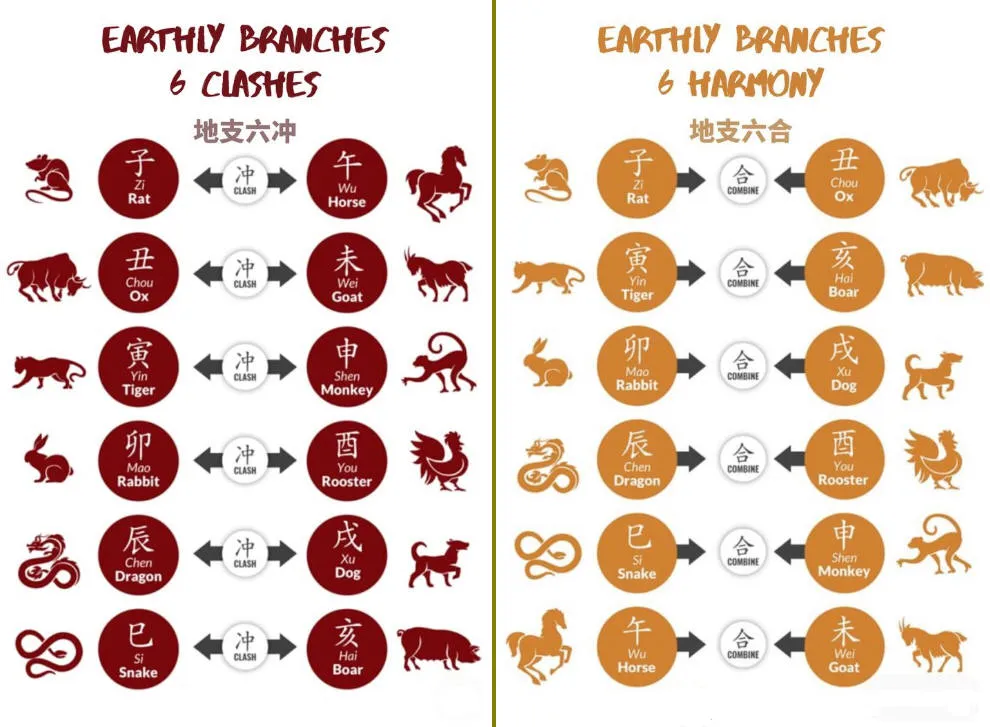
2. Conflict (Zodiac Conflict ⑤): An important reminder of almanac practice, indicating the zodiac sign incompatible with the day’s energy field.
If it conflicts with your zodiac sign, be more cautious in making important decisions. Avoid arguing with others and taking risky actions to reduce accidents. It does not mean “conflict will definitely cause accidents”, but just a thoughtful reminder of almanac practice.
3. Auspicious Time ⑥: The efficiency code of almanac practice, the most efficient time period of the day. Arrange important meetings, creative work, negotiations and other key matters at this time to improve efficiency and reduce obstacles.
For example, 9:00-11:00 AM is often an auspicious time. It exactly coincides with the hourly health preservation logic of “Sishi (9:00-11:00 AM) when the Spleen Meridian is dominant and thinking is clearest” in Chapter II, realizing the initial combination of almanac practice and hourly health preservation.
3. Case + Tools: Quick Start to Almanac Practice (1 Minute a Day)
Practice Case: Xiao Zhang, an entrepreneur, randomly chose days to launch new projects, but both were suspended due to accidents. Later, he referred to almanac practice, chose days marked “Do’s: Start Project, Do’s: Open for Business”, and arranged meetings at the auspicious time (9:00-11:00 AM).
Consistent with the hourly health preservation logic of “Sishi when the Spleen Meridian is dominant” in Chapter II, the project progressed smoothly with significantly reduced obstacles, saving a lot of unnecessary internal friction.
Plan Shortcomings: “Do’s and Don’ts” and “Auspicious Time” in almanac practice have no precise scientific verification. The content is relatively general, and annotations may vary among different tools, which is easy to cause confusion.
Especially for beginners, it’s easy to overthink details and affect the efficiency of almanac practice.
Improvement Suggestions: For almanac practice, prioritize authoritative almanac tools, focus on the first 3 items of “Do’s and Don’ts”, and don’t get stuck on trivial details. The almanac is only for reference; important decisions need to be judged based on your actual situation, without blind reliance.
Avoid being bound by rules and let almanac practice truly serve life.
Quick Start Tools: Recommended XX Almanac, XX Calendar (mobile version), simple to operate. After opening, directly check the first 3 items of “Do’s and Don’ts” and the auspicious time, no need to read the full text word by word.
It only takes 1 minute a day to finish almanac practice — time-saving and practical.
Mastering the core usage and quick-start tools of the almanac, start with simple daily practice and gradually develop the habit of taking advantage of the situation.
In the following, we will combine hourly health preservation with almanac practice to double the effect of timely living.
IV. Combined Skill — Hourly Health + Almanac Practice (Easier Work)
1. Core Logic: Why Double the Effect?
Why is the combined effect better? Hourly health preservation is “seeking inward”, following the body’s rhythm to stabilize the internal state (like “internal nourishment”). Almanac practice is “borrowing outward”, following the universe’s energy to smooth external actions (like “external assistance”).
Combining the two internally and externally, you can make life more efficient and easier without relying on willpower, doubling the effect — this is also the core skill of timely living.
The concept of “Heaven-Human Unity ⑦” in Huangdi Neijing is the core of their combination — the human body is part of nature.
The body’s rhythm must be consistent with the celestial rhythm to achieve physical and mental health and smooth progress in all matters, which is also the theoretical basis for their combination.
2. Scene Practice: 3 High-Frequency Scenarios (Direct Application)
Three high-frequency life scenarios are presented as “original practice + combined plan + result + pitfalls avoidance”. The plans can be applied directly, close to daily life and easy to operate.
Beginners can also quickly master the combination method and easily practice timely living.
Scenario 1: Important Meeting or Interview
Original Practice: Randomly choose a free time, ignoring your own state and the day’s energy field. It often leads to nervousness in interviews, unclear thinking in meetings, and poor performance.
Combined Plan: Dual adaptation of almanac practice + hourly health preservation. First, check the almanac to choose a day marked “Do’s: Communicate, Do’s: Sign Contracts”. Then arrange it during Sishi (9:00-11:00 AM), avoiding your zodiac conflict.
It can not only borrow the universe’s energy but also exert the body’s best state, improving performance stability.
Result: Xiao Wang, an office worker, prepared for an interview according to this plan. He had clear thinking and stable performance, successfully getting the desired offer. Using this plan for important meetings, his communication efficiency was greatly improved, winning recognition from leaders and colleagues.
Pitfalls Avoidance: If there’s no “Do’s: Communicate” day, choose “Do’s: Start Work, Do’s: Make Decisions”. If you can’t arrange it during Sishi, avoid rest periods like Zi Hour and Hai Hour to prevent poor state from affecting the combined effect.
Scenario 2: Starting a Fitness Plan
Original Practice: Exercise randomly after work. It’s easy to get tired, hard to persist, even injured. The fitness effect is poor, and most people give up halfway, which also consumes their own energy.
Combined Plan: Combine almanac practice + hourly health preservation. Choose a “Do’s: Exercise” day to start, prioritize exercising during Shenshi (15:00-17:00), and avoid your zodiac conflict and “Don’ts: Earth-Breaking” days.
Consistent with the hourly health preservation law of “Shenshi when the Bladder Meridian is dominant”, the body’s endurance and metabolism are the best at this time, and you won’t feel overly tired after exercising.
Result: Xiao Chen, a fitness enthusiast, persisted in this plan for 3 months. He lost 6 catties in 1 month, had no excessive fatigue after exercising, and his physical fitness improved significantly. He completely got rid of the dilemma of “giving up after exercising”.
Pitfalls Avoidance: If there’s no “Do’s: Exercise” day, choose “Do’s: Travel, Do’s: Move”. Avoid rest periods like Zi Hour and Wu Hour, and don’t do high-intensity exercise to prevent injury or energy consumption, adhering to the core principles of both.
Scenario 3: In-Depth Rest Day
Original Practice: Lie down and scroll through the phone when tired, stay up late to catch up on sleep. You feel more tired after resting and can’t relieve physical and mental fatigue. You still have “Monday Syndrome” when going to work on Monday, falling into a cycle of “ineffective rest”.
Combined Plan: Cooperate almanac practice + hourly health preservation. Choose a “Do’s: Bathe, Do’s: Rest Quietly” day, take a bath during Haishi (21:00-23:00), take a 15-minute nap at noon, and go to bed before 23:00.
This promotes the circulation of qi and blood in the whole body, relieves fatigue quickly, consistent with the hourly health preservation law of “Haishi when the San Jiao Meridian is dominant”.
Result: Xiao Zhou, an office worker, rested according to this plan. He felt light in body and comfortable in mood, full of energy on Monday. He completely got rid of “Monday Syndrome”, fatigue was fully relieved, and rest efficiency doubled.
Pitfalls Avoidance: If there’s no “Do’s: Rest Quietly” day, choose “Do’s: Calm the Mind, Do’s: Rest”. If you can’t take a bath during Haishi, advance it to Xushi (19:00-21:00). Resolutely avoid staying up late during Zi Hour to prevent feeling more tired after resting, adhering to the principle of following the rules.
Mastering the combined scene usage can make timely living more efficient. You can try to plan key matters for the next week according to your own needs.
You can also start with today’s tasks in Chapter V to gradually develop the timely habit.
V. Conclusion — Be an “Effortless” Modern Person, Practice Timely Wisdom
1. Core of Timely Living: Go with the Flow, No Effort Needed
The most tiring thing for modern people is not “being too busy”, but “fighting against the rules” — staying up late to push through, forcing themselves to work hard, and finally being physically and mentally exhausted.
Huangdi Neijing teaches you to go with the flow, following the body’s rhythm to maintain your state through hourly health preservation. The almanac teaches you to take advantage of the situation, borrowing the universe’s energy to save effort through almanac practice.
This is the life wisdom of the Chinese people, the simplest “effortless living method”, and the core essence of timely living.
There’s no need to be perfect. You don’t have to force yourself to remember all hours and almanac rules, or strictly follow every detail.
Even if you only do “go to bed before 23:30 at night” (core of hourly health preservation) and “check the almanac on important days” (core of almanac practice), you can gradually get rid of internal friction and live a more relaxed and transparent life.
2. Today’s Tasks: Hourly Health + Almanac Practice, Start Now
Combining the usage of both, finish these 5 small things today to easily start timely living. Focus on current execution, simple and easy to operate, quick to get started.
① Hourly Health Preservation Practice (3 things, execute now)
▸ Put down your phone before 23:00 tonight (delay to 23:30 if you can’t, step by step)
▸ Drink a glass of warm water (about 200ml, do not chug on an empty stomach) when you wake up tomorrow morning
▸ Set a 15-minute “close eyes to rest” alarm after lunch (even 5 minutes works)
② Simple Almanac Practice (2 things, execute now + tomorrow)
▸ Check tomorrow’s “Do’s and Don’ts” (focus on the first 3 items, no overthinking)
▸ Arrange small things according to tomorrow’s “Do’s and Don’ts”: If “Do’s: Meet Friends”, invite a friend for a light meal; if “Don’ts: Travel Far”, postpone long-distance travel (check your itinerary in advance if you must go).
Invitation to Action: Tonight, start with this today’s task and be an “intern learning to be a Chinese”. Try to adjust your life by combining hourly health preservation and almanac practice, and come back to see your state change in 30 days.
VI. Glossary
① Shi Chen Dang Ling: A TCM term, referring to each hour (two hours) of the day, there is a corresponding zang-fu organ dominating the body’s qi-blood circulation and physiological functions. At this time, the zang-fu organ has the most vigorous qi and blood and the strongest function — it is the best time for health preservation and conditioning, and also the core concept of hourly health preservation.
② Shi Chen (Hour): A traditional Chinese time unit. Ancient people divided a day into 12 hours, each corresponding to two modern hours and 12 zang-fu organs. It is the core time basis for hourly health preservation, such as Zi Hour (23:00-01:00), Mao Hour (05:00-07:00), etc.
③ Do’s / Don’ts: Core terms of the almanac column. “Do’s” refer to matters suitable for the day, and “Don’ts” refer to matters unsuitable for the day. The core is to follow the celestial energy rhythm to reduce obstacles in doing things. It is not a mandatory requirement, only for life reference, and is the core column of almanac practice.
④ Earth-Breaking: A common metaphysical term in the almanac, originally referring to breaking ground for construction (such as decoration, building houses, etc.), later extended to all large-scale ground-breaking and renovation activities. “Don’ts: Earth-Breaking” in the almanac reminds that such activities should not be carried out on that day to avoid conflicting with celestial energy — it is a common precaution in almanac practice.
⑤ Zodiac Conflict: A core term of the almanac, derived from the traditional Ganzhi calendar. It refers to the five-element attribute conflict between the Ganzhi of the day and a certain zodiac sign. It is believed that on the day of conflict, people with that zodiac sign have a weaker energy field and are prone to obstacles, requiring more attention — it is an important reminder of almanac practice.
⑥ Auspicious Time: A core term of the almanac, referring to the time period with the smoothest celestial energy, highest work efficiency and least obstacles in the day. It is often used to arrange important meetings, project launches, negotiations and other key matters, which is in line with the operation law of celestial rhythm and the efficiency code of almanac practice.
⑦ Heaven-Human Unity: The core concept of traditional Chinese medicine, holding that the human body is part of nature. The physiological rhythm and life activities of the human body must conform to the rhythm of nature (sun, moon, stars, seasonal changes, solar term alternation) to achieve physical and mental health and smooth progress in all matters, which is also the theoretical basis for the combination of hourly health preservation and almanac practice.
I’m abroad and have jet lag. Does this method still work?
Yes, the core is to use “local time”. If you are in New York, Zi Hour is 23:00 to 01:00 local time, not Beijing time.
Your body follows the sun, not the time zone. Hourly health preservation is based on the local solar rising and setting rhythm, and almanac practice can also use tools corresponding to the local time zone. The core is to follow the local celestial rhythm.
Checking the almanac every day is too troublesome. Is there a simplified version?
Yes, just remember two core principles. First, make wishes on the new moon and release on the full moon — the first day of the lunar month (new moon) is suitable for starting new projects, and the fifteenth day (full moon) is suitable for ending old things. This is a simple method summarized by ancient people combining the moon phase.
Second, must check solar terms — three days before and after each solar term, especially the Beginning of Spring, Beginning of Summer, Beginning of Autumn and Beginning of Winter, it is suitable for quiet rest and avoiding drastic changes. Solar terms are key nodes of celestial energy conversion, and following the rhythm at this time can reduce internal friction.
The almanac says “Don’t Travel”, but I have to go on a business trip. What should I do?
Don’t worry. Almanac practice is a “suggestion”, not an “order”. Knowing that the day’s energy is not supportive, make more preparations — leave 1 hour earlier, check your documents and luggage twice, avoid arguing with others on the way, and keep a calm mind.
This is “knowing but not fearing”. It is to follow the rules without being bound by them. The core of the almanac is “reminder” rather than “compulsion”.
Is there a similar system in the West?
Yes, such as circadian clock medicine and astrological “Mercury retrograde”. Modern circadian clock medicine research shows that the human body has a 24-hour physiological rhythm, which is consistent with the core concept of China’s hourly health preservation.
The “Mercury retrograde” in astrology emphasizes that it is not suitable to make important decisions or start new projects during the retrograde period, which is consistent with the logic of “Don’t Start” in the almanac.
It’s just that the Chinese have integrated this system more carefully, combining traditional Chinese medicine health preservation and life practice, and it has been used free of charge for thousands of years, which is more in line with the living habits of the Chinese people.
Office workers don’t have time to pay attention. Is there a simplified version?
It only takes 3 minutes a day. Simplified version: Remember to “drink warm water during Mao Hour” when you wake up in the morning (hourly health preservation), spend 10 minutes closing your eyes to rest at noon (hourly health preservation), and check the first item of tomorrow’s “Do’s and Don’ts” in the almanac before going to bed at night (almanac practice).
There’s no need to pursue perfection or remember all the rules. Developing basic habits of following the rhythm can gradually show results. The key is “step by step” rather than “accomplishing in one step”.
Can combining the two really improve life efficiency?
Yes, but the core is “going with the flow” rather than “superstitious about the effect”. Hourly health preservation helps you adjust your physical state, reduce fatigue, and make you more efficient when you are awake; almanac practice helps you avoid energy lows and reduce obstacles.
Combining the two essentially allows you to “do the right thing at the right time” without relying on willpower. With long-term persistence, the effect will be more obvious.